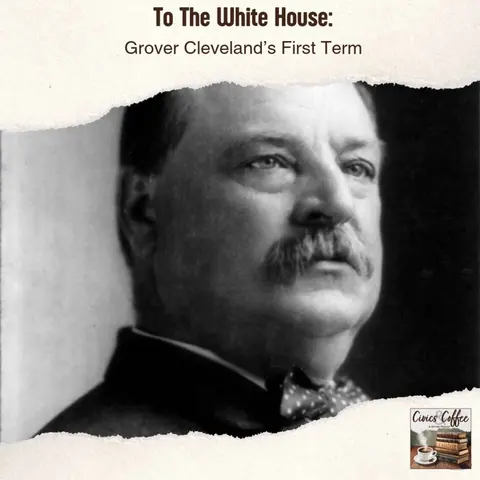
To the White House: Grover Cleveland's First Term

 RSS Feed

 Castbox

 Podchaser

 Deezer

 Apple Podcasts

 Spotify

 Amazon Music

 Overcast

 Castro

 iHeartRadio

 PocketCasts

 YouTube
Grover Cleveland enjoyed a rapid political rise - and survived a late breaking scandal - to become the country's twenty-second president of the United States and breaking the Democrat's nearly three-decade lockout in the process. How would the newly elected Democrat navigate the executive branch while dealing with a split Congress? Learn how Cleveland's push for executive power mirrors contemporary political dynamics illustrating that the balance between branches of government have always been a pertinent issue.
Thought This Was Interesting? Just Wait Until You Try…
Ma, Ma, Where's My Pa? The Rise of Grover Cleveland
Want Me To Cover a Topic?
Want More Civics & Coffee?
Sign Up for the Substack
Join the Patreon Coffee Club
Make Sure We Are Connected:
Love Civics & Coffee?
Welcome to Civics and Coffee, a history podcast. The show all about United States history, delivered to you and the time it takes to enjoy your morning cup of coffee. I'm your host, Alicia, a historian trained in United States history with a passion for telling both the known and unknown parts of America's past. So grab your coffee and get ready for some bite-sized history. Every citizen owes to the country a vigilant watch and close scrutiny of its public servants, and a fair and reasonable estimate of their fidelity and usefulness. Thus is the people's will impressed upon the whole framework of our civil polity municipal, state, and federal. And this is the price of our liberty and the inspiration of our faith in the Republic. Grover Cleveland, March 4, 1885. Hey everyone, welcome back. In the spring of 1885, Grover Cleveland assumed the presidency, becoming the first Democrat since James Buchanan in eighteen fifty-six to achieve such a victory. After narrowly defeating the problematic Republican candidate James G. Blaine and weathering a late-breaking scandal, the 22nd president entered the executive mansion with a divided Congress as Republicans held control of the Senate and the Democratic Party controlled the House. What that meant for the first Democratic president in almost 30 years was yet to be seen. So this week I am diving into the first term of Grover Cleveland. What did he focus on? What were his achievements? How did he make history on the personal front? And how does his administration tie to our present moment? Grab your cup of coffee, Peeps. Let's do this. As I shared last week, Grover Cleveland enjoyed a fairly meteoric rise in his political career. After gaining admission to the New York Bar at just 22, Cleveland earned a reputation as an honest, hardworking public servant who was unafraid to stand up to the political machines, earning him the respect, admiration, and support of voters from both political parties. His honest reputation in part helped him win the role of mayor of Buffalo before he was elected as governor of New York in 1882, seen as a prime position for the upcoming presidential election in 1884. Cleveland squared off against Republican James G. Blaine and in one of the tightest presidential contests in U.S. history, bested the former Secretary of State by carrying his home state of New York. Like he did in prior public roles, the new president buried himself in the work of the country. Cleveland claimed to have a quote-unquote Whiggish view of the presidency, with the quote, chief executive restricted to administrative duties and abjuring a role in the legislative process, end quote. However, he was also a man who counted Thomas Jefferson and Andrew Jackson among his political heroes, and specifically admired Jackson's quote, presidential independence and authority of the righteous executive, end quote, when going up against Congress. Thus, once in office, Cleveland sought to reassert executive authority. While he solicited the opinions of his cabinet officials, and each were welcome to share their thoughts, there was an understanding that the ultimate decision was up to the president. He did not seek a vote or open debate on the issues. Cleveland's push to exert more executive authority led to stiff criticism by detractors, and one of the earliest and clearest fights over the power of the executive revolved around the Tenure of Office Act, a law that plagued Cleveland's predecessors and a version of which led to Andrew Johnson's impeachment. During his bid for the presidency, Cleveland ran on a platform supporting civil service reform. Yet, once in office, the president suspended 643 officials in just his first 10 months. Republicans in Congress felt like the president betrayed his campaign pledge and wanted him to admit his reasons for suspending public officials were for partisan and not performance-based reasons. The president, however, believed that the Tenure of Office Act was unconstitutional, and that as the chief of the executive branch, it was his purview who to let go. Trying to force the issue, the Republican-controlled Senate tried to pressure the president into submission by refusing to approve his new appointments until Cleveland shared the justification for the predecessor's removal. In a three-month period, only 15 of the 643 positions had been filled. The two branches and their views came to a head over the suspension of George M. Duskin, a U.S. attorney for the Southern District of Alabama. The president had suspended Duskin while Congress was in recess, which he was within his rights to do, and appointed John D. Burnett in his place. Upon their return, Senate Judiciary Chairman George D. Edmonds thought Republicans might finally have a good test case, and on January 25, 1886, the Senate passed a resolution directing the Attorney General to submit documents relating to the suspension of Duskin. The Attorney General indicated that while he was happy to provide the requested materials related to the nomination of Burnett, he had been instructed by the President to admit any documents or correspondence related to the suspension of Duskin. Displeased and likely looking to prove a point and maybe exert dominance early in the administration, the Senate censured the Attorney General and the President for noncompliance. However, their plan backfired. The president himself formally responded on March 1st, issuing a message designed as much for the American people as it was for the Senate. He laid out his opinion about the Tenure of Office Act and doubted its legality. As such, the president indicated he had no plans to comply with the Senate's request. Not quite yet willing to cede ground, the Senate pushed back, again by passing another series of resolutions, announcing their intention to block any further nominations until the president provided the information they requested. However, their time and effort were largely wasted. By the time the resolutions came to a vote, Duskin, their test case, had termed out of office, making their requests for documentation unnecessary. Duskin's term expiration, combined with the growing support from the American people after Cleveland's March 1st response, made Republicans in the Senate realize they'd been beaten. Congress eventually submitted a bill to repeal the Tenure of Office Act in its entirety, which the President signed in March of 1887. Despite running on a platform of civil service reform, President Cleveland replaced roughly 75% of the 100,000 non-classified federal workers before he left office in 1889. After losing to Benjamin Harrison in the 1888 contest, Cleveland ensured that his actions couldn't be duplicated by using the Pendleton Act to increase the number of federal employees designated as classified, therefore enjoying increased protection from partisan firing. As Cleveland ended his term, the number of protected employees rose from roughly 16,000 at the start of his term to 27,000. Cleveland exerted his prerogative in other ways, including the veto, using it a total of 170 times during his first term, a number he would exceed upon re-election four years later. Historian Donald Greer Stevenson explains that of the men who have served as the chief executive, Cleveland ranks among the highest for most vetoes, surpassing all of his predecessors combined, and coming in second to only Franklin Delano Roosevelt, who was elected four times and oversaw both the war and the Great Depression. Cleveland's use of the veto was primarily focused on Civil War pension legislation and earned him the nickname the Veto King. In November of 1885, Vice President Thomas Hendricks passed away at his home. Hendricks had been deteriorating in health since suffering a stroke a few years earlier, and the president took this death as an opportunity to update the law governing the presidential line of succession. This resulted in the 1886 Presidential Succession Act, an update from the bill passed in 1792, which previously specified that if the president and vice president were unable to serve, the president pro tempore of the Senate, followed by the Speaker of the House, would assume responsibility. Under the new law, the line of succession fell to the heads of the executive departments and the order in which they were established, ensuring that the nation had a deep bench of leaders. This bill remained in place until 1947 before it was repealed during President Truman's administration. President Cleveland was also present for key cultural moments, such as the dedication of the Statue of Liberty. The 151-foot statue, originally titled Liberty Enlightening the World, was a gift from France and was initially meant to be a celebration of the United States successfully emancipating slavery and ending the Civil War. However, delays in construction and fundraising prompted the artist Frederick August Portoldi to shift his focus to more of a celebration of the nation's centennial celebration. Even then, delays pushed the dedication to October 28, 1886, where the president and former governor of New York spoke briefly to more than one million city residents about the statue, saying partially, quote, We will not forget that liberty has here made her home, nor shall her chosen altar be neglected. End quote. Entering the White House a bachelor, Cleveland initially continued his single lifestyle, enjoying the company of his male colleagues. However, the president did eventually decide to get married, at the age of 49, to a woman more than half his age and the daughter of one of his associates, 21-year-old Frances Folsom. The couple exchanged vows in the White House on June 2nd, 1886, making it the ninth wedding held inside the mansion per the White House Historical Association. And back on the legislative front, the president signed the Interstate Commerce Act in 1887, which established the Interstate Commerce Commission. The commission, which would go on to become the first independent federal regulatory agency, came in response to calls from the public to regulate the railroad industry, which had long enjoyed a firm grip on prices and was largely unregulated. Cleveland followed this up with signing the Dawes Act, a bill the president was said to be particularly enthusiastic about. The law divided tribal lands into individual allotments and further pressured Indigenous Americans to assimilate into American society. Under the parameters of the Dawes Act, each family unit was eligible for 160 acres of land, single individuals 80 acres, and orphan children 40 acres. Past episode topic, Helen Hunt Jackson's publication, A Century of Dishonor, may not have moved the general public in a way she wanted, but it is cited as one of the motivators for a movement toward general reform of how the government approached this treatment of the indigenous community. Heading into election year, the president signed the Scott Act of 1888, yet another Chinese Exclusion Act. The law's intent was to expand upon the act that was signed in 1882 and barred re-entry for any Chinese immigrants who chose to leave the United States to visit friends or family. Making matters complicated was the fact that the new law was pushed through without negotiation with the Chinese government, putting relations with the country in a precarious position. These moves did not seem to be enough to keep Cleveland in office, however, and though he won the popular vote, again, just barely, the Electoral College did not swing in his favor, and Cleveland lost his re-election to Republican challenger Benjamin Harrison. This, of course, represents just the midway point for Cleveland's political career, who launched a comeback four years later to become the first man to win two non-consecutive terms to the White House in 1892. But we'll cover that in a future episode. The man who represented the first Democrat to return to the White House in nearly 30 years, Cleveland is perhaps best known, at least in his first term, for re-establishing the power of the executive. As historians Christopher Hugh and Stephen Calabrazi assert, quote, from the perspective of the unitary executive, Cleveland's record is an unequivocal triumph, end quote. Those listening may be thinking there are some parallels between the past and present, since, much like Cleveland, the current administration has indicated its belief in the theory of the unitary executive. And just like Cleveland, the current president is only the second man in history to serve two non-consecutive terms. With two years left as of this recording in 2026, time will tell what other similarities the two chief executives end up sharing. Before I sign off today, I want to welcome a few new additions to the Patreon. Emma, Lauren, Tad, welcome. Thank you so much for joining. I hope you enjoyed the bonus content. If you too want even more history goodness in your ears, consider joining the Civics and Coffee Club on Patreon. Memberships start at just $3 and come with things like book reviews and a bonus series I call Civics and Cocktails. If you can't afford a monthly donation in this economy, but still want to show your support, please consider sharing an episode with a friend or giving the show a review on your platform of choice. Spreading the word is how we get more people interested in history, and I might be a little biased here, but I think we could use a few more history nerds. Thanks, peeps. I'll see you next time. Thanks for sitting down with me as I explore this chapter of American history. If you liked what you heard, be sure to subscribe and share with your friends. I look forward to our next cup of coffee together.
