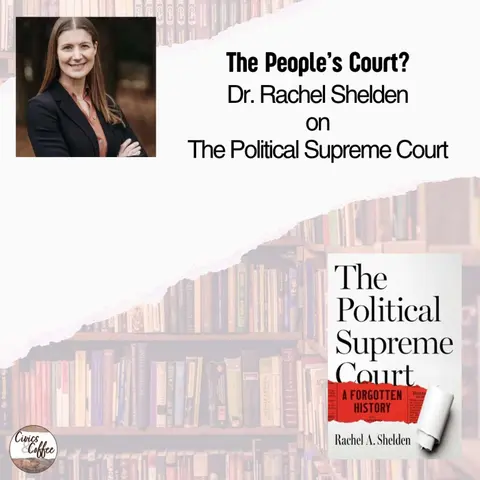
The People's Court? Dr. Rachel Shelden on The Political Supreme Court

 RSS Feed

 Castbox

 Podchaser

 Deezer

 Apple Podcasts

 Spotify

 Amazon Music

 Overcast

 Castro

 iHeartRadio

 PocketCasts

 YouTube
The Supreme Court is considered the final authority on constitutional legal matters in the United States - but was this always the case? In her new book, The Political Supreme Court, Dr. Rachel Shelden argues that for the first century of its existence, the Supreme Court was part of the political dialogue. Join me as I sit with Dr. Shelden to explore the historical intertwining of the Supreme Court with American politics in the 19th century including the key figures and pivotal events, illustrating how justices were deeply involved in political matters and often considered for presidential candidacies. Learn about the evolution of the court's role and authority, and where Shelden sees potential for change in the Supreme Court's relationship with the public and politics.
To learn more about Dr. Shelden, please visit her website at https://rachelshelden.com/
To buy a copy of The Political Supreme Court, click here.
Welcome to Civics and Coffee, a history podcast. The show all about United States history, delivered to you and the time it takes to enjoy your morning cup of coffee. I'm your host, Alicia, a historian trained in United States history with a passion for telling both the known and unknown parts of America's past. So grab your coffee and get ready for some bite-sized history. Welcome back, everyone. The Supreme Court has been in the news a lot lately. As critics cite the court's dubious decisions, many may be wondering was it always this way? My guest today shares that for the first 100 years of the court, things looked much different. And her scholarship offers some suggestions for possible remedies. I hope you all enjoy the conversation. Hello everyone. Joining me today is Dr. Rachel Sheldon. She is an associate professor of history and director of the George and Ann Richards Civil War era center at Penn State University. She is a member of the Historian's Council on the Constitution at the Brennan Center for Justice, and a scholar of 19th century America, whose latest book, The Political Supreme Court, explores the surprisingly brazen partisan nature of the court and its members, which will be the focus of our conversation today. Welcome, Dr. Sheldon. Thank you so much for having me. Thank you so much for being here. Let's dive on into this incredible book. So, you know, this is kind of marketed as a quote unquote forgotten history. So what prompted you to write this forgotten history?
SPEAKER_00Well, so I've long been interested in the Supreme Court, but I had not really written that much about it other than in um relationship to Dred Scott. But while I was working on my first book, which is about politicians in Washington in the 1840s and 1850s and how their social lives influenced their political behavior and policy making, I kept seeing the justices everywhere. You know, we're always sort of taught that members of the Supreme Court have been separate from the political life of Washington for as long as the court has existed. And that was not what I was seeing. And I wanted to know more about it. And so then I started digging into what were the justices doing in their daily lives and what was their relationship to the politics of Washington. And boy, they were everywhere. They were really integrated into the politics of the court. And I think, you know, I'm not a lawyer, but I have always been really interested in legal history. And so I think in some ways that predisposed me to go in with a little bit more of a clean slate in terms of thinking about what the court might be like and not with those sort of preconceived notions of how the court operates.
SPEAKER_01Yeah. So as you mentioned, you know, you explained that the Supreme Court was integrated in in American politics, but that the landscape as we think about it was very different from today. So can you expand on this and and maybe why it was considered acceptable?
SPEAKER_00Yeah. So I argue in the book that the Supreme Court was a political institution both in design and in practice. And it was political both because the court's relationship to politics was different and because politics itself was very different in the 19th century. So today we really think about politics as a binary, right? Political parties are Republican or Democrat. There are some third-party movements that occasionally uh make a little bit of a stink, but uh in general, it's a binary. But the 19th century political world was very different in two ways. One, in the way that we think about political parties as being much more fluid in the 19th century. So you had lots of different parties, particularly at the state and local level, but even at the national level. And also because parties and politics more generally was the area in which we talked about the Constitution. Uh so today we we think of the Supreme Court as sort of the last word on the Constitution, and the courts in particular as the last word on the Constitution. But in the 19th century, the late 18th and 19th century, the Constitution was the purview of everyday people and the purview of the other branches of government. So it was part of the political conversation and especially the partisan conversation about how the nation should exist. So when the Supreme Court was organized in 1787 in the Constitutional Convention, it was with the intention of thinking about it not as the final authority, but as part of the government and part of a government that was trying to promote this democratic ideal of what a nation should look like. And so the court was part of the conversation rather than the last word. And it needed to be answerable to the people. So it was organized in such a way by Congress that each member of the court had responsibilities to the circuits, meaning the different regions of the country, where they would hold court there. And the reason for that was that they wanted to be accessible. They wanted the justices to be accessible to the people. So the court itself was really integrated into the political world on purpose. And the justices took that very seriously.
SPEAKER_01I definitely want to ask you about writing circuit, but you you also introduce uh, you know, a bevy of narrators and individuals. So one of the people I want to ask you about is Thomas Todd. So can you give us a little bit of information of who was he and and why was he kind of essential to preserving the political role of the Supreme Court in the 19th century?
SPEAKER_00I love talking about Thomas Todd. So I love this question. Uh there's a there's an old law review debate that's sort of tongue-in-cheek from the late uh 20th century about who the most insignificant justice is ever to serve on the Supreme Court. And Thomas Todd is sort of like the number one on everyone's list. And the reason for that is that these folks who evaluated him were judging him based on his decisions on the Supreme Court, which are almost none. He had very few remarks at all on the Supreme Court. But the problem with that is that's just not the way that the justices operated in the 19th century. It's not the most important role for them. So Thomas Todd is uh nominated to the court in 1807 by Thomas Jefferson, and he's the first Western justice on the Supreme Court. West in 1807 was Ohio and Tennessee and Kentucky, which is a little bit confusing for us today. But those folks really thought of themselves as the West. And so Todd is nominated to the court to serve as the justice for this region, the uh legislation that makes him a Supreme Court justice, which creates the Seventh Circuit that he is going to represent. He says specifically it has to be someone from this region who is going to serve on the court. And Todd is closely tied to the Jeffersonian politics of the region. He knows all the folks who are there. And so he really brings them along. You know, it's very hard, I think, still for us to think about the 19th century as a time when people were really unsure about the future of the union. But Todd's role in sort of bringing, incorporating the West into the nation in terms of its courts was really important. So I think of Todd as one of the most important justices to serve on the Supreme Court. And I think, you know, the role of circuit writing is really important for that. And I'm sure you're gonna ask me more about that, but I can say more now. Yeah.
SPEAKER_01Yeah, so kind of talking about that, um, you know, you go into circuit writing a lot. So I want to kind of ask you first about just the, I guess, the physical nature of it. So can you talk about just like the process of it, what it looked like for the justices during this period, and and kind of the physicality of it and the logistics, I guess.
SPEAKER_00Yeah. So let me start with sort of the organization of the courts. So today we have the Supreme Court, the circuit courts of appeal, and the district courts, right? That's the three levels of federal courts. And in the 19th century, we had sort of a similar setup. We had district circuit and supreme court, but there were only two kinds of judges, only two kinds of federal judges. There were Supreme Court justices and there were district court judges. And there were no circuit court judges that were separate from these people. Instead, Supreme Court justices would serve as circuit judges alongside their district court colleagues. And so what happened is they would spend only a few months a year, sometimes as little as four weeks, in the Capitol. And then they would go out and serve in the circuit courts that they were assigned to. In the first decade of the new nation, they served in pairs and then they served in a variety of different circuits. But by the early 19th century, it had come to be assumed that each justice, each justice would be assigned to one circuit and almost always the circuit that they hailed from. So they were, they were drawn from the circuit that they represented. And when they went out on circuit, it was pretty harrowing. You can imagine a country that had very few paved roads, particularly if you were riding to locations that were sort of in the center of the country, like Thomas Todd was. We can't imagine, I think, today, a Supreme Court justice sitting in a federal district court, right, and hearing a jury trial. But the circuit courts were designed that way. And so the justices were involved in jury selection. They were involved in cases where the juries played a very big role. And those juries were made up of some of the most elite people who lived in the states, white men, property holders often, who often served also as key political leaders. So they were integrated into this sort of political space on circuit that the justices today have no relationship to.
SPEAKER_01Yeah. And so talking about being kind of politically integrated, what were some of the, I guess, political implications of writing circuit and why was it seen as so pivotal?
SPEAKER_00Yeah, so each region of the country was very protective of its circuit representation. They often refer to it as judicial representation. So thinking of the justice as representing their interests on the court, their ideas, their values, their laws, and also their politics. And so there was an expectation that the justices would bring all they knew from the circuit to the Capitol to be able to say, well, this is how this region of the country sees it. And if uh a region of the country, a circuit, did not like the way that the court was going, it would often complain that it was not represented on the Supreme Court. And this was really important to people because they saw every part of government as a representative space. They wanted to know that they were part of the union. So throughout the 19th century, when regions of the country are unhappy about what they are seeing on the court, they complain and they ask for more representation. They want more justices from the West. They want more justices from the North. There are all kinds of moments in which regions of the country are really upset about what the court is doing because they think they are not represented there.
SPEAKER_01And then you talk about the Burr conspiracy. And so can you talk a little bit about how it demonstrates just how intertwined the court was to contemporary political matters?
SPEAKER_00Yeah, so I'm fascinated by the Burr conspiracy and its relationship to Thomas Todd and some of these other folks who lived in Kentucky in this period. So I'm sure your listeners know that uh in 1805, Aaron Burr started sort of an alleged conspiracy to separate the western part of the United States, including those uh three states of Ohio and Kentucky and Tennessee and the lower Southwest Territories, to be a new nation. And so he traveled through this region to try to get support. And he made a lot of friends, including the district judge in Kentucky, Harry Innes, who was a sort of a pal of his. And he engages in what uh his biographer, Mary Tacau, calls a little bit of light treason, I think. You know, he's he's really involved in this. So, you know, again, there's sort of an expectation, I think, that this region of the country was very fragile. It was an area that was really not necessarily tied to the eastern states, and it hadn't had representation on the Supreme Court before. Uh, so the Burr conspiracy um really prompts two things. One, a an understanding that there needed to be some kind of representation on the Supreme Court from the West because it would be helpful to keeping the union together, and two, a recognition that local and state politics work very differently from national politics in the 19th century. So, you know, Thomas Jefferson is probably the biggest opponent of Burr's. He's desperately wants him to be convicted for treason and really pushes for it. And um, Burr is tried in a court in Virginia, in a circuit court in Virginia, presided over by John Marshall, you know, probably Jefferson's biggest enemy in this period. And Jefferson is totally like directing the entire thing. And this is important because Marshall is overseeing the way that this trial is going to go forward. There are lots of politicians from Washington who are serving also on the jury, including John Randolph of Roanoke, a really hilarious character from this period, who's the foreman of the grand jury. And during this time, people in the West have a different perception of Burr. They're much more sympathetic to him. So when Burr faces initial treason charges in Kentucky, he is exonerated. And there are giant parties, including featuring the district judge Harry Innes and Thomas Todd, and some of these other Western Jeffersonians. So it really demonstrated in a lot of ways how different things were in the West in terms of each political party. And it also demonstrated that this kind of Burr conspiracy could be used as a political tool. So many of the opponents of the Jeffersonians would complain about the relationship between Innes and Todd and Aaron Burr in a political sense. They weren't really complaining about their political involvement per se, right? Like the idea that they were engaged in politics, but just that they were engaged with Aaron Burr, who is uh, you know, known to be so treasonous. So the entire idea of Burr that we would imagine, like, you know, oh my gosh, it's so inappropriate. These people were quite friendly with Burr. Um they knew Burr. Harry Innes oversees a case in which Burr is tried, even though he was sort of involved with Burr. Um, none of that is really an issue in terms of their judicial station, but it is used as a political argument against them and against their party.
SPEAKER_01Well, and then again, kind of unpacking this interweaving of politics. Well, one of the other things that you talk about is how frequently justices were courted as presidential candidates in the 19th century. So can you speak to why this happened and and how it again demonstrates the partisan nature of the court during this time?
SPEAKER_00Yeah. So when I started this project, I was aware of a couple of justices who were actively interested in the presidency. John McClain of Ohio was one that, you know, he he's super fun because he ran for president every four years. Uh and and Salmon Chase, who's well known as the uh Chief Justice in the post-war period, in the post-Civil War period, and desperately coveted the presidency. So I thought maybe they were just a couple. But there were 51 justices who served uh on the court in its first 100 years, and 19 of those folks were either active presidential candidates or promoted by others as presidential candidates. And that second one may sound not as important, but the fact is that you couldn't really run for president yourself. That was not a thing that anyone did in the 19th century. You had to be put up by others to be a presidential candidate. So 19 justices who are thought of as good options for the presidency by their political party. And these guys are well known in terms of their political views, both from their decisions on the court and also from their activities before they get on the court. Then this is really important, I think, that the justices who come to the court in the 19th century come from political positions. They come from the cabinet, they come from the governorship, they come from a variety of congressional positions, they come from newspaper editing, which is among the most political of positions in the 19th century. And so their political views are pretty well known. It's not a surprise to see some of the things that they decide on the court because their politics are already out there. And the justices would often talk about those politics if they were well known. So if there was a case that came before the court in which their politics were not known, then they might be a little bit more hesitant before the case was decided. But that was not super common. These justices were very open about their political views while they were in politics and carried those ideas with them. There was an expectation that they would carry those politics because those were politics that mattered a lot to the future of the union. These people believed that they were protecting the union and making sure that it would survive. So the idea that a Supreme Court justice could be a presidential candidate is really about how do we bring forward someone who has the views that best represent our nation, who has the best constitutional approach to the future of the nation. And Supreme Court justices are great examples of that. They're people whose politics and constitutional ideas are well known.
unknownYeah.
SPEAKER_01Such a departure from what we're used to, I think.
SPEAKER_00Yeah, can you imagine John Roberts running for president? That would be really uh, that would be different.
SPEAKER_01To to say the least. So I think returning to uh something you you you know quite well, the the Dred Scott decision. How does that kind of serve as representation of the court's involvement in in political life?
SPEAKER_00So Dred Scott is one of the things that got me the most interested in this, aside from my first book, because I've just always been fascinated by the way that so many people pushed back against Dred Scott in really political ways. Um, so I'd written about this a little bit before in an article about Upper South Unionists in reaction to Dred Scott, but there's a lot of complaint about this case. So in 1856, the Supreme Court hears a case involving Dred Scott, who had been enslaved and was enslaved in Missouri and who had gone to the Northern Territories and sued for his freedom based on the idea that he had lived in these Northern Territories, in these territories that were covered by the Missouri Compromise. So in 1820, right, the Congress decides that they're going to compromise on where slavery will exist in the nation with no slavery above the 3630 parallel. And Scott goes there with his family and his enslaver, and he argues that he is not enslaved because he was living in these areas, something that had for many, many years worked in the Missouri courts. And there's a terrific literature on this. Many folks have written about it. Ann Twitty, um, Kelly Kennington, Lee Vandevel, great work on how many enslaved people sued for their freedom. So Scott was working in a tradition that he thought was going to be successful, and he brings it, this case, through the state courts and then the circuit, federal circuit court, and then it gets to the Supreme Court in 1856. And during that time, the Democratic Party had become a little bit split over a variety of different things, including issues involving slavery. And so this case, when Justice Tawney comes out and makes the argument of the court, he says that uh Dred Scott could not be free and could not sue in federal court because he was not a citizen and black people could not be citizens of the United States, and that the Missouri Compromise was unconstitutional because Congress did not have the right to legislate for the territories. So the Democratic Party reacts to this in split ways because many people in the United States, not just Republicans who existed at this time, not just other Northerners, really believed that Congress had the right to legislate for the territories, really believed that this was the only way to preserve the Union, among others. And so they were really disturbed by this decision, in part because they thought that the court Had no right to be making these kinds of giant pronouncements that the court did not have that much power. It shouldn't have that much power. So you get in response to Dred Scott an enormous number of reactions from people in the North, from people in the upper south, from people in the West who say this is just not okay. We disagree. We disagree with the court. Imagine disagreeing with the court today. You can't really do much about it. But the Republican Party in particular reacts to this in very strong ways, including by saying this is just not true. You can. Congress can legislate for the territories, and they should legislate for the territories. So in their 1860 platform, just as they had been arguing since they were formed, they say, we want Congress. We're running on a platform that Congress should uh eliminate slavery in the territories. In other words, what they're saying is, who cares what the court said? Who cares? It's not, it's not actually that important what they say because the people get to decide whether something is constitutional or not. And Abraham Lincoln very famously says this in 1858 in his debates with Stephen Douglas, and he says it again in his first inaugural address that the Supreme Court cannot have the final authority over constitutional questions, or the people will have ceased to become their own rulers. So the political reaction to Dred Scott is very partisan. And by that I don't mean it's a binary. I mean there are many parties that are opposed to it. And it's also very much a question of constitutionality that is being decided by the people at large and not by the court itself.
SPEAKER_01That was a fascinating part of the book. And uh hope I hope many, many people dive into that chapter. So another character I want to ask you about, or another narrator that you you dive into is John Archibald Campbell during the cessation crisis. So how does he kind of represent that that long history of the Supreme Court justices working on national political problems?
SPEAKER_00So John Archibald Campbell is someone that I hadn't known quite a bit about previously from his involvement during Reconstruction in the Slaughterhouse cases. And I don't want to spoil too much about the book, but he he comes off in sort of uh sympathetic in the um chapter about the secession crisis, but he's really quite an evil person. And and you'll get to see that a little bit later in the book if you continue on. But during the secession crisis, he was actually very skeptical of secession. Um, he was not sure it was a great idea, but he's in Washington over the course of the secession winter, so you know, December to April 18, December 1860 to April 1861. And during his time there, he is working overtime to try and keep the union together. So he's working with politicians in Congress, he's working with the existing cabinet, he's working with the future cabinet, he's trying to get people to make some sort of compromise so that the union can stay together. And he says repeatedly during the winter that he's only able to do this because he's in Washington and is someone serving in the federal government, that it gives him access to all of these various politicians who he can talk to and try to work with. And throughout this period, he is writing to people back home to suggest, oh no, you can't do this. He says at one point that he would stand for election for the convention to decide secession, but that he discovered that in in his district, he was not, his views were not well accepted. And so um he didn't think it would really be worth it. But but this tells you something, right? That he's saying, I would be happy to stand for election to a secession convention as a delegate, right? Like not as a as a um judicial advisor, um, as someone who is actively stating what my political views are. And that's what he does throughout the secession winter. He's very pushy about what he thinks Alabama, where he's from, should do. And this is really like the case throughout the 19th century is that justices didn't really shy from having conversations about these major political issues. It was not like, oh, let's wait for a case to come to the Supreme Court, both because you could still talk about it before the Supreme Court got to it. And second, the court's decision didn't really matter that much because people may or may not follow it. Uh so the idea that the Supreme Court is just waiting for political questions, major constitutional questions to come to them the way it does today, this would have been totally insane. Like, what's the point of waiting for a case to come if you can't have that much authority when it does? And if you can do more before then to try to fix the circumstances.
SPEAKER_01And so can you talk a little bit about like Reconstruction and the politics at play with the court and Chief Justice Seven Chase?
SPEAKER_00Yeah, so you know, one of the sort of important things about the Reconstruction Amendments as they relate to the court is that they do something that um we sometimes don't always see that we we usually think of as very positive, but also has real consequences. And in this case, what I mean is that the 13th, 14th, and 15th Amendments, which abolish slavery, um, which create birthright citizenship and equal protection of the laws and uh the right to vote for black men, these amendments require a lot of legislation from Congress to enforce them, to make sure that they are protected. And the and the place they look for that protection is in the federal courts. Uh, if you are a black man who is suing for something in a state court, the likelihood that you're going to get a good trial in a state court in the South is pretty low. Um, and so Congress understands this and moves lots of these protections to the federal courts. What this means is that the federal courts begin to expand their jurisdiction over a whole range of major constitutional issues in ways that they never had before the uh civil war. And this is good in some ways because it really does create those protections in a in a variety of different places. But in other ways, it changes the relationship between the federal courts and constitutional questions with an outsized uh reaction by the Supreme Court, who is now hearing many, many more constitutional questions as time goes by. So Salmon Chase, who was Chief Justice in 1864, becomes Chief Justice, replaces Roger Tawney, who made the Dred Scott decision. Uh, Salmon Chase is some someone who could not be more different from Roger Tawney, and that he had long made these arguments about the court not having this final authority and um been really insistent that it was important that politics be the place where constitutional questions are answered. And he's faced repeatedly in Reconstruction with uh the problem of the expansion of jurisdiction of the federal courts and is not always sure what to do. He would much rather help out in Congress. And by that I mean literally write legislation for Congress, for various congressmen to actually change things on the ground, literally assist the president with his kind of policy, really thinking through how the politics of Reconstruction can work from the political angle rather than from the judicial angle. And so this expansion of jurisdiction really puts him in a tricky place where he feels as though this is becoming problematic for the nation because the Supreme Court keeps overruling Reconstruction policies, even policies that he's quite fond of, and he can't really do much about it. And so he has to sort of go through with this. Chase is in some ways the last chief justice who really understood the importance of making sure that the people were the keepers of the Constitution. You know, Tawney had violated this principle in Dred Scott. But in other ways, he had been more receptive to the idea that the people would rule. By the end of the 19th century, things are changing on the court because they keep hearing these constitutional questions, and Congress keeps expanding their jurisdiction, not just in questions of reconstruction, but also in corporations and other areas of law.
SPEAKER_01Yeah, so speaking of kind of the evolution of the court, we we have this long history of the 19th century where politics was fined, it was expected, it was anticipated. Where and when do we make a switch and this idea of an apolitical court begin to take hold?
SPEAKER_00So the end of the Civil War creates all kinds of things, including this expansion of jurisdiction, but also some real changes in the way that people think about profession. Many folks have written about the professionalization of medicine, professionalization of the newspaper business, a variety of other professions that start to become really focused on themselves as professionals. And this is what happens with the law as well. There had been a movement in the 1840s to try and make law more of a science, but it doesn't really take off until the 1870s with the creation of the American Bar Association, the promotion of more lawyers going to law school rather than serving as apprentices the way that Lincoln did. And as a result, these lawyers begin to see themselves as the keepers of the constitution, as the bastion of constitutional thinking. And that combined with the expansion of jurisdiction starts to create a scenario in which the justices increasingly think of themselves as quite important in the question of constitutional interpretation. Politics is also changing in this moment. We are going to get for the first time in the 1880s the secret ballot, which had not existed for many years before, new laws involving primaries and other kinds of structural changes that creates much more of a binary between Republicans and Democrats, and that fluid political system that had existed before starts to fall away. And in 1890, um, you get sort of the culmination of all these things together with the centennial celebration of the Supreme Court's meeting in New York in 1790. And so during this celebration, you can see sort of the way that lawyers and judges and some politicians have begun to think about the court as this space where constitutional thinking happens and even final constitutional thinking happens. And what they do is they rewrite the history of the court up to that point. So starting in the 1870s and the anniversary of the Declaration of Independence, you get this sort of move to write new histories of the court, new histories of American life, new histories of the Constitution. And by 1890, you have this slew of folks writing about the Constitution as the purview of the Supreme Court from the very beginning, or at least from John Marshall, who is everyone's uh favorite justice. So this changes the nature of the way people think about the court. It doesn't happen overnight. It takes some time for people to really focus on the court as outside of politics and as really this constitutional authority that we hadn't really expected before. But it really takes off during this uh late post-war period. And as a result, we get sort of the idea that justices should not be participating in the day-to-day life of American politics.
SPEAKER_01Which is uh a fascinating turn in and of itself.
SPEAKER_00Yes, it is indeed.
SPEAKER_01So, what do you want readers to take away from your book? There's so much here, there's so much to unpack, there's so much good stuff, but what do you hope readers take away from your book?
SPEAKER_00The most important thing that comes out of the book for me, anyway, is to think about the Supreme Court's long history as being very different from what we would imagine it to be, and that it has changed so much that it was so different, and therefore it can be different again. You know, there's a lot of unhappiness with the Supreme Court now, but there's also a lot of expectation that this is just what we get. But the Supreme Court did not have that kind of final authority in the 19th century. They did not have the sort of role of bastion of all constitutional decisions. Instead, they were much more answerable to the people, which is not the way that we think about the court. And it's not the way that Chief Justice Roberts in particular talks about the court. He frequently talks about the court as needing to be separate from the people. So this is really an uh an important moment to think about how the court actually worked over the first 100 years? How did the court think about itself in relationship to popular ideas? And how do we regain some of that control over the way that the court works? Congress has a right to change the court as much as it wants, and it did for the first 100 years all the time, change things about the court. Uh, so we could do that again.
SPEAKER_01A nice, nice beacon of hope. I like. I like that. And so where should people go when they've finished your book and they want to learn more about you and the work that you do?
SPEAKER_00So they could go to my website, uh rachelsheldon.com, uh, where I post uh information about my other research projects. Uh I'm on Blue Sky. Uh I'm I'm not a Facebook or Instagram person, but I do love Blue Sky and the great community there. And I'm I'm often publishing in um popular outlets these days in Philadelphia Inquirer, Washington Post, etc.
SPEAKER_01All right. And I know I've I've I've pestered you with a lot of questions and we've covered a lot of ground, but is there anything that we haven't covered that you want future readers to know?
SPEAKER_00Well, one of the things that I found very interesting in this project that I didn't get to do as much of in the final book was thinking about the actual production of Supreme Court reports uh and what we do know about what the court has done. The reporters are super interesting. They play a role in the book uh in various places. And I want to know more about them. So in my next project, I'm really exploring the creation of Supreme Court reports. A little bit of a spoiler here in the sense that the reporters had to contract with private printers to publish the reports. And so, you know, they're not, they're not particularly verbatim the way that we would imagine them to be today. Uh it's a it's a totally different um kind of system. And people thought about the written word in this context in very different ways. So I'm excited to see where that takes me and also how it relates to this book in particular. Ooh, that sounds exciting. Thanks.
SPEAKER_01All right. So for the listeners out there, if you have any interest in the Supreme Court and 19th century politics and how it relates to today, be sure to grab your copy of the Political Supreme Court. Thank you, Dr. Sheldon.
SPEAKER_00Thank you so much for having me.
SPEAKER_01My thanks again to Dr. Sheldon for spending her time with me. The Political Supreme Court is a fascinating deep dive into the court's early years and is worth a read for anyone interested in the political history of the United States. Thanks, peeps. Thanks for sitting down with me as I explore this chapter of American history. If you liked what you heard, be sure to subscribe and share with your friends. I look forward to our next cup of coffee together.
