Behind the Mask: Friday the 13th

 RSS Feed

 Castbox

 Podchaser

 Deezer

 Apple Podcasts

 Spotify

 Amazon Music

 Overcast

 Castro

 iHeartRadio

 PocketCasts

 YouTube
A secluded summer camp, a group of teenagers left to their own devices, and a faceless murderous stalker watching them from the woods - what could possibly go wrong? For this year's annual Halloween episode, I am diving behind the mask to give you the history of the 1980 horror film Friday the 13th. From the commitment to realistic effects to the addition of a last minute jump scare, learn all about this nearly fifty year old franchise - and why some say it actually serves as a metaphor for the Reagan 1980s.
Thought This Was Interesting? Just Wait Until You Try…
Want Me To Cover a Topic?
Want More Civics & Coffee?
Sign Up for the Substack
Join the Patreon Coffee Club
Make Sure We Are Connected:
Love Civics & Coffee?
Photo Graphic From: Wikimedia Commons / Public Domain
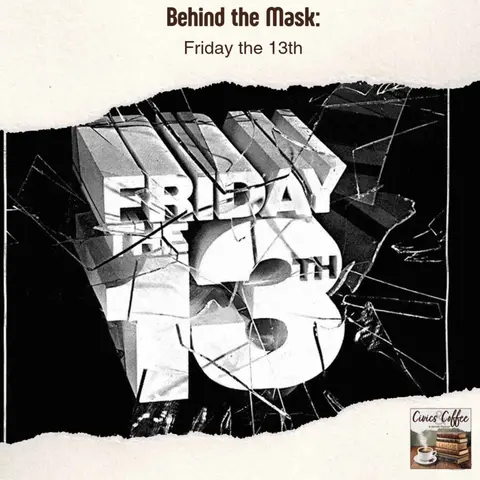
Welcome to Civics and Coffee, a history podcast. The show all about United States history, delivered to you and the time it takes to enjoy your morning cup of coffee. I'm your host, Alicia, a historian trained in United States history with a passion for telling both the known and unknown parts of America's past. So grab your coffee and get ready for some bite-sized history. Hey everyone. Happy Halloween! If you are a longtime listener of the show, then you know that today is my birthday, Christmas, and New Year's all rolled into one. I am what you might call a Halloween supergeek. I love the day and everything that comes with it. I have long been a fan of ghost stories. In fact, the first book I ever remember purchasing was the Scary Story series by Alvin Schwartz. And like a true millennial, I was firmly planted on the couch every Friday night to watch Nickelodeon's Are You Afraid of the Dark? But I have both my grandmother and one of my mother's best friends to thank for introducing me to the horror genre when I was much too young to be watching such craziness on screen. And honestly, I'm grateful. What better way to know you're alive than spending 90 minutes on edge, scared out of your mind? It's sort of a little tradition of mine here on the show to dive into the spookier side of history during October. And I like covering the pop culture moments, where the lore and mystery of Halloween and media intersect. I've done episodes about Alfred Hitchcock's The Birds, which is to date my mom's favorite episode, and gave you a rundown of my favorite slasher movie, Halloween. But this year I wanted to spend some time exploring the backstory and legacy of one of the other slashers spawned in Halloween's aftermath, Friday the 13th. From its iconic soundtrack to one of the most stunning plot twists in horror movie history, Friday the 13th is one of the longest and most successful horror movie franchises to come out of Hollywood. As of this recording, there have been 12 films featuring the Four He's family grossing nearly $500 million at the box office. But as I will cover, it all started with a crazy gamble in 1979. So this week I am diving into the history of the original 1980 horror movie classic Friday the 13th. What was the inspiration? What was its critical reception? And how did it influence the movie business? Grab your hockey mask. Oops, I mean your coffee peeps. Let's do this. The 1970s is the decade that gave birth to the slasher horror genre, typified by a faceless, usually invincible killer stalking a number of unsuspecting teenagers in some unassuming location, the slasher flakes were generally viewed as what one media scholar referred to as, quote, modern if bloody morality tales, end quote. Cinema experts cite either the Texas Chainsaw Massacre or Black Christmas, both released in 1974, as the originators of this new form of the scary movie. And while both movies were and are cult classics with deeply committed fan bases, they did not achieve the widespread commercial success during their initial release that John Carpenter's 1978 Halloween did. While also an independently shot and distributed film, Halloween became one of the biggest independent films in American history, something it was forced into as studios affiliated with the MPAA, or the Motion Picture Association of America, refused to buy the rights to the film. The success of Halloween demonstrated that there could be a market for horror, if done correctly. Prior attempts by major studios at horror pictures usually included big budget affairs, such as 1973's The Exorcist, which led to decent success. But when they tried to release its sequel in 1977, the profit margin was not what executives were looking for. This, media scholar Richard Knoll explains, quote, suggested that a sizable audience still existed for horror, but one that was only large enough to enable lower-budgeted films to turn a significant amount of profit, end quote. And it's within this landscape that Sean S. Cunningham came up with the concept for Friday the 13th. Cunningham, who served as producer and director on the film, had experience working with famed horror director Wes Craven on 1972's Last House on the Left, and wanted to create his own horror roller coaster. While working on a family-friendly soccer movie, Cunningham was hit with the framework of Friday the 13th. What screenplay writer Victor Miller later said in a documentary was basically an attempt to rip off Halloween. Cunningham knew he wanted the movie to take place on Friday the 13th, and that he wanted it to be scary. That was all he had. To attract investors, Cunningham created a mock poster for the film, the now famous title bursting through the screen with broken glass, with the header, The Most Terrifying Film Ever Made, in bold letters along the top. He put the advertisement in Variety, a movie trade publication, and within just a few days, Cunningham had his funding, without even a script. Armed with roughly $550,000, the ragtag group of filmmakers had to figure out where they could shoot their movie. In order to cut down costs, a single location was ideal. And thus a Boy Scout camp in Blairtown, New Jersey, the North Bergen Boy Scouts, also known as Camp Doby Bosco, was selected as the main site of the shoot. Now that a location had been secured, the filmmakers could start fleshing out a story. As I mentioned, Victor Miller was brought on to write the screenplay, and it is Miller you can thank for coming up with the idea of, and even though this movie is nearly 50 years old, I will go ahead and give you a spoiler alert warning here. A crazed mom who snaps after losing her son to an accidental drowning at the same camp decades before. The script, however, was an iterative process, and cast members later recalled getting new pages every day, never sure exactly what the call sheet was going to bring. Miller later recalled wanting to create the sense that the teens were in a remote location, isolated from any help, and that when trouble arrived, they were going to be very much on their own, which is why he later objected when investors brought in another writer who added the police officer scene. Now, if you've watched the movie a time or two, or 200, you may have noticed that the actor playing the officer has a wee bit of trouble as he departs on the motorcycle. As it turns out, he had no experience riding motorcycles, and he did crash and the motorcycle landed on the poor man. And speaking of actors, Friday the 13th was an early role for one actor who went on to become incredibly popular, the one and only Kevin Bacon. Most of the cast was pulled from the local New York theater scene. Because the movie was being shot on a shoestring budget, producers could not afford the cost of any big name celebrities, and thus they took advantage of their proximity to the Great White Way and the hundreds, likely thousands, of hungry actors looking to break into show business any way they could. Joining Bacon on screen was fellow theater veterans Mark Nelson and Janine Taylor, who played Ned and Marcy, and Lori Bartram, described as the heart and soul of the production, who played Breda. Famed crooner Bing Crosby's son Harry Crosby made his film debut in the role of Bill, as did Adrian King, playing Final Girl Alice. Rounding out the cast was Walt Gourney, who played the crazy prophet Ralph, Peter Brower as camp owner Steve Christie, Robbie Morgan as early victim Annie, and of course Betsy Palmer as Mrs. Voorhees. Shooting began on September 4th, 1979, and Cunningham brought in special effects artist Tom Savini to make the kill scenes as scary and realistic as possible. Savini previously served in Vietnam as a combat photographer and used the trauma of that experience as a sort of inspiration to create practical effects for movies. He worked with famed horror director George Romero on both Martin and Dawn of the Dead and had built a pretty decent reputation for his commitment to realism. While the effects may look cheesy when viewed through a modern lens, I can tell you when I first saw it as a kid, the kills were pretty horrific. Perhaps the most notorious kill scene was the one that included its most well-known actor, Kevin Bacon. Again, a big spoiler warning here, but after a rendezvous with his girlfriend, Bacon's character is seen relaxing in one of the bunk beds in the cabins when suddenly a hand reaches from underneath the bed and a spear pierces his throat from below, and blood shoots from the wound. In an interview about the scene, Savini later admitted that the mechanism behind the effect, a pump intended to move fake blood through the hole, actually broke, forcing one of his assistants to manually blow into tubing, causing the blood to erupt much more forcefully than intended. But one brutal confrontation was real. When the teens find the snake in the cabin, and Bill uses a machete to hack it into several pieces, Matt was in fact a real snake, whose handler was not aware of their pet's intended fate. One of the things most folks love about Friday the 13th is the ending. But that isn't how it was originally going to close. The initial cut had the movie ending with the final fight scene between Alice and Mrs. Voorhees. And, well, you all know what happens there. But investors in the film felt that it was too tame of an ending, and that the movie needed one final jump scare. And so Cunningham went back to the drawing board when someone suggested Jason popping out of the lake. There was some hesitation. The whole idea behind the story was that he was dead. But they found a loophole. What if it was a dream? Thus, a new ending was born. A fun fact, Jason's original name was slated to be Josh, but was changed midway through filming and was actually inspired by a kid from screenwriter Victor Miller's youth. Director Sean Cunningham was also thinking about casting his own son in the big role, but his wife shot the idea down, and Ari Leben was given the slot. When Friday the 13th was put on the market for distribution, it became part of a three-way bidding war between MGM and United Artists, Warner Brothers and Paramount Pictures. Paramount won domestic rights, with Warner Brothers securing international distribution. And Paramount leaned into the marketing for the film. Although I'd say there was a bit of a missed opportunity on the release date. Despite there actually being a Friday the 13th in 1980, in June, no less, the film debuted on May 9th. And even with critics panning the film, with Jean Siskel of Siskel and Ebert to date myself, claiming the movie was somehow a referendum against the women's movement, whereby men were telling women to get back in the kitchen, the film was a smashing success. Friday the 13th would go on to earn nearly $40 million in domestic sales alone, more than making up for the initial $550,000 investment. The film was so commercially successful that just four months after it debuted in theaters, a sequel was already in production, much to the confusion and mild annoyance of many of the original film's creators. The original final girl Alice, played by Adrian King, reprised her role for the sequel, but eventually stepped back from acting after a scary incident with an obsessive individual who stalked King, even inserting themselves into her life under false pretenses. In an era before law enforcement took stalking seriously, the situation with her assailant devolved to the point where King eventually had a gun pointed to her head. Luckily, she was able to talk him down, but that put the young actress off of show business, and it would be a few years before King felt that she could return to the franchise that made her an icon via the convention circuit. Together with Nightmare on Elm Street and Halloween, Friday the 13th helped popularize a new craze in horror. And Hollywood quickly took notice and sought to cash in. Throughout the 1980s, there were dozens of cheesy, gory horror movies based on holidays, from April Fool's Day to By Bloody Ballantine, Mother's Day to Blood Rage, and of course there were a ton of slasher movies to keep you up at night throughout the decade. Just between the three Juggernauts, there were almost 20 films released in the 1980s. And I can say I'm fairly confident I have seen most, if not all of them, at least once. So why did slashers become all the rage in the 1980s? Well, according to historian Kara Varin, apologies if I mispronounced the last name there, slasher films were metaphors and represented the quote, failings of the modern economy. She goes on to explain, quote, these films functioned as an allegory for the horrors of impending adulthood in a largely harsh political and economic environment, end quote. Released in the eras of stagflation and ergonomics, where government spending on social safety net programs were slashed at the same time that the job market looked grim, the unkillable, unknowable serial killer served as a stand-in for the myriad economic anxieties and insecurities awaiting teens as they entered adulthood. I, for one, just enjoy the fright I get from watching the spookiness unfold on screen. Since its release in 1980, there have been a dozen chapters added to the lore, several documentaries, and of course, there is now a television series on Peacock, which, based on the previews, looks to give us a backstory on Mrs. Vorhees. I am recording this before it premieres, but if you are interested, the show is called Crystal Lake, and it stars Linda Cartolini. Love them or hate them, horror movies like Friday the 13th scratch and itch for millions and prove that even formulaic, predictable films with cheesy effects can have a lasting impact on pop culture. And before I sign off today, I must do my civic duty plug and say, if you are eligible, please make sure you go vote on Tuesday if you haven't already. As the late Gloria Steinem once wrote, voting isn't the most we can do, but the least. To have a democracy, you have to want one. I know it isn't easy, and that some of the challenges facing the country feel more insurmountable than a single election. I also know many of you will face incredible barriers to cast your ballot, and some of you might feel as though the fix is already in. But one of my historical idols was the late great John Lewis, who until his dying day remained committed to the potential of this nation and its people. And in voting. Thanks, peeps. Happy Halloween. I'll see you next time. Thanks for sitting down with me as I explore this chapter of American history. If you liked what you heard, be sure to subscribe and share with your friends. I look forward to our next cup of coffee together.
