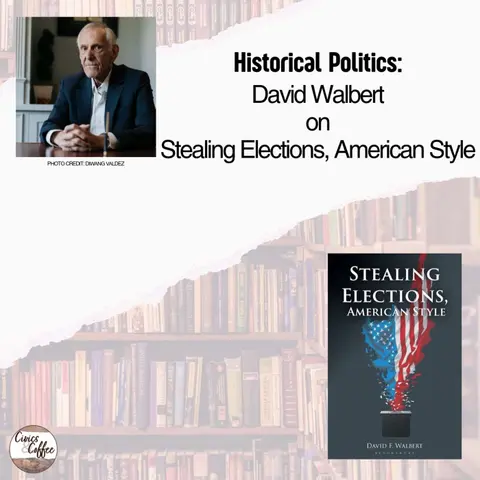
Historical Politics: David Walbert on Stealing Elections, American Style

 RSS Feed
 Castbox
 Podchaser
 Deezer
 Apple Podcasts
 Spotify
 Amazon Music
 Overcast
 Castro
 iHeartRadio
 PocketCasts
 YouTube
 Does the United States really have free and fair elections? In this conversation, voting rights attorney David Walbert discusses his book Stealing Elections American Style, which explores America's contentious electoral history. He highlights the ongoing issues of voter suppression and the historical context of the 1876 election, illustrating how political structures have perpetuated racial inequalities and the challenges faced in achieving true democratic representation. Join us as we highlight important moments including the controversial Bush v. Gore Supreme Court case and why Walbert believes civic engagement remains critical to democracy.
Learn more about David at his website here.
Buy your copy of the book through my bookshop affiliate link here.
Welcome to Civics and Coffee, a history podcast. The show all about United States history, delivered to you and the time it takes to enjoy your morning cup of coffee. I'm your host, Alicia, a historian trained in United States history with a passion for telling both the known and unknown parts of America's past. So grab your coffee and get ready for some bite-sized history. Welcome back, everyone. If you are listening to this on release day, then we have exactly four weeks until voting day for the midterms in the United States. It can feel like a fraught, pointless process for many, and one where several feel like the fix is already in. My next guest has a different perspective. I hope you all enjoy the conversation. Hey everyone. Joining me today is David Walbert. He is a voting rights attorney who has tried a wide range of civil and criminal cases and became one of the country's leading voting rights lawyers. He has taught constitutional law courses and testified before Congress as an expert on voting rights legislation and has now written a new book, Stealing Elections American Style, which will be the focus of our conversation today. Welcome, David.
SPEAKER_01Well, it's very nice to be here. Thank you so much.
SPEAKER_00Thank you for coming on. Let's dive right on in. So given kind of the charged rhetoric around the topic, what motivated you to research and publish a book that explores America's contentious electoral history?
SPEAKER_01Well, Alicia, the um yeah, I've been doing voting litigation for years. And I started it soon after law school, and I came to Georgia, and things were really, really bad in the sense that, you know, this is in the mid-70s that I got out of law school and came here. So voter registration problems, the historic voter registration problems, had been substantially rectified by the Voting Rights Act. So, you know, Georgia has 159 counties, and you'd have counties that were 50% black population back then that would have zero registered voters. And the Voting Rights Act very much changed that. But there was still in Georgia, I think probably at the time it had maybe uh 27% African American population, something on that, 26, 27, and way less than 1% of the elected officials in the state were African Americans. And that was because of the way the election structures were set up. Typically, a classic uh case would be 30, 40 percent uh black county in the black belt across Georgia, and all the seats on the county commission, the city council would be elected at large, so that black candidates, black voters could not effectively win a seat on that commission. So they were all uh 100% white, and really was it was political white supremacy. And that's not a term I originally used when I was a young lawyer, but ironically, there was a famous judge here you might have heard of, Elbert Toddell, and he was a Fifth Circuit judge who really is as much as important as anybody who made Earl Warren's court decisions actually come to life in the South. And he was the chief judge uh during this time of the old Fifth Circuit. The Fifth Circuit back then wasn't like today in any sense, uh, either philosophically or geographically. It covered everything from Texas over to Florida. There was no 11th Circuit. So he, that court covered the entire segregated South, not Virginia, South Carolina, so on, but the whole southern row of states, southern United States. And I was talking to him one day, this was back in the day when you could just sort of drop in and shoot the breeze with a federal judge. And I did that as a young lawyer. We were talking about these cases, the voting, vote dilution cases, what the term art became to be used for them. And I remember he was the first guy that said, well, this is the last linchpin of white supremacy, isn't it? That's stuck in my mind. That was probably, oh, I don't know what, 1980, maybe I was having that conversation with them. So that's stuck, that conversation has stuck in my mind ever since then. And that's what it was. You know, it was political white supremacy effectuated by these election systems and structures. So I'd, you know, this is a long answer to your question of why did I write the book? But, you know, we saw a lot of progress, you know, and a lot of it, unfortunately, was in spite of the Supreme Court, you know, as uh the Warren Court was long gone. You know, uh Richard Nixon had two vacancies on the Supreme Court when he took office. So that was the beginning of the end, if you will, of a court that really was sensitive and cared about equality and voting rights. And notwithstanding that, we made a lot of progress over the next uh, gee, from uh, you know, into the 2000 era, somewhere around then. So a lot of the systems that were drawn that had the effect, starting around you know, 2000-ish, things started all of a sudden, not only was progress kind of arrested and very difficult, but it was going backwards. And the rise of the Republican voter suppression regime, where I think they thought and believed and uh that demographics are ultimately gonna uh uh l you know limit their political opportunities. And the response of that was to not change their political philosophy and to uh respond to voters, it was to get rid of the voters. So that voter suppression that has been driven by the myth of voter fraud, you know, you jump up and down and yell fraud loud enough you can get anything passed. And that's been a strategy now for a quarter of a century, and it just between John Roberts' opinion in the Shelby County case, getting rid of half of the Voting Rights Act in 2013, and then other opinions since then, of course, Calais this summer. But it uh I was just so I won't say frustrated, but disgusted, you know, with where we were going. And and but it was, you know, first of all, I'm not like 30 years old anymore. So yeah, believe it or not, standing up in court and trying to cage for uh two weeks is actually quite physically demanding. So it's uh, you know, it was that. But the other thing is, well, where the Supreme Court was going, it was clear you couldn't win a case. You know, and and the decisions they were handing down made it impossible to challenge a lot of these very clearly discriminatory uh laws. So about two years ago, I guess, I decided I said, you know, maybe I can fight the fight by writing a book that will help a lot of people that are kind of in the middle ground, if you will, understand the reality and exactly what the truth is about all these different aspects of our current voting uh regime. And I didn't want to write a book that was just an academic tome written to, you know, other lawyers and political scientists and historians who should already know all this stuff. I wanted to make it a book that would be interesting and enjoyable read for anybody that likes reading, basically. So I combined kind of the more detailed discussions of what's going on today in terms of voter suppression with the whole history of the country on voting. And in that, have uh a number of chapters that are very specific stolen election stories. So the first chapter being, you know, Tilden Hayes in 1876. And these stories are really uh pretty remarkable, and they're really you can't make it up. Truth is crazier than fiction.
SPEAKER_00Yeah.
SPEAKER_01And and just some of the things that happen are just really stunning reading. So it I hope it makes for an overall, and that gives a flavor and a deeper sense of our history of voting, which has got a lot of warts on it. So that's why I wrote the book to see if I could get it out there to people and they could read it and have a better understanding of the truth about some of these issues. I'm a big believer in uh the power of knowledge and information and facts. Uh you know, I was a physics physics student in college, so maybe I'd you know that's look for the truth and figure out, don't figure out the answer first. You know, figure, get the facts, and then from that you can make the conclusions rather than the other way around, uh, where you have your opinions in terms of the facts, as we seem to be kind of a common phenomenon today. So uh I'm hoping that the book will have that effect. It'll uh get some people that uh not just true believers already. I don't want to just preach to the choir. I like to preach to the choir, but I like to preach to uh people who are really wondering about the truth about these things. And I think this book, it's just in a very readable way, it's still jam up with all the information you would need to form your own opinions on these questions. So that was the goal for it.
SPEAKER_00Well, and as you mentioned, you begin the book by sharing the story of the 1876 election. So for those who might not know what happened and and what does it tell us about the fractured nature of national elections in the United States?
SPEAKER_01Aaron Ross Powell Right now are such a divided country in so many ways, but if you go back to 1876, so that's just uh not this is just a decade after the Civil War had been concluded, and partisan um fever was uh a lot hotter than it is today. Let's put it that way. The Republican-Democratic schism and um I guess uh anger, I'll stop short of hatred, but there was a lot of that too. It was very, very intense. And for a lot of reasons, and Grant was the incumbent president, he was a Republican, and I noticed that you had one of your earlier uh sessions, Alicia, was on you know, the 1873 panic. Well, the 1873 panic was very rough, and when the 1873 election came along, it was still going strong in the 1874 congressional election, largely because of that, and there was you know corruption, uh the whiffs of corruption were swirling around national government too, uh unlike today, where it's not only whiffs swirls around, but it originates in the White House. I don't think Grant was ever personally tied up with it. I think it was just his administration had some issues, but uh, I mean, child's play compared to what we're seeing today in terms of corruption. But all that came together. So in 74, it was a Republican uh majority in Congress, and so it was switched by a hundred seats, went from Republican. So it went from a Republican majority to a very big Democratic majority. So that was the environment that was leading up to the 1876 uh presidential election. And it was back in those days, and I kind of missed these as a trial lawyer, instead of having all the stuff on TV with little sound bites and ads, you know, people go out and talk to large gatherings and they would hold forth. And I mean, there was a guy slipping my mind now, Ingersoll was his name, ex-attorney general from Illinois. And he was one of these great, like Clarence Darrell in later years, they just they could speak for two hours and people would be spellbound. These guys were just great orators, and Ingersoll would go around and he would get out there and talk about uh, you know, Democrats, you know, he was Republican, he would talk about Democrats with things like he'd have that whole big crowd out there and say, Who is the man who shot our greatest president, Abraham Lincoln? That was a Democrat. Who is the man that stole babies from the mother's breast? That was a Democrat. And he just goes through the whole line of everything about slavery and so on, and it was uh very powerful. Democrats had the same thing on their side. And on election night, everybody thought actually that um uh Tilden, who had been the governor, very good governor from uh New York State, the Democrat, and he had quite a uh record of uh anti-corruption. He was very instrumental in bringing about the downfall of Boss Tweed, who was from New York City, the Boss Tweed gang, phenomenally corrupt group, and controlled politics as well. And so he had that going for him in a context where corruption and government corruption was an issue during the campaign. So everybody thought, you know, that he was Tilden was going to win, and on election night came in that, yeah, he that's exactly what we thought. They're all rolling in, he's winning. Uh even some of the states that were questionable, he's winning them handily. And I mean that both candidates went to bed that night thinking that, you know, that uh Democrat had won, that Tilden had won. The head of the Democrat, the Republican Party headquarters in New York City, they shut down. They all went to bed home and gave it up and went up to their standard hotel, went upstairs. That was it. And some guy, very strange, you know, interesting guy historically, Dan Sickles, and he was a rogue and a rascal by any standard. And he goes by the headquarters of the Republican Party after going to the theater. He's not really particularly paying attention to it the night of the election, and he asks for the clerk where where the what happened, you know, everybody went to bed. He says, Well, where are the returns? They're over there on the desk of the Germans. He goes there and looks at them and sees that in three states that are still have federal troops in them during at the end of Reconstruction, Louisiana, South Carolina, and Florida, you know, it's well, I wouldn't say they aren't. In South Carolina and Florida, the votes weren't too heavily pro-Tilden, but uh they were definitely pro-Tilden. And in Louisiana, they were not just pro-Tilden, they were overwhelmingly pro-Tilden. So he comes up, sickle sends a telegram to the governors of each of those states and says, if you hold your state, Hayes wins. Hold your state. And he says, he doesn't tell them that, you know, that's not true. They got to all three gotta hold their states, not just your state. And he gets a telegram back from Chamberlain, who's the governor of uh South Carolina right away saying, no problem, they're saying he's in board. And Louisiana's immediately uh say, oh no, yeah, yeah, hey's won this. I think in the actual returns were that uh Tilden was 8,000 votes ahead, not an 8,000 out of 150,000 cash, big advantage. But this sickles guy, he knew that the Republican administrations that were there during occupation, they would do anything to hold on to their office as a practical matter. So it was from then on the most extraordinary uh saga of corruption and cheating uh ever, you know, unfolded over the next months. Louisiana had a quote that uh in the book is one of the most uh interesting, stunning ones in the all of our election history, and a fellow's on the Louisiana Canvassing Board, which is the board that collects all the returns from all the parishes, which are the counties, of course, in in uh Louisiana, and collects those returns are of course out to be total. And this fellow says, well, they may hear have us at the vote, but we got them in the count. And uh boy, he they had them in the count. Miraculously, uh, you know, all these precincts that were heavily democratic, all of them getting tossed out right and left. You know, they couldn't hand pick the votes because they didn't know who voted for who, of course, in the theory, anyhow. But they're throwing out these precincts, and of course they're losing some Republican votes for Hayes in the process, but they're picking out the precincts that are overwhelmingly Democratic. And at the end of the day, I think it was by 3,500 that uh Hayes ends up carrying Louisiana after losing by 8,000. And that triggered almost a Second Civil War. We were close. Uh, there was uh right while that was happening, head of the Democratic Party in Indiana telegraphed his uh equal in Louisiana and said, we have 500,000 armed men ready to come. Just let us know. So that's the standard. And that that kind of talk was all over the country. And it went on and on until uh, you know, in the spring, under the Constitution back then, you got sworn in in March. And it really went on really to the last night, you know, in Congress was taking the electoral votes. And so they had everything, you know, was done to try and avoid open warfare, because a lot of people were saying that if Tilden isn't president, you know, they're we're gonna go we're gonna go to war. Now, the irony is the Democratic factions that were most assertive about that were not from the South. They were Northern Democrats and Western ones. And I think that's that's real simple is that you know, the South had just experienced that issue. You know, they just had a Civil War. And of the white males in the South, you know, 30% of them were dead after the uh Civil War. So, you know, uh it was uh they saw it a little bit more realistically than just yelling and screaming about it and talking about going to war again. But there at one point Congress created a commission of 15 people to try and decide this uh dispute before they have to decide the electoral votes when they're sent to Congress. And the weird thing about it was Congress empowered that, you know, they couldn't really give to the commission the ability to decide. They could make a decision, but still it's up to Congress at the end to accept it or reject it. The anticipation was they accepted. And it's composed of 15 people, five House, five Senate, and you know, those are both skewed by the majority, you know, the Senate was a majority Republican, House of Strong Majority Democrat. Well, those two that 10 reflected that you know it was five Democrats, five Republicans from the Senate and the House, and then the Supreme Court, and they appointed um there were two Republicans on the Supreme Court, two Democrat appointed Supreme Court justices, and then another fellow that was supposed to be from Illinois. And the Democrats felt okay about that because he was considered the least political of the justices. But lo and behold, uh the state legislature in Illinois appointed him to the U.S. Senate. That took him off the Supreme Court, took him out of running, and Democrats are freaking out because they've agreed to this plan. It's been enacted by legislature, and there were no more Democrats on the court. So they didn't have, you know, they were like in deep, they were in trouble. And so Bradley gets appointed, and they're hoping that he might be sympathetic to Democratic cause. He had authored opinions, striking down some of the Reconstruction legislation the Republicans had passed. So they thought that, well, maybe he's not so political. That commission, here's all the evidence. And especially out of Florida, had a crystal clear legal decision from the Supreme Court of Florida, which was majority Republican that completely supported Tilden's position. So if you just followed the law, they would have had to, at least with Florida, they would have had to vote for Tilden. And Louisiana was just so outrageous on the facts, you'd think they would have done it too. But you know, they went right down politics. It's eight-seven vote on every single issue that was before him. So is a completely political decision. And the country, again, when that came out, saying the the explosion of anger by the Tilden people and Democrats around the country was extreme. It was probably worse than what happened right after the Louisiana theft. And again, all kinds of noise about warfare and gunplay and shooting and so on, and to the point where I think it was the sergeant at arms of the House, Democrat, he called for authorization for a hundred thousand armed deputies for the sergeant at arms, and to specifically and explicitly ensure that Tilden became president. So all all kinds of things were going on in terms of politics, threats. You know, if you read a simple version of history, people would in some Books, I was saying, well, the deal was that the Democrats would allow Hayes to be president in exchange for ending Reconstruction in those last three states. But it's really, I think that's a simplification of it, and ignores what was really going on in terms of A, the Solan election, and B, how the politics sort of after because Hayes, Hayes was not going to continue Reconstruction, regardless. You know, when he was campaigning way before anything happened in the election, before he has ever trying to work out anything with uh Democrats, he was very explicit about, and the term back then I think it was used as you know, local control. So, you know, didn't specifically say we're going to add reconstruction in that language, but favored, you know, having uh Louisiana control of its own affairs and the same with the last three and all the other states their reconstruction was done. I I do think that technical ending of it in terms of withdrawal of the troops and some other things was expedited, but I think it was inevitable anyhow under Hayes, you know, based on what he had been saying. Um he was no uh he was not a you know the people that were called the radical reconstructions back then are the ones that were really pushed reconstruction legislation and trying to really r uh address the uh not just technical elimination of slavery, but to try and integrate African Americans into the uh into the country in a meaningful way, so they had economic opportunities and what have you. So um Hayes was not not of that persuasion in from anything I've ever read. So but anyhow, so it's uh and one of the kind of the got me thinking about really getting into that very clear political involvement of the Supreme Court of Justices in that one. I I did a little uh arithmetic on this and took all the cases that really decided who was going to be president of the United States. You know, that one, of course, and then Tilden, I mean, uh Tilden Hayes, of course, but Bush V. Gore, of course.
SPEAKER_00Yeah, well, speaking of the Bush Vigore decision, can you talk a little bit about the 2000 presidential election and and some of the legal issues it uncovered?
SPEAKER_01Surely. One of the things that people don't know unless they've read a lot about it and didn't know at the time, was that there were a tremendous amount of very race-based anti-democratic voter purges in the months leading up to that election in 2000 in Florida, state of Florida specifically. Of course, Bush's brother, Jeb Bush, was the governor of Florida. And Catherine Harris was actually, she was the Secretary of State during part of the time, and she was the campaign co-chair, I think it was, is her exact title, of W. Bush's presidential campaign. So Florida did everything it possibly could to try and make that come out in Bush's column. And beginning with, again, with uh voter purges, that if you take the demographics of the people being purged and correlate that to the demographics of how that they would tend to vote, Gore lost far more votes than the illegal purges that occurred before the election than he did than the 500-some vote gap. I mean, he lost way, way, way more than that. And that's something that really wasn't picked up on until after the polls closed. People really weren't aware of that. And and it was really under Florida law, it was really illegal. I mean, the Court of Appeals said you can't do this, and they just kept doing it. Purging people that had criminal convictions in other states, had their full civil rights restored. They had no right in Florida to say you can't vote, but there's I think it was 50,000 of them they tried to uh purge at one point. And they also didn't let people uh register to vote. So they got never got on the, they never got into the system. So we don't even know how many of those there are that didn't uh get uh able to vote. So that is a big piece of it. And then of course, afterwards, there's all kinds of the ridiculous butterfly ballot in uh Palm Beach County, where communities, precincts are voting heavily for Buchanan because of the confusion of the ballot. And these are Buchanan, as you may recall, had been pretty apologetic about Nazism and what had happened in Germany. And apologetic, I don't know if that's quite right, but he was very, very, very tepid about it, let's put it that way. And these precincts were very heavily older Jewish immigrants who had lost family in the Holocaust. So they hated Buchanan and they ended up voting for him because of this screwed-up ballot, meaning to vote for Gore. Ollie uh Freisher was uh Fleischer was Bush's spokesperson. Uh, he made it say, well, yeah, this is a very this is a stronghold down here from Buchanan, no surprise. Buchanan to his credit said, that's ridiculous. If anybody there voted for me, that was a mistake. So that was kind of leading up to it. But from then on, and some people have seen this, what the so-called punch card system, where you'd go in and you take a card, you slide it into a little device, and then you take a stylus and you and it would show you where you punch out these Chads theoretically, so that that would then be read by an optical scanner about who you'd punched out. Well, the problem was, and it was well known that these things were not very good in terms of accuracy. And you had to perfectly punch that thing out. And me being a lawyer, I'd always take my my card and I'd look at the back and I rub it to make any hanging chads fall off and what have you. But that's not normal, that's not a normal person. Elderly people, it's it's hard to do it. You could try and punch it and so on. So you get everything from there's all this lexicon that describes failed votes. There's the hanging chad, the segment chad, the dimple chad, and vocabulary about these things. And this was not new to the 2000 election. People knew that about these voting machines, that they just were not reliable like that. And in fact, in uh Florida, they had the exact same problem a couple years earlier, and everybody agreed that when you have that, you then go to hand counts. You have somebody examine the ballot, and the law in Florida, and I think probably every state was that the intent of the voter is a definitive thing. That's the guideline when you're looking at a hand count or any kind of count. It's what's the intent of the voter? In fact, we ascertained that ballot counts. So that's what they had historically done in Florida, but Catherine Harris, as a secretary of state, did everything she could to interfere with that process in the counties in Florida to try and stop it, because every time they're doing that, they're finding more and more uh gore votes are coming in, and the Bush gap is getting smaller and smaller. And it goes on like that, so that at one point, there's a whole number of decisions, and I was actually in India at the time, and when I saw that the Supreme Court had taken CERT discretionary appeal from the 11th Circuit, actually, that one was from the uh Florida Supreme Court, I said, okay, that's the ball game. The fix is in because there's no federal issue there. If you look at the Supreme Court's clear precedence over and over and over, there was nothing that was a federal decision that should have gone to the Supreme Court. It was a state law question of is the state law being filed accurately and honestly to count the ballots, period. And that was the first time that I realized that it was uh going to be a heck of a problem. It takes four votes to get cert out of the nine on the Supreme Court. So at least four of them are wanting to uh do it in. And this is after the Supreme Court of Florida had made very clear uh rulings about Florida law, what should be done, the hand counts, and how no Secretary Harris, you can't just arbitrarily stop those. They need to go forward. And that goes back and forth between the Supreme Court of the United States and and Florida over several weeks, and finally, uh order issues from the Supreme Court of the United States without briefing and without argument saying stop the count. Stop it right where it is, which is Bush up by 500 or something, and then there is an argument, and then their full opinion comes down from the court, and there is no law in that opinion. You know, it is specifically it says that this is not precedent for anything else. They say that right then, and of course it's not because there's no law in it. Scalia's concurrence is maybe the most amazing. What he's saying is the count needs to be stopped so there's no degradation or besmirching of the president's victory. So he's literally declaring who's the victor at that point. So the idea of who wins or who won is irrelevant to him. It's just so flagrant, his failure to consider the question of who won. They're just deeming it, we got to make sure that it just looks good. You know, we don't want to have any of these questions hanging over it.
SPEAKER_00So what do you say to folks that read this book and are are left feeling defeated and unsure of how to move forward?
SPEAKER_01I see it as an uplifting book for a president, because if you are feeling defeated, look how defeated we've been in the past. I mean, my God, six percent of the population of the adult population was eligible to vote in the first presidential election. And women couldn't vote by constitutional law, they could in some states, but until 1920, uh black people couldn't vote in the South for all intents and purposes. Bogus literacy tests and what have you. Black people were kept from voting until you know 65. All kinds of systems were then in that were there that prevented them from winning office. So we've had a really kind of uh pretty ugly history, but I look at it very much as progress. And I think history is to me, I'm very optimistic, and I like to think of history as heading in the right direction, but not in a uh continuous way. I mean, it's two steps forward or three and a couple back. That's what you learn out of history, is it's there is no straight line in it. It is up and down, but it is overall it's progress, definitely progress. So I get very optimistic about it. And I think that certainly we have an atrocious Supreme Court right now, for sure. And that is a very, very big problem when it comes down to the right to vote, because they are not supportive on those issues at all. They have eliminated the Voting Rights Act, period. But it is a matter of not quitting and not giving up, and everybody's got to just really be invested in the idea of democracy. I end the book with this quote as a judge up in Massachusetts dealing with this issue, but in a First Amendment context of and he and the case involves all the efforts to deport people who are legally here in this country, uh, students, for example, and uh are speaking out in favor of uh Palestinians. And he goes through, and and uh they're being singled out because of what they say and being deported, strictly in violation of the First Amendment. And the judge in that case writes this lengthy, 161-page order going through everything that's wrong in that case and the lies and the disingenuousness of it by uh the Secretary of State Rubio and, of course, the President. And he goes through and ends with the question about will people let it happen or not? Because it's only the people that can stand up for it. And he he ends his order with, as I've read and reread the record in this case and listened widely and reflected extensively, I've come to believe that President Trump truly understands the and appreciates the full import of President Reagan's inspiring message. That refers back to when Reagan said, freedom is a fragile thing and it's never more than one generation away from extinction. It's not ours by way of inheritance. It must be fought for and defended constantly by each generation, for it comes only once to a people. And then the judge, after mentioning that, says, I fear that President Trump believes the American people are so divided today that they will not stand up, fight for, and defend our most precious constitutional values so long as they are lulled into thinking their own personal interests are not affected. And I think that's the danger. We can't fall into that trap. We've got to remember and always believe and fight for the rights that we have, constitutional rights, the right to vote. But you know, I just think that uh as bad as things look at any given time, things can be a whole lot better. And I think I really one of the things that, you know, Alicia that had first really hit me with that, when I moved to the South, you know, in 73, I'd never lived in the South before. And I come down here as a young lawyer, and the can the state of race affairs, in my opinion, was pretty crazy. You know, the level of racism and segregation and white supremacy and so on that was still very much part of that society were so palpably real and powerful that it was really struck me. But when I, you know, as I, you know, had a lot of more and more and more black acquaintances and friends at that time and learned more and more about personal stories, it had been so much worse 10 years before, you know, in the 60s, it'd been so much worse 20 years before in the 50s. So as bad as it was from my point of view, God, it had been uh 10 times worse very recently. So, you know, I guess that's one of the experiences I've had that give me the optimism about things can improve and not always in one line. If people do, in fact, exercise their rights, their rights to speak out, the rights to protest, and the right to vote. If those rights are exercised, I'm pretty optimistic about where the country ends up going, honestly.
unknownYeah.
SPEAKER_00And so where should people go to learn more about you and the work that you do?
SPEAKER_01Aaron Powell It's DavidFwalbert.com, and that's got uh a good overview of everything I've done law-wise. You know, it's not just voting rights, it's uh you know a lot of other stuff too in there.
SPEAKER_00Uh nice. And before I let you go, is there any parting words of wisdom that you want future readers to know?
SPEAKER_01Well, I just think that it is critically important to stay optimistic and to not give up and to realize that what makes a democracy function is engagement. And and a very uh and I'm I do worry in that regard about disinformation. And it is critically important to talk to the other side. We've got to, you know, people have to have got to engage. I don't think a democracy, this is really a little chunk of wisdom that I was given by a fellow years ago who had been, he was much older than me, but he'd been a great newspaper reporter, Gene Patterson, got a bunch of pullers and what have you. And he was a witness for me in a case, and I brought him into town and talked to him a little bit. So then we spent the whole evening talking about, you know, other things like the media. And I said, You don't think we'll ever have a media in this country again? And he said, Well, not with the antitrust laws being erased by the Supreme Court like they are. I said, Well, isn't it can't uh everybody get really good information off the internet? So, yeah, the problem with that is everything gets siloed. You know, you can get what you want, and everybody else gets what they want, and a democracy cannot survive without a common shared sense of the basic facts. We're gonna have different values, but we can't be living in fictional worlds. A democracy can't work that way. So I think it's incumbent on us, it's a real challenge to us, to not just talk to our s each other, to our friends and our um people who are our same beliefs, but engage with other people that are not of the same philosophy politically and otherwise. And it's got to be done in a respectful way. We're all people, and we all start off the same, you know, at zero, and we end up getting our values and so on from our environment and our experiences. But it's important to have respect, human respect for people on the other side when they deserve it. I'll put that in there. I think the important thing is just keep the faith. Keep on trying and keep on working at it and stay engaged. You know, don't be frustrated so that you withdraw from the political process. That is our savioring grace at the end, and we must stay engaged in it. That'd be my best message I think I could give. And of course, read the book. Because then you'll see, yeah, it's kind of rough today, but man, it's been rough before. It's been very rough. So it can give you uh some good stories in there, but it can also give you a really good sense of uh how progress has really been very, very dramatic over our voting um career in this country specifically. Voting history.
SPEAKER_00Well, on that note, to the listeners out there, Stealing Elections American Style is available now. Thank you again, David.
SPEAKER_01Alicia, it's been a pleasure. Thank you very much.
SPEAKER_00My thanks again to David for spending his time with me. If you want to read more about America's long, complicated election history, grab yourself a copy of Stealing Elections American Style today. Thanks, peeps. I'll see you next time. Thanks for sitting down with me as I explore this chapter of American history. If you liked what you heard, be sure to subscribe and share with your friends. I look forward to our next cup of coffee together.
