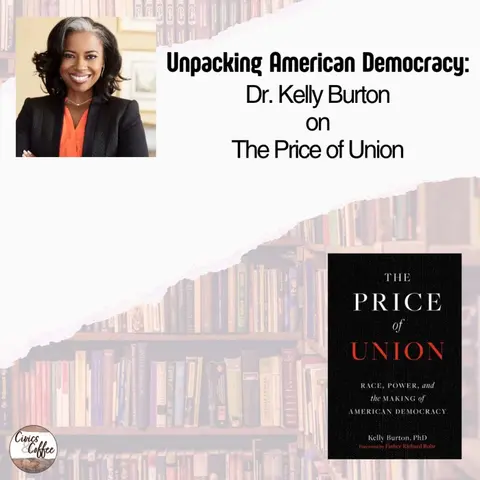
Unpacking American Democracy: Dr. Kelly Burton on The Price of Union

 RSS Feed

 Castbox

 Podchaser

 Deezer

 Apple Podcasts

 Spotify

 Amazon Music

 Overcast

 Castro

 iHeartRadio

 PocketCasts

 YouTube
Is the American experiment in democracy undergoing a temporary setback? Or is it undergoing a racial reckoning 400 years in the making? That is what Dr. Kelly Burton explores in her book The Price of Union: Race, Power, and the Make of American Democracy. Join me as I discuss her book and what motivated Dr. Burton's research - and where she thinks the United States goes from here.
In this conversation, Dr. Burton and I discuss:
- Dr. Burton's book where she argues that America's origins are rooted in economic ventures.
- Why she believes the Constitution is as an economic document.
- The long-range implications of the Three-Fifths Compromise we may not think about.
- Why Dr. Burton believes there is a need for a new understanding of democracy and a reimagining of the political order to ensure human flourishing for all.
To learn more about Dr. Burton check out her website: priceofunion.com
BUY THE BOOK: The Price of Union
Want Me To Cover a Topic?
Want More Civics & Coffee?
Sign Up for the Substack
Join the Patreon Coffee Club
Make Sure We Are Connected:
Love Civics & Coffee?
Disclaimer: Links to books are affiliate links. Each purchase helps support great historical scholarship, independent book stores, and the podcast!
Welcome to Civics and Coffee, a history podcast. The show all about United States history, delivered to you and the time it takes to enjoy your morning cup of coffee. I'm your host, Alicia, a historian trained in United States history with a passion for telling both the known and unknown parts of America's past. So grab your coffee and get ready for some bite-sized history. Hey everyone, welcome back. The United States is gearing up for the midterm elections next week. If you have been asking yourself questions about what comes next or perhaps what contributed to some of the division we see today, my guest this week has a book you should check out. I hope you all enjoy the conversation. Hello everyone. Joining me today is Dr. Kelly Burton. She is a political scientist, entrepreneur, and executive leader whose work sits at the intersection of race, power, and democracy. She is the co-founder and former CEO of Black Innovation Alliance, a national organization advancing inclusive entrepreneurship and black economic mobility. And she is the author of The Price of Union: Race, Power, and the Making of American Democracy, which will be the focus of our conversation today. Welcome, Dr. Burton. Hi, Alicia. Thanks so much for having me. Thank you so much for being here. Let's dive right into what prompted your research.
SPEAKER_00When our current president was elected the first time, I realized that I was confused. And not in not in the way that all of us, well, many of us were confused, but as a trained political scientist, I felt that I should have better tools for understanding what was happening to our democracy. And I was at a loss. So I started on the journey of writing this book because I needed to figure out for myself what was happening within American democracy.
SPEAKER_01And so you kind of take a long view in your research, and you start at America's origins and you describe it as a venture. So how does this make us rethink the country's origin story?
SPEAKER_00Well, when we think about our beginnings, it often starts at 1776. So even right now, in this moment, we're in the 250th anniversary of the signing of the Declaration of Independence. And so if we don't think about the Declaration of Independence, we think of the Constitutional Convention. But in truth, the American project was in motion for 150 years before the Constitution. And the Constitution that was drafted was in relationship to a colonial economy. And so I really wanted to understand what was the true why behind America, what is the true purpose behind America? And what I learned is our story really begins in Jamestown in 1607. And the reason that England came to the New World was the same reason that its European counterparts had come to the New World. And that was to make a fortune. The goal was to engage in this high-risk enterprise with the hopes of a high return on investment. And so at the end of the day, America is a venture, and the government that we created 150 years after those ships landed in Jamestown was created to extend and facilitate the venture.
SPEAKER_01And kind of moving forward in this history, you discuss how, in the aftermath of Bacon's rebellion, the planner class created a new social class. And so I'm curious, can you talk a little bit more about this and again, why it might challenge some preconceived notions about the history of race in the United States?
SPEAKER_00Absolutely. We tend to think about race as descriptive, as demographic, as neutral. But I wanted to understand what is the role that race plays in our democracy. And I realize that it is truly functional and structural. And what I mean by functional is race in our caste system that further extends race and racism is designed to deliver very specific outcomes, right? So if we go back to the beginning, why was race created? Race was created because you had two classes. You had the planner class and you had multiracial indentured servants. And, you know, 20 or 30 years in, these indentured servants are starting to get pissed because they feel that they are being exploited and they begin to rise up. And Bacon's Rebellion is an example of that, where these multiracial uh group of rebels essentially burn Jamestown to the ground. And the planter said, All right, we're gonna have to figure out how we create more stability within this group if we're gonna be able to, again, extend this venture. So they began to give elevated social standing and certain benefits and incentives to the servants of European descent, at the same time stripping blacks and indigenous people, Africans and Indigenous people of specific rights. So that's the beginning of our modern-day racial caste system, but it has always existed to deliver on a thing. And in that case, it was to cohere this group of European immigrants, give them certain incentives to make them comfortable and to calm this rebellious spirit so that the elite could be about the business of exploiting this new territory.
SPEAKER_01And another kind of you know different argument that you make in this book is that the Constitution is more of an economic document. And so I want to explore that a little bit with you. So how is the Constitution an economic document? And again, you know, how does this framing help us recontextualize the founding era?
SPEAKER_00When we think about the constitution in our like general discourse, people immediately go to one of two things, the preamble or the Bill of Rights. And the preamble was an afterthought. It was really drafted to add flourish. It wasn't anything that the founding fathers debated on. And the Bill of Rights came after the fact. It's a reason that they are the first ten amendments to the Constitution, because individual rights was not a primary concern of the founding fathers. There are a few for which it mattered, but most not so much. Many had real concerns around direct democracy. So when you actually read the Constitution, the Constitution that came out of the convention, it yes, outlines the branches of government and the establishes powers across those branches, but they really exist to facilitate commerce. So there are a lot of references to the ability to tax, to coin money, currency, tariffs, trade, to establish intellectual property, to engage in contracts. All of this is in the Constitution. So when we think about it, we're thinking about the First Amendment, the Second Amendment. It's like, no, the framers were thinking about how do they accomplish what they hadn't been able to accomplish under the Articles of Confederation, which is what which was to build a government, establish a government that could stand up an army and create a bank because they were tired of having to pay for these militia to protect their stuff. We talked about Bacon's rebellion, um, what preceded the Constitutional Convention was Shea's rebellion, where you had all of these soldiers who had not been paid from the Revolutionary War and now were being taxed by the states and they were being squeezed, and they were, you know, coming for the 1%. And so there are these letters between the founders where they're like, oh my God, like they're coming for us. The, the, the, you know, they're the hordes are at the gate. And so these are the pressures that the founding fathers were dealing with. So they created a government in response to that to essentially protect their stuff and further enable them to continue to expand the American project.
SPEAKER_01Yeah, and sticking on the Constitution for just a a bit longer, you cite the Three-Fifths Compromise as the most politically consequential provision in the Constitution. So I'm curious, can you expand on this and why you make this case?
SPEAKER_00Absolutely. When we learn about the three-fifths compromise, it's usually like in, I don't know, seventh, eighth grade civics class or and and when we talk about it, it's in terms of the ways that enslaved Africans were stripped of their dignity because they were considered as three-fifths a person and not as a whole person. In truth, the North was trying to get the the amount to be even less because they knew that the more percent, the higher the percentage, the more power that the South would derive from that. Because essentially what the three-fifths compromise did is it allowed the Southern planters to derive representational credit from their enslaved population. So the book references how in Hamilton, in the musical Hamilton, uh there is this scene where it talks about it must be nice, it must be nice to have Hamilton on your side, with the belief being that, you know, Hamilton disliked Aaron Burr even more than he disliked Thomas Jefferson and persuaded folks to vote for Jefferson. Well, in truth, Jefferson was able to win the presidency because he was able to count on the representational credit from the enslaved population throughout the South. The three-fifths compromise was so powerful that between the Constitutional Convention and the Civil War, most of the presidents were from the South, most of the Supreme Court justices were slaveholders, uh slave owners, and uh most of the leaders in the Congress were also from the South. So much so that once the three-fifths compromise was nullified on the back end of the Reconstruction Amendments, not one president came from the South from Civil War to civil rights. And LBJ, who was from Texas, became president, but not through election, through presidential assassination. He was elected the second time, but it was because he was able to log some wins coming via the assassination of uh John F. Kennedy. So that's how powerful the Three Fifths Compromise was. It allowed the South to dominate in the first 80 or so years of our government. And therefore, in many respects, the nation was shaped in its image.
SPEAKER_01Yeah, and you explore this idea of like the racialized social contract. And so, how has America's racialized social contract impacted people of color as it relates to American democracy?
SPEAKER_00So, going back to what we learn, we learn about the social contract typically in like when you're in college, political science 101. And but no one ever mentions uh that in our American context, the social contract was racialized. Because when our nation was founded, the only folks who had citizenship were white men who owned property. And then it was further extended to white men, but up through Reconstruction, there only white people had, white men in particular, had access to American citizenship. So that initial social contract was really created between white America and the American government. The social contract essentially stating that you as an individual, you have political sovereignty. And you give over your political sovereignty to a government, to a nation state, in exchange, that government is going to provide you the baselines of security and the ability to achieve prosperity. That's the essential negotiation in your typical social contract. So, what I argue in the book is that particularly during, particularly during the first founding and even extending it to the second founding, the book is organized into these three foundings, the first founding being from the Constitutional Convention to Reconstruction, the second from Reconstruction to Civil Rights, and the third from civil rights to present. But during that first founding, in particular, anyone who was not white was found outside of the social contract, which meant that they operated as source material for the government to deliver the social contract to these European immigrants.
SPEAKER_01Yeah. And talking about that second founding, you know, there was a slew of federal policies that were passed between Reconstruction and the New Deal. But how did these federal policies fall far short for black Americans?
SPEAKER_00Reconstruction delivered the Reconstruction Amendments, the 13th, 14th, and 15th Amendments, which abolished slavery, gave citizenship to blacks, black men in particular, and the vote. And then there's additional civil rights legislation on the back end that also addressed segregation and prejudice in public accommodations. However, shortly thereafter, the Supreme Court delegitimized a lot of that and revoked the need for the federal government to protect the rights of black people, which opened up the South to rain terror on the heads of black people in the South and even in the North to institute real severe segregation. And so we see brutal crackdowns throughout the South and across the country. You saw race massacres as far as Colorado and Illinois. And the federal government essentially pulls back. The book talks about how, with the Tilden Hayes Compromise, the North agreed to pull federal troops out of the South. And so what you see is a receding and a pulling back. And as a result, all of these measures that were put in place, these new arrangements that were put in place by the radical Republicans, are largely overhauled by the federal government and state governments, which returned the South back to forms of quasi-slavery and instituted a very strict racialized hierarchy within the North and throughout the expanding West.
SPEAKER_01Well, and you spend some time kind of highlighting how the treatment of black soldiers demonstrates kind of an abandonment. So I'm curious, can you can you talk about that a little bit and kind of how that really demonstrates kind of this failure that you highlight throughout the book?
SPEAKER_00Yeah, I argue that of all the ways that the federal government left black people to languish in the margins of the American story, the way this government has treated black soldiers, particularly during the second founding, was the most egregious. Because these are folks who had given the ultimate sacrifice to their government. And when their government needed them to protect and defend them, the federal government turned its back. And so in the book, there are probably about a dozen different examples of how across various campaigns during the early, you know, first half of the 20th century, the federal government allowed for the harassment, the abuse, the maiming, the murder of black soldiers both within the army and once they left the army, including one instance of an infantry, an all-black infantry, which was assaulted by a white mob in defending itself. It, you know, they were court-martialed as a result of it. And the government ended up hanging over a dozen of its own black soldiers just because they defended themselves against white civilians. So it's very brutal, though, the way that our government has treated black soldiers, especially during that period. And it, to be honest, it was one of the more difficult sections of the book to write.
SPEAKER_01Yeah. It was one of the more difficult sections of the book to read. I'm not gonna lie. So you've previously referenced this in one of your previous answers about you you broke this book up into what you call, you know, the first founding, the second founding, and the third founding. And, you know, uh, as a student of history, I'm I've I've read about you know, the first founding and the second founding, second founding starting at at Reconstruction. And I I I think this was the first time I've I've read something about the third founding starting starting with the civil rights era. So I'm curious as to, you know, why did you start there? What was the motivation behind that?
SPEAKER_00And and and and what makes that so critical? Oh, that's such a good question. Because I did have a moment in writing the book, like, do I want to take the license here? Like, this is a very Eric Foner is like the man. Um I really didn't want to mess with his framework too much. So I'm like, I'm I'm hoping that he will, you know, bless it. But the argument is this that every time this government tries, is there's an attempt to open up rights. So from the constitutional convention, there's a conversation, a debate. And what I argue in the book is we're often taught when it came to the constitutional convention that the big debates were about how power would be shared across the branches or how power would be shared across the large states versus the smaller states. But in truth, when you read Madison's notes, it's very clear the major point of debate was whether or not this new government would allow for a slave economy. And the South was very clear: no slavery, no union. And the South was the, you know, they held the power, they held the sway because they were the wealthiest uh and they had the, you know, the, you know, that's where you, you know, Madison and Washington and Monroe, and so that's where your heavy hitters came from. Virginia ran the show. And so, you know, coming out of the Constitutional Convention, the big point of negotiation, the big bargain, the chapter's called the bargain, is that if there's good to be a union, it's gonna be ordered by this kind of racialized economy and this racialized political order. Like that was the big point of concession. And we see that pattern play out over and over again where the North capitulates to the South. We see it in Reconstruction, where the North capitulates to the South. And then we see a similar reset with the civil rights legislation of the 1960s. So I argue that again, every time there's an opening, the system recalibrates. We saw the Constitutional Convention, we saw it at Reconstruction. Now, by the time we get to this third founding, the assumption is like there are new agreements with the first and the second, it was constitutional. With the third, it was legislation that really mirrored the second, and it's finally attempting to make the reconstruction, the promises included in reconstruction real. If you put them side by side, they're all almost mirror images of one another. So that's why I take the uh the license to say, all right, this is representative of a third founding because finally these the attempts to allow for the full inclusion of black people and others are made real because this legislation has enforcement power. We often don't really talk about the implications of the civil rights movement and the civil rights legislation in particular for American politics, but it really worked to reconfigure the landscape in many ways. Number one, it resulted in the reorganization of our two-party system. Because you have white folks who are in the South and had been loyal Democrats for generations. Once the Democrats, the National Party, take up civil rights, the entire South migrates out of the Democratic Party into the Republican Party over the span of about a generation, which is unprecedented. And even today, Day, if you look at Southern legislatures, it's the same dynamic of white over black that we've seen for hundreds of years. Because you walk in and the chamber is split between black Democrats who are the minority and white Republicans who are the majority, with the white Republicans continuing to hold political sway over the black democratic minority. So it's the exact same pattern that we see over and over and over again because the system was essentially designed. When I say the system, American democracy was designed to protect the racial order, because the racial order allows democracy to function. And the second way that the civil rights movement and the civil rights legislation reorganized American politics is it resulted in the bifurcation of the white vote into kind of racial conservatives and racial liberals. And these are folks who not only aligned with the promises of the civil rights movement, but also the following rights revolution around LGBTQ rights and women's rights and protests against the war in Vietnam. And so it resulted in this bifurcation where there was an alignment of white progressives with black folks and other marginalized classes. Previously, to be a progressive was associated with the New Deal. But now on the back end of this, of the civil rights movement, progressivism was more reflected in what we now call culture wars, which I would argue was a direct derivative of the civil rights movement.
SPEAKER_01Yeah, it was a super compelling argument. And I'm curious to see what what other historians take take and do with it. Because I I thought it was a very interesting intervention that you made. So thank you, Alicia. I appreciate it. And speaking of other scholars' work that you you kind of built off of, Isabel Wilkerson has written about caste, and so you also talk about the consequences of it. So can you talk a little bit more about this and some of the arguments that you put forth?
SPEAKER_00Absolutely. I felt for for folks who've read cast, and caste essentially is a masterful work because it forces us to think about race at this higher level of abstraction, to say caste, this social hierarchy and process of social ordering exists everywhere, no matter where you are. There's something about how human beings are hardwired where we seek to be better than, we seek this kind of social climbing and aspiration. And what it looks like here in the United States, it's it's largely racialized, right? So if we assume that our racial caste system is the dominant social order, what are the implications of that for American democracy? And then taking a historical view, I didn't spend a lot of time on this at the end, but I think when we think about racism, it's the conversation is always about how it harms black people and other people of color. But I think there's a bigger conversation about how it has impacted white folks and how it has impacted America more broadly speaking. Because essentially the caste systems and this container of whiteness or white people has worked to cohere people of European descent. Now, if we think about it, before coming to the New World, going back to, I don't know, the 1600s, these are folks who in their native countries had been at war with one another for hundreds of years. Hundreds of years. Even if you go back to the Europe today, you still see the beef between England and Ireland. It's a very long-standing beef. Um, and these, you had a lot of this, this um acrimony across the continent. But when they came to the United States, they were all kind of clustered into this container called white people, which forced them to like leave those attachments that crossed the pond. So white folks were forced to part ways with their heritage, with their nationality, with their language, in many respects with their religion, in many respects with their last name. And these were lineages and legacies that had been in place for generations to associate with this cross-class, what uh Theodore Allen refers to as this cross-class affiliation of whiteness, which really was devoid of culture outside of Americana or outside of Southern heritage. And so there is an untethered, in some ways, white folks are untethered from deeper cultural meaning. The other thing that I think white folks have lost in this is a strong attachment to their economic interests. Because whiteness is cross-class, which says you as a yeoman farmer can be in this group with planters. We're all in it together because we are all Europeans and we all are a dominant race, right? We're in it together, we're on the same team. It doesn't matter if if you're the second string punter and I'm the quarterback and I make 20 times what you make, right? We're on the same team. So this has really disconnected white folks from their economic interests. We in the progressive spaces always say, oh, you know, you know, the West Virginia coal miner who is in the Republican Party and in league with the Silicon Valley Titan is voting against their economic interests. Well, they've been separated from their economic interest for a very long time because the only thing that this government has ever really promised white people is elevated social standing. And that is what they are voting for. So they're voting to preserve their elevated social standing. That's why they, you know, they tend to lean into all of these issues, like whether or not they're, you know, they their kid has to share a bathroom with somebody from another gender, which has no material effect on their lives. But they vote based on these things. But it's because for hundreds of years, white folks have largely been separated from their economic interests, which is part of the reason that you see don't see a strong kind of working class here or working class politics in the United States in the ways that you see in other places. So I think that's really just the tip of the iceberg. There's all sorts of research that says that the America is less generous, that we have a much more flimsy social uh safety net, that there are fewer common goods as a result of racism. So there's a lot of research. Heather McGee has a great book that that's out about this. So there are all sorts of implications associated with racism, but the effects are not just uh the negative consequences do not just fall to people of color. There are a lot of ways that white people have been punished because of their unwillingness to really rethink this racialized order, which is ultimately in service to the elite in the 1%, which has always been true.
unknownYeah.
SPEAKER_01It was it was a wonderfully framed chapter, and I I I hope folks really uh dive into it and and really are willing to take it in, because I I thought it was framed quite beautifully. Thank you.
SPEAKER_00Thank you, Alicia. I appreciated it. It's it's uh it's writing this book was like I describe it as putting together a 10,000-piece puzzle. So if there are folks that do puzzles, you know, like, oh, I've got a weekend, I'll do a 250 piece, or I'm I got a good long weekend, I'm gonna do a five. I mean, I have 1,000-piece puzzles that I bought when I was feeling like ambitious, like, oh yeah, I'm gonna do this. And I have never touched them. Like that is the threshold for me. But so to say, like I felt like this book took me seven years to write, and uh I felt like it was putting together a 10,000-piece puzzle with no picture. So as I'm doing the research, I'm just clustering ideas. Like, I think this is connected to this. I think this is over here. And what what it what I I can't even say that I endeavored to do this, but what I ended up with was this kind of grand theory of the relationship between race and democracy and this framing that I'm hoping gives folks greater clarity on how we got here and why race continues to be so central to the conversation. We can't continue to pretend that it's a sideshow. It is at the heart of what is happening in our nation and we've got to tackle it head on.
SPEAKER_01Well, and that kind of cues up my my next question that I have for you. So, given all this history and and and kind of the precipice on where we stand, what's next?
unknownI don't know.
SPEAKER_01Good lord, good God.
SPEAKER_00Yeah, no, not to set you up there, but will we? Well, you know, here's the thing. I this is where I landed. I started to write this book because I needed to figure out what the heck was going on in this country as it related to our democracy. And by the end, Alicia, I'm like, I can no longer cape for this democracy. I just can't. Because the book is for folks. I say in the book that progressives, we have our own version of Make America Great Again. We're in this moment and we're like, dog on it. You know, if we could only go back to dot, dot, dot. And in researching the book, I'm like, there was never any original like state of purity for this democracy. This democracy has always sustained a very real dark side. There's a section that talks about what has made America great. And there are all these assumptions. It's our freedoms, it's our liberties, it's our currency, it's our, you know, our, you know, entrepreneurial spirit. And I'm like, yeah, and it's also the ways that this country has mastered the ability to leverage the law to extract, exploit, and erase entire communities of people. That is also a big part of what has made America, quote unquote, great. And I'm not interested in further advancing a political order that requires the subjugation of entire groups of people for hundreds of years in order to deliver political outcomes for the majority. So my hope is that this book helps people begin to make peace with this 250-year-old political project. I think it's running its course. I'm hoping that it's going to find its people and find its champions and encourage folks to create spaces where we can really begin to imagine what comes next. I was in an interview earlier this week, and the host said, Well, Kelly, you know, there are the only place that we're really hearing folks say, what is post-democracy, are these technocrats like Peter Thiel, who are arguing that, you know, tech billionaires are the ones, and now trillionaires got to help us, are the ones who should be, you know, in charge. And I'm like, God help us. Absolutely not. But this is what I know to be true, Alicia. Somebody's gonna build the future that our children are going to have to exist in. And I would rather it be people who are thinking about how we build the sort of political order that is capable of enabling human flourishing for everybody, not people who spend their entire day thinking about how they can further enrich themselves, you know, through the further, you know, marginalation, subjugation, and extraction of the rest of us.
SPEAKER_01Well, and where should people go when they've finished this book and they want to learn more about you and the work that you do?
SPEAKER_00You can find me at the Public Intellectual on Substack. That's where my broader body of scholarship lives. I have thoughts about all of the things, and most of them are pretty provocative, especially about what comes next. Like that's where I'm leaning in. What is on the other side of democracy as we know it? Not as, you know, I did this social media post that talked about it, it, you know, it was like a little graphic that said, pick one, communism, socialism, democracy, none of the above. And I'm like, none of the above. Good lord. Like these are 500-year-old ideas and concepts. And when we think about democracy, even going back to the Greek states. So, you know, there's got to be, we can't be in a place where we're talking about mining asteroids and we can't think about what comes next, given everything that we have learned and come to understand about how we optimize as individuals and as communities and as an inter, you know, globally interdependent world. This 17th, 18th century democracy is not sufficient for carrying us into a bold new future. So I'm hoping that it's going to give people, quote unquote, permission to grieve what we are going through, make peace with it, and you know, organize in spaces where people can continue to build what's next. Okay, back to your question. You can find me at Substack. The priceofunion.com is where you can find more information on the book. There's a conversation guide if you've got a small group or a book club and you want to dive into these ideas. Um, I'm going to be on book tour probably for the next 12 to 18 months. So hopefully you can find me in a city near you. And uh you can also find more about me and my broader scholarship at publicintellectual.org. Lovely.
SPEAKER_01And so we've talked about a lot, but we still have only really scratched the surface of so much that you've covered in this book. So is there anything that we haven't covered that you want future readers to know?
SPEAKER_00Buy the book, engage with the book and talk back to me. Uh, I'm on LinkedIn, you know, DM me, message me. I am so excited to get this book out into the world. I will I've received so much really amazing feedback from folks about its impact, but also, you know, it's uh it's a a cold splash of water in the face. I will tell you that. Uh it's a bit of a gut punch because we are we are operating under a grand myth. Um, and this hopefully will just broaden people's understanding and perspective because clarity is key if we're actually going to be called into this next founding. I feel that the greatest inheritance that we could receive from that founding generation is the uh willingness to begin again. It's not our constitution, it's not our declaration of independence, it's the spirit and the willingness in the guts to say our existing political order does not fit our societal future. And so we need to step into that gap and build what is necessary.
SPEAKER_01And on that note, to the listeners out there, the price of union is available now, so be sure to grab yourself a copy of this thoughtful look at the history of American democracy and some compelling ideas for how we move forward. Thank you again, Dr. Burton. Thank you, Alicia. My thanks again to Dr. Burton for spending her time with me. The Price of Union is out now. Thanks, peeps. I'll see you next time. Thanks for sitting down with me as I explore this chapter of American history. If you liked what you heard, be sure to subscribe and share with your friends. I look forward to our next cup of coffee together.
