The Dowry of Death: The Case of Benjamin Burton

 RSS Feed
 Castbox
 Podchaser
 Deezer
 Apple Podcasts
 Spotify
 Amazon Music
 Overcast
 Castro
 iHeartRadio
 PocketCasts
 YouTube
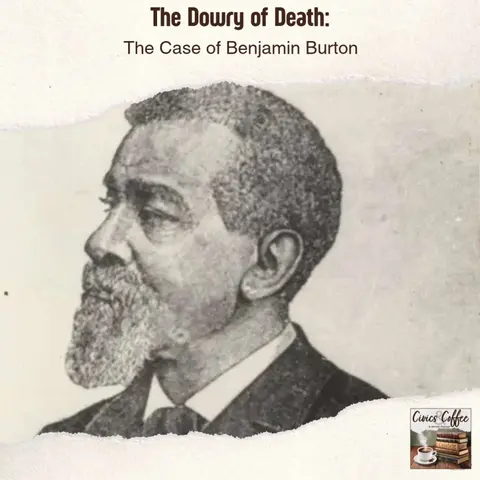
 He was one Rhode Island's richest Black entrepreneurs. His death sent shockwaves into the small, coastal community of Newport. Initially ruled a suicide, rumors of family disputes, financial mismanagement, and concerns about a new addition to the household prompted authorities to dive deeper. What they exposed was a horrific story of greed and manipulation. Prepare yourself for the Gilded Age case of Benjamin J. Burton.
And check out the novel A Harbor of Deceit mentioned during the episode.
Welcome to Civics and Coffee, a history podcast. The show all about United States history, delivered to you and the time it takes to enjoy your morning cup of coffee. I'm your host, Alicia, a historian trained in United States history with a passion for telling both the known and unknown parts of America's past. So grab your coffee and get ready for some bite-sized history. Hey everyone, welcome back. If you've been a longtime follower of the show, then you know that I am a super fan of the Gilded Age, including the HBO series, which is scheduled to return in just a few weeks. One of the storylines showrunners explored in season three were the lives of wealthy black Americans, sometimes referred to as the Black Elite. These families represented a wide range of experiences who, through access to education and entrepreneurship, managed to break through some of the significant barriers posed by Jim Crow to become successful merchants, doctors, and lawyers. The show even included a storyline where Peggy visited the town of Newport, Rhode Island to give a talk to her cousin's women's group, which, ironically enough, is where this week's story is set. And despite the fact that the HBO series takes creative license with its characters for dramatic purposes, the show is grounded in an incredible amount of history, including the fact that Newport was home to a number of financially successful black families, including one gentleman by the name of Benjamin J. Burton, whose death in October of eighteen eighty five sent shockwaves through the small community. Initially deemed a suicide, questions about the scene and his daughter's new husband prompted a deeper look into exactly what transpired just before shots were fired and screams were heard from his home. So this week, I am diving into the life and death of Benjamin J. Burton. Who was he? What happened to him? And why did his death create such a divide within Newport? Grab your cup of coffee, Peeps. Let's do this. Before I get started, I want to really highlight the work of Nancy Markey and Kay Adams for bringing this story to light. Most of what I was able to pull together came as a direct result of their efforts, and they've since written a novel about the incident, which I've included in the show notes for the episode. So with that, let's begin. Benjamin J. Burton had humble beginnings. Born in Connecticut in 1826, he arrived in Newport around 1845. The details of his early life are unclear, but at some point he married Roseanne Babcock, and the couple would go on to have two daughters, Maria, born around 1861, and Emmy, born around 1867. In Newport, Burton established the first black-owned luggage delivery business, catering to the tourists who made the sleepy town their summer getaway. As he was starting out, Burton focused on the business his competitors refused, and was quickly carting trunks and luggage all over town at all hours of the day and night. As the idyllic town of Newton expanded, so did Burton's business, and with the glittering wealth of the Gilded Age, Burton enjoyed increased success with his express and transport business. Burton parlayed his earnings into a new venture, the first mass public transportation line. A bus line driven by horses, Burton's innovation helped the Newport community expand even further as residents were able to move into neighborhoods previously seen as undesirable due to their distance from the town center, where many of the jobs and places of worship were located. Burton was comfortably in the upper middle class of the black community, and his daughters Maria and Emmy were viewed as genteel young women. As such, they would be considered highly sought after as future wives and mothers, and would be comforted by the fact that they would not have to worry about working as a domestic or a laundress. Burton became a widow around 1880, leaving Benjamin to figure out how to raise two young black women alone while also trying to maintain the family business and ensure that his girls maintained their status as respectable young women. To those on the outside, Burton was always affable and approachable, never one to show signs of sadness or stress, despite the fact that he was running a demanding business and raising two children. But much like the era's name, not everything was as shiny and serene as it appeared on the surface. And in the fall of 1885, the Newport community would be in for quite the shock. It started on the morning of October 6th at the Burton Home, located at what was then 63 Levin Street. Described as a two and a half story home with adjoining tenement fit for an additional four families, the house was a stunning piece of architecture and fitting for one of the state's wealthiest entrepreneurs. Suddenly the sounds of two shots, followed shortly after by the screams of a woman, were heard emanating from the home as onlookers saw 24-year-old Maria Burton fly out the front door, yelling, quote, Help, my father has shot himself, end quote. A local delivery man in the area dropped his task and went into the home to determine if he could provide assistance, only to discover that Benjamin J. Burton appeared dead. By his side, a pistol. When police arrived, they sent for the medical examiner and the coroner before trying to take control of the scene, which had already grown quite busy with curious onlookers. Once the medical examiner arrived, Burton was quickly moved to the kitchen table where he was given a quick assessment. The examiner located two bullet entry wounds near Burton's ear and by his chest, and confirmed, to the surprise of absolutely no one, that Burton was, in fact, deceased. The medical examiner did, however, take note of one seemingly odd detail. Burton had a partially chewed piece of bread in his mouth. Now that death was confirmed, it was now up to the coroner to determine the cause. The coroner interviewed the Burton family, including daughter Maria, her eighteen-year-old sister Emmy, and Maria's new husband, Alan. Of top interest to the coroner was everyone's location at the time of the shooting. The youngest sister, Emmy, seemed unsure in her answer of her exact location, and indicated that she did not recall hearing the gunshots. Maria offered that she was visiting with a neighbor in one of the adjacent tenements attached to the house. As for husband Alan Dorsey, well, he indicated he had been resting due to a cold and had been in one of the upstairs bedrooms. Alan admitted to hearing loud banging, but he claimed that he just assumed that the noises were sounds of door slams and did not think that they were bullets firing from a gun. The coroner next asked about Burton's state of mind and behavior leading up to the shooting. According to the sisters, their father had been incredibly depressed as of late, expressing feelings of sadness and indicating that he did not believe he would live much longer. Despite the oddly specific nature of these statements and the fact that they seemed contradictory to the outward portrayal Burton showed the community, the coroner concluded his investigation and determined that the death, with two gunshot wounds to the head and the chest, must have been a suicide. Burton was buried just two days after the shooting, and his funeral was held at the Union Congregational Church to a packed house, as it seemed as though the entire community of Newport wanted to pay their respects. Neighbors and friends were split over the coroner's findings. There were some who simply could not believe that a man as successful as Burton, who still had a young daughter to marry off, would take his own life. This feeling was supported by Burton's sister-in-law, Emily, who simply refused to believe he could shoot himself twice. Emily also had some information that threw suspicion on the newest member of the Burton household, Alan Dorsey. Dorsey, who was originally from Athens, Pennsylvania, had also come from humble beginnings. The son of a barber, Dorsey was studying to become a surgeon and, if successful, would become one of the first in the country. While attending Lincoln University in Pennsylvania, Dorsey worked summers in Newport as a waiter to help pay his tuition. It was during one of his summer stints that he met the young Maria Burton in 1877, and the two began a courtship. The couple eventually married on June 17, 1885, just before Dorsey was scheduled to return to Philadelphia to complete his medical training at the University of Pennsylvania. Marrying Maria Burton, the daughter of one of, if not the richest black businessmen in Rhode Island, was like winning the lottery for Dorsey. Upon their engagement, Benjamin Burton indicated he had money set aside to give the young couple. A dowry, essentially. Thus, instead of toiling away as a waiter at one of the hotels or restaurants in Newport that summer, Alan Dorsey spent his time off relaxing and living the high life. This, according to Burton's sister-in-law Emily, left a bad taste in Benjamin's mouth, and he began to suspect that his new son-in-law was perhaps not as committed to Maria as he was committed to the money that came with her. But while Emily had her doubts, Alan Dorsey had plenty of defenders, including civil rights icon George T. Downing. Downing saw Dorsey as a young and talented man just beginning his life. Dorsey represented everything that was possible for black Americans when given the same opportunities as their white neighbors. There was a potential for greatness in Dorsey, and Downing was not going to let rumor or innuendo undercut what he saw as a bright future. This was also in the midst of Jim Crow when black men were falsely accused of a whole host of crimes, albeit almost entirely by white people, so Downing could have been feeling a little extra sensitive in his protection. Regardless of intentions, the dispute over Dorsey's potential guilt and the disagreement among community members about whether Burton actually committed suicide by shooting himself twice attracted the attention of the Rhode Island Attorney General, who ordered Burton's body exhumed 10 days after his death for an autopsy and an inquest. Burton's autopsy revealed a few facts that made the ruling of suicide questionable. First, the body lacked any remnants of powder burns near the entry wounds, which one would expect if the gun was held at close range during a suicide attempt. The second odd finding was, again, the half-chewed piece of bread in Burton's mouth. This indicated that perhaps instead of a gun at the time of his death, Burton was holding a roll or a piece of bread. Moving to the inquest, the Attorney General brought in Patrick J. Galvin to oversee the case. Over the course of four days, Galvin interviewed over 60 witnesses, trying to understand everything from the state of Burton's finances to the inner workings of the Burton family relationships. Now, despite what some in the community wanted to believe, there were those whose testimony backed up the daughter's story, that Burton had expressed morose thoughts, including that he wished he could blow his brains out. In his testimony, George Downing even offered that Burton had been depressed over some financial losses he sustained due to bad gambling losses. But Burton's sister-in-law Emily proved to be quite formidable in her testimony, explaining everything she knew about the courtship between Maria and Alan, and that Maria had been asking family for money when her father refused to pay out the dowry as expected after the young couple were wed. Giving the young couple a motive, Emily also let it be known that she disclosed the loan schemes to her brother-in-law just before his death. Several doctors were interviewed at the inquest, and they all seemed to agree that the shot to the heart would have been fatal. So if the shooting was the result of suicide, Burton must have somehow shot himself in the head first, then the chest. The doctors who believed it was not a suicide, however, offered that the shot to the head would have surely rendered Burton unconscious, and thus made it impossible for him to shoot himself in the chest. When Maria and Alan were interviewed, they were eerily calm and stuck to their story. When the inquest was over, it was determined that Burton's death was no longer a suicide, but likely murder. However, the coroner would only stipulate that the gun was fired from, quote, persons unknown, refusing to list any suspects, much to Patrick Galvin's dismay. Not to be deterred, Galvin decided to re-review the inquest testimony to determine if there were any inconsistencies he could use to pit one Burton against the other. Galvin was able to get young Emmy to undercut Maria's original alibi under the threat of a perjury charge, and the new information was sufficient to get authorities to arrest her and husband Alan on November 19, 1885. Once her sister was arrested, Emmy's health deteriorated rapidly, and after a lung hemorrhage convinced her that she was on death's door, Emmy reached out to Galvin to give what she believed was a deathbed confession. She admitted that Alan had been the one to shoot her father, but that Maria was well aware of the plot and had done nothing to stop it. Galvin's instincts were right, and he next turned his attention toward Maria, hoping he might be able to convince her to fess up to what she had done, especially once he learned that she was pregnant. Galvin transferred Maria from the Newport County Jail to the state prison under the pretense that she could enjoy around the clock medical treatment during her pregnancy. By this time, Maria had contracted consumption, and there was some doubt as to whether she'd be able to make it to the birth. In an interview ahead of the trial, Alan Dorsey dismissed the claims from Emmy as nothing more than hysterical musings of a young girl. However, things changed when the trial began. Once Galvin presented the medical evidence, reviewing it in graphic detail, something in Maria Burton broke. After calling for a pastor to pray with her, Maria summoned Galvin and made a full confession. According to Maria, Alan had only ever been interested in her money and had tricked her into getting married, assuming that he would inherit quite a large sum once the two exchanged vows. Once it became clear that this wasn't going to happen, Alan became crazed and abusive toward Maria, threatening to divorce her, which would become a major scandal. Desperate to figure out a way to finance his education after having spent the whole summer lounging instead of working, Alan pressured Maria to find creative ways to find the money, which is what prompted her to ask for loans from family like her aunt Emily. When even that proved insufficient, Dorsey grew more panicked and feeling incredible pressure, Maria let it slip that her father might have a life insurance policy. That was all Dorsey needed to hear. While Maria tried to stall for time, Alan's patience ran out on October 6th. After tapping little sister Emmy as guard and sending Maria off to a neighbor to create an alibi, Alan grabbed the gun from the bureau and fired two bullets, killing his father-in-law. The couple were found guilty and sentenced to life in prison. Their child was put up for adoption. Little sister Emmy was also sentenced to life in prison for her role in the murder, but died just six months later from consumption. Maria didn't last much longer, passing away just two years later from the same disease. As for Alan, well, he spent 25 years in prison before receiving a pardon in 1912 when he moved to New York City to work as a waiter until he passed away in 1918 at the age of 60. Benjamin J. Burton might have been one of Newport's wealthiest residents, but even he could not protect himself from the crazed greed and singular ambition of a man intent on claiming a future he felt entitled to. And before I sign off today, my big thanks to Jennifer with the Cleo Dialogues for her support of the podcast through Buy Me a Coffee. Thank you so much. The Clio Dialogues is another wonderful history podcast that I recommend checking out to learn more about great historical scholarship. And your support helps keep this show running and goes to things like hosting fees and research materials. If you want to learn more about how you can support the show, you can check out the website at www.civixandcoffee.com. Thanks, peeps. I'll see you next time. Thanks for sitting down with me as I explore this chapter of American history. If you liked what you heard, be sure to subscribe and share with your friends. I look forward to our next cup of coffee together.
