Exclusion or Restriction? The Chinese Exclusion Act

 RSS Feed
 Deezer
 Apple Podcasts
 Spotify
 Amazon Music
 Overcast
 Castro
 iHeartRadio
 PocketCasts
 Castbox
 Podchaser
 YouTube
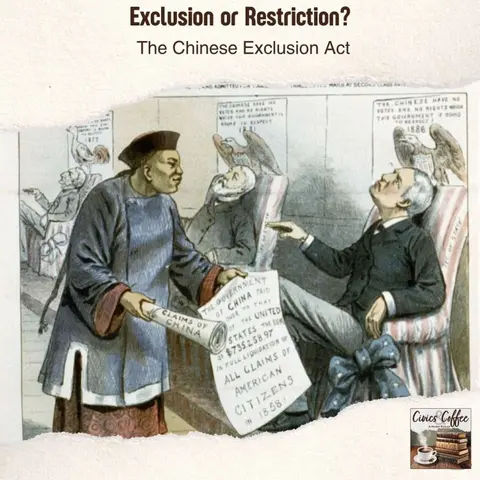
 In 1882, President Chester A Arthur signed legislation barring Chinese laborers from entering the United States for a period of ten years. It went on to become known as the Chinese Exclusion Act, but is that an accurate framing? Join me this week as I explore Chinese immigration and why some historians refer to the 1882 law as the Chinese Restriction Act.
Welcome to Civics and Coffee, a history podcast. The show all about United States history, delivered to you and the time it takes to enjoy your morning cup of coffee. I'm your host, Alicia, a historian trained in United States history with a passion for telling both the known and unknown parts of America's past. So grab your coffee and get ready for some bite-sized history. Be it enacted by the Senate and House of Representatives of the United States of America in Congress assembled, that from and after the expiration of ninety days next after the passage of this act, and until the expiration of ten years next after the passage of this act, the coming of Chinese laborers to the United States be and the same is hereby suspended. And during such suspension, it shall not be lawful for any Chinese laborer to come or having so come after the expiration of said ninety days to remain within the United States.
SPEAKER_00United States Congress, may sixth, eighteen eighty two. Hey everyone. Welcome back. You didn't really think we were done talking about Chinese exclusion, did you?
SPEAKER_01Chinese immigration into the United States and the various tactics deployed to try to limit and later expel them from the country had sweeping and significant impacts. Joining the thousands of others who poured into California in search of gold in the 1850s, Chinese immigrants quickly became cheap labor when the elusive commodity was extracted out of the hills and waterways of what they once called Gold Mountain. Ever industrious, Chinese laborers were critical to the construction of the Union Pacific Railroad, often performing the most dangerous tasks for a fraction of what their white counterparts were paid. But as hard economic times hit with the recession in 1873, anti-Chinese sentiment reached new heights, and calls for their expulsion started to grow louder. These calls culminated in the spring of 1882 when President Chester Arthur signed an act to execute certain treaty stipulations relating to Chinese, commonly referred to as the Chinese Exclusion Act, the law suspended the immigration of Chinese laborers for a period of 10 years and implemented criminal penalties for anyone who knowingly violated the law. Historians and journalists have long pointed to the 1882 legislation as the jumping-off point for exclusionary policy against Chinese immigrants. But is this an accurate assessment of the law and what followed? This week I am diving into the quote unquote Chinese Exclusion Act. What happened in the run-up to its passage? How impactful was it? And why is it perhaps better to refer to it as the Chinese Restriction Act?
SPEAKER_00Grab your cup of coffee, peeps. Let's do this.
SPEAKER_01Before I get started, I want to give a brief word of caution. This episode will include quotes from primary sources that reference Chinese immigrants using offensive language and terminology. There's always a debate on whether to include historic quotes such as these, since they help reinforce the narrative, but they also risk inflicting harm. In this instance, I decided to include the quote with this warning at the start of the episode. So, with that, let's dive in. As I mentioned in the opener, Chinese immigrants first entered the United States in mass numbers thanks to the discovery of gold in California in the 1850s. While many immigrants only intended to come to earn enough money to help their families, several Chinese decided to stay and make the United States their home, creating an uneasy tension with their white neighbors who saw and treated the Chinese as distinctly and permanently different. While a significant number of white Americans were never overly accepting of any non-white race, viewing members of indigenous nations as little more than savages in need of civilizing, or looking at black Americans as uneducated and in need of their quote-unquote protection, Chinese immigrants presented a completely distinct set of problems. Chinese immigrants, to some, were both godless others and tricksters who were industrious and adaptable. As historian Beth Lew Williams asserts, for these white Americans, Chinese immigrants could never be assimilated properly to Anglo-Saxon U.S. culture. And further, they represented a distinct threat. In their eyes, unlike the indigenous or black American, if Chinese immigrants were left alone and given an even playing field, they could very likely take over the United States. This in part helps explain the push for exclusion. The idea of the Chinese immigrants being a distinct and separate other, or quote unquote alien, also comes from when they came to the United States. The Chinese arrived at a moment where the country was negotiating what it meant to be a national citizen. At its founding, the United States Constitution failed to outline the parameters of what it meant to be a citizen of the country, and thus it was largely left up to the states to specify the terms, rights, and qualifications of citizenship. This meant that being a citizen of New Jersey looked different than being a citizen of Illinois, and the rights someone had in one state did not necessarily transfer to another. After the Civil War, however, Congress was forced to address the idea of citizenship on a much broader scale. The end of slavery and the emancipation of millions of black men, women, and children meant that the United States had to evaluate new political questions, and for the first time, the federal government outlined what it meant to be a United States citizen and the rights and privileges that it guaranteed with the passage of the 14th Amendment. Despite outlining who could become a citizen and what rights that guaranteed, Chinese immigrants remained on the outside, and questions about their ability to join the United States was initially unclear. In 1790, Congress passed a naturalization law limiting access to only those who were quote-unquote free white persons. And anti-Chinese advocates who believed that the Chinese represented a threat to American commerce and way of life sought to maintain a distinct line between white citizens and Chinese immigrants. Thus, they charged that Chinese laborers were, quote, heathen coolies, end quote, enslaved laborers without religion, who posed a threat to the white American workforce. Congress updated the naturalization law in 1870, providing for the naturalization of individuals from Africa or of African descent, essentially precluding Asian immigrants and Chinese specifically, from being eligible for naturalization. Yet many businessmen still relied on Chinese labor. In 1868, the United States and China signed the Burlingame Treaty, which provided the free flow of immigration between the two countries so that the United States had a ready supply of labor to complete the Transcontinental Railroad. In California, where Chinese immigrants represented roughly 10% of the overall population, they made up roughly 25% of the labor force. This only further fueled racist concerns about a supposed Chinese takeover and helped men like Dennis Kearney rise in popularity and launch populist movements like the California Working Men's Party, which sought to force out Chinese immigrants by any means necessary. As I mentioned in my episode about the California Working Men's Party, Kearney was infamous for his rallying cry, the Chinese must go, and for declaring that he was committed to expelling Chinese immigrants, quote, peaceably if we can, forcibly if we must, end quote. The noise coming from the West and people like Dennis Kearney was becoming a problem for the federal government. On one hand, Congress understood the concerns of their white constituents along the West Coast, and in some respects, shared the same concerns. But they also wanted to keep the doors open to ongoing trade with China. There was also an existing treaty in place, the Burlingame Treaty, that they did not want to violate since that could interfere with future commercial interests and imperialist visions. Thus, in 1880, the United States and China entered into new negotiations, the result of which was the Engel Treaty of 1880. Ratified in 1881, it reversed the Burlingame Treaty and allowed the United States to, quote, regulate, limit, or suspend, end quote, Chinese immigration. But it did not go so far as to allow the United States to outright prohibit Chinese immigration entirely. For those most committed to ridding the country of the Chinese element, the treaty simply did not go far enough. This all led to John Miller, Republican from California, introducing Senate Bill 71. The legislation sought to exclude Chinese laborers for 20 years and require Chinese immigrants to secure a passport prior to entry. Anyone found to be in violation of the new immigration law faced fines and imprisonment. This version of the bill eventually landed on President Arthur's desk and was deemed too extreme for signature, and the president vetoed the bill, much to the anger and frustration of Western residents who took to burning Arthur in effigy. Understanding the political stakes for continued inaction or perceived inaction on the quote-unquote Chinese question, Arthur signed a watered-down version of Miller's bill on May 6, 1882. Despite what it is known for today, the law titled An Act to Execute Certain Treaty Stipulations Relating to Chinese was pretty narrow in scope. First, it specified that only Chinese laborers were barred entry into the United States, carving out exceptions for diplomats, merchants, and elites. In a gesture of goodwill toward China, the law also gave the Chinese government the authority to distribute exemptions. Thus, as historian Bethleou Williams asserts, Chinese immigration did not really slow. Quote, most migrants made one of three claims to skirt the law. They purported to belong to the exempted elite, to have previously resided in America, or to be merely in transit across the United States, end quote. These built-in exemptions and limitations on excluded individuals led to only a 16% drop in immigration in what Williams refers to as the restriction period, the years between the passage of the quote-unquote exclusion act in 1883 and 1889, when Williams argues the real exclusionary policy began. Even contemporary press reports refer to the law not as an exclusionary policy or act, but as the Restriction Act. Thus, while most know it as the Chinese Exclusion Act, Williams argues it makes more sense to refer to the law as the Chinese Restriction Act. While the law may have been the opening for eventual total exclusion toward the end of the decade, the 1882 bill still provided too many loopholes to truly be labeled or otherwise considered an effective exclusionary law. One of the unintended consequences of the restriction law was the emergence of smuggling. With the implementation of the restriction law, Chinese immigrants encountered new difficulties in arranging their passage to the United States and turned to smugglers for a ride. And despite passing the restriction law, federal enforcement and support was lacking, prompting local residents to join the efforts in border control. However, the land border with Canada was and remains significant. And even with the help of locals, customs officials were simply outmatched and unable to enforce the law as intended. Frustrated by the lack of results, white vigilante groups decided to take matters into their own hands and expel the Chinese by any means necessary. This led to a series of violent outbursts throughout communities along the western part of the United States in the mid-1880s. One of the most violent incidents occurred in Rock Springs, Wyoming Territory, when 28 Chinese miners were killed, and the white community forcefully expelled hundreds of Chinese immigrants and burned their homes, not bothering to confirm whether the homes were fully evacuated. The riot, which occurred in September of 1885, sparked national conversations about how the United States should move forward in dealing with the quote-unquote Chinese question. The violence at Rock Springs felt like a launching point, and over the course of 18 months, Chinese immigrants contended with a seemingly endless string of violent attacks. Over 150 local communities used violence and intimidation to try to expel Chinese neighbors, all in a way to force national action. For the working class, the federal government had failed in their duty. In their estimation, the weak restriction law just didn't go far enough, and thus they were doing what needed to be done in order to force the issue. This was a sentiment shared by at least a few in the press, as one article in the Philadelphia press newspaper said partially, quote, a trial of four years of the Restriction Act has shown that it is little better than a rope of sand as a bulwark against the Mongolians. The frauds that can be practiced under it are as numerous, and the wily Chinese were not slow to find the loopholes and take advantage of them. The local vigilante expulsions against the Chinese was also creating larger problems. Not only were the stories generating national headlines and creating headaches for Congress, but word of the violence was reaching China, posing a bit of a diplomatic challenge. To those committing the acts of violence, however, it did not matter. Their needs were more important, and no treaty was going to override that. Calls for restitution for the losses assumed by the Chinese were ignored, at least initially. As historian Bethleou Williams explains, quote, together law and violence sought to deny the Chinese any place in America, end quote. The situation grew so dire that Chinese Minister Chang Xiao Ju wrote to Secretary of State Thomas Bayard admonishing the federal government's inaction, saying partially, quote, the Chinese have been driven by violence out of many places, their dwellings burned, their property robbed, and in some instances the people murdered without any serious attempt made by the authorities to prevent these acts or afford protection, end quote. The ongoing violence prompted Chinese officials to reconsider their own immigration policy with the United States, and for the first time they wondered whether it was prudent to continue sending Chinese nationals overseas where their lives were clearly at risk. Once the United States knew that the Chinese government was on board with exclusion, officials took full advantage, passing the Scott Act of 1888, which gave Congress the authority to revoke the one exemption that seemed to be a major sticking point for customs agents, the right of return. Hastily put together after prior negotiations with China failed to produce a satisfactory treaty, the Scott Act was partially a Hail Mary attempt to secure President Cleveland a second term. It did not work. But the Scott Act, what some may consider the true starting point of exclusion, did give the federal government more power over immigration and successfully narrowed the pathways available for Chinese migration. This did not exclude Chinese immigrants from the United States, of course, but it undoubtedly helped cement their status as a permanent other or alien and gave permission to Americans and white non citizens to treat the Chinese as an underclass. Racist tropes and propaganda would continue unabated for decades. Chinese and Asian immigrants faced arbitrary quotas until 1965, when the Immigration and Nationality Act eliminated the racially based quota system. And in 2011 and 2012, Congress passed unanimous resolutions expressing their regret for Chinese exclusion, recognizing that the laws, quote, legitimized racial discrimination, end quote. Coming to the country in the hopes of making money to send home or to start a new life in a new country, Chinese immigrants were much like the immigrants of Europe who boarded a ship in the mid-19th century headed for the United States. Although they were initially tolerated, the Chinese quickly came to be viewed as a threat that could not be assimilated and faced violence from their neighbors and apathy from state leaders.
SPEAKER_00Vigilante violence prompted national action, but instead of trying to understand, the Congress decided to exclude those who were seen as different. Thanks, peeps. I'll see you next time.
SPEAKER_01Thanks for sitting down with me as I explored this chapter of American history. If you liked what you heard, be sure to subscribe and share with your friends. I look forward to our next cup of coffee together.
