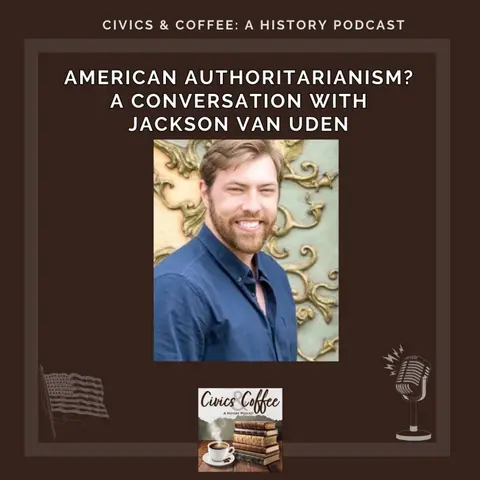
American Authoritarianism? A Conversation with Jackson van Uden

 RSS Feed
 Castbox
 Podchaser
 Deezer
 Apple Podcasts
 Spotify
 Amazon Music
 Overcast
 Castro
 iHeartRadio
 PocketCasts
 YouTube
 There has been a lot of talk lately about fascism, communism, and authoritarianism in U.S. politics, but what does the history tell us? Join me as I welcome historian Jackson von Uden to discuss his research on authoritarianism and its long thread through American history. Discover the distinctions between authoritarianism, fascism, and communism, and how these concepts manifest in various political contexts. Our conversation reflects on historical examples, including the founding era, Reconstruction, and the actions of 20th-century presidents, highlighting moments where authoritarian tendencies emerged in American governance. Finally, Jackson shares why he feels it is important to understand these patterns as Americans navigate the current political challenges.
To learn more about Jackson check out his website: https://historywithjackson.co.uk/
Want Me To Cover a Topic?
Want More Civics & Coffee?
Sign Up for the Substack
Join the Patreon Coffee Club
Make Sure We Are Connected:
Love Civics & Coffee?
Welcome to Civics and Coffee, a history podcast. The show all about United States history, delivered to you and the time it takes to enjoy your morning cup of coffee. I'm your host, Alicia, a historian trained in United States history with a passion for telling both the known and unknown parts of America's past. So grab your coffee and get ready for some bite-sized history. Hey everyone, welcome back. What exactly is authoritarianism? And what role has it played throughout American history? That was the topic of conversation with my guest this week. I think you will find it informative and as we head to the polls in a few weeks, useful. I hope you all enjoy the conversation. Welcome everyone. Joining me today is Jackson von Uden. He is a historian who specializes in authoritarianism, tyranny, and dictators across the modern world. He is currently completing his doctoral research at Royal Holloway University of London and is a fellow member of the public history community with his podcast, History with Jackson, which features conversations with historians, authors, and researchers. Today, however, we are going to explore Jackson's research and how it applies to the United States. I am so thrilled to have a chance to speak with you. So welcome, Jackson.
SPEAKER_01Thank you very much for having me on. I've been very excited to come onto the podcast. So, you know, I think we're going to have a very interesting conversation about authoritarianism and America.
SPEAKER_02Yes. Yes. Very interesting indeed. But before we dive in, can you share a little bit about your background and specifically like how you came to study tyranny and authoritarianism in the United States?
SPEAKER_01Of course, so there's two kind of strands for that first. So I will start with the tyranny and the authoritarianism strand. So, you know, as any good university student in the UK, you go out on a Wednesday night. Wednesday night is the sports night. So you played sports during the day. I played rugby. I went out out. And there was one week where we were supposed to be doing an essay on some kind of ideology or structure. And I was a little bit hungover on a Thursday morning in flip-flops, in rugby shorts, and a hoodie, going through the library thinking, oh, what am I going to do? And I came across this very battered black, uh, black cotton hardbound book, hardback book. And I thought, oh, what's that? And it was a book on totalitarianism. It was from the 1953 conference, 1954 conference, sorry, on totalitarianism, whole held at the American Academy of Arts and Sciences. Very boring. But you know, this this book had, you know, Hannah R. Rent had been at this conference and she'd offered comments. Uh, Carl J. Friedrich, who I'm a big fan of, led the conference. And Zbignu K. Brzezinski, former NSA, was, you know, Friedrich's doctoral student who was making the notes at this conference. And I absolutely loved this conference. I loved the papers in it. I loved the discussion. And I was absolutely hooked on wanting to learn more about kind of totalitarianism and the ideology. And from there, I kind of splintered into authoritarianism, splintered into tyranny. But then I also live in Peterborough. So I'm kind of confronted, Peterborough in the UK, Catherine of Aragon's buried in our cathedral. I'm kind of confronted with tyranny on a daily basis when I go and work with people on Tudor History and the Cathedral. So that's kind of how I got into like the tyranny, the dictators, the totalitarianism. But the United States was a bit different. Now I've always been interested in American history and presidential history because I lived in the US in 2007. So I was there. My kind of political awareness started during that kind of primary season in 07 and the presidential election. So I was aware of Obama and what Obama was doing and his debates with Clinton and later on his debates with John McCain. So that was that was kind of where my interest in American and American presidential history emerged. And it was with the rise of Trump in 2016 where I was doing some studying earlier stages of my education there where I was like, okay, well, he's an interesting president. He's somewhat different. And it was only when I went to university that was able to combine these two strands and go, all right, there's there's something going off here that rings a lot of bells for me across all of my research. And I want to explore it a little bit more. And I'm very fortunate to have a fantastic supervisor who was interested in both kind of strands. And he just said, let's go and have a look at this a bit more. So that's how I was able to kind of combine both these very, very interesting strands to go and have a look at them.
SPEAKER_02Yeah. Well, and at least here in the United States, there's been a lot of punditry and a lot of conversations about authoritarianism, fascism, and communism, and specifically charges about what political party fits into each category. And so as somebody who has studied it extensively, lay it out for us. What is authoritarianism and how is it distinguishable from other systems of power?
SPEAKER_01So I'll say, I think it's a little bit easier to start on that last bit there. Um, with the fascism, the communism, and authoritarianism. I think America has a very different lived experience of fascism and communism to the rest of the world, particularly Europe. And you know, Europeans have a very different understanding of what those are. And we also know that they're ideologies. So, you know, fascism we we mainly associate with Mussolini and Hitler in Germany and Italy, respectively. And then communism we associate with Eastern Europe, Russia, USSR, and you know, China. And we see we see these kind of ideas as ideological. Fascism is you know looking at you know racial policies, nationalism, uh, and you know, trying to offer a degree of non-restriction on businesses. Obviously, they they they don't always. Uh, and then communism is is trying to be that self-sustaining system, but also providing for the people. And I think what happens a lot in American discourse is that fascism and communism are treated as functional kind of ideas of how the regime acts, and they get used interchangeably with authoritarianism and totalitarianism. So you can idealistically be a communist and not be an authoritarian. Now, we know in practice that doesn't really happen, but I it is something that very much irritates me if you can hear my my answer there. So, you know, those two are our ideologies which end up being authoritarian and totalitarian. And these are authoritarianism and totalitarianism are ways regimes operate, they're ways regimes function, they're ways that they want to act. So they're curtailing civil liberties, they're dismantling or undermining democratic institutions, or they've completely gotten rid of them in the later stages. They're creating a cult of personality around their leaders. They're suppressing dissent or removing political opposition. Sometimes, particularly within totalitarianism, they're committing genocidal actions. And then they're also capturing the judiciary and trying to have an extent of economic control. So these are the kind of functions that exist within authoritarianism and totalitarianism, the characteristics that exist. Now, leaders who are fascist and communist, they end up taking on some of these characteristics and exhibiting some of them within their leadership. But they can also exist within democracies and within democratic leaders. So we can see that in Eastern Europe with Victor Audubon, where he is able to come to power within a democracy and exhibit authoritarian characteristics and become what we call academically a competitive authoritarian, someone who maintains a degree of elections to kind of give himself this facade and this legitimacy. We have Putin in Russia, who is able to create himself an authoritarian regime there. Alexander Lushenko in Belarus. We have uh Risa Perdogan in Turkey. All of these leaders have come through democratic systems and created authoritarian ones. But then there are also leaders, you know, we've had some across American history, across British history, and most nations really, who are democrats and they they understand the importance of democracy, but they exhibit authoritarian characteristics within their rule because they either A, intend to eventually become authoritarians, or B, they know that an authoritarian action and characteristics are required for that time.
SPEAKER_00It doesn't mean that they themselves have authoritarian aspirations and intentions.
SPEAKER_02So you indicated in your last answer that there have been throughout American history some presidents who kind of bent towards uh authoritarian tendencies. And your research tends to kind of shine that light. And that might surprise some listeners. So, and this might date back to the founding era. So, can you talk a little bit about this and kind of how you came to your conclusions?
SPEAKER_01So, particularly within the founding era, I was looking at the Constitution, uh, the Federalist Papers, and Democracy in America by by Torkville. You know, and then you know, you can't really avoid them if you're studying American history. I think you're a bad American student if you haven't read them. Um and what I could see within these documents, and then particularly, I think a lot of these kind of views come from your lived experiences and your perspectives that you gain from your research and what you're reading. But I could see a lot of characteristics that weren't particularly democratic and weren't particularly meritocratic. They were actually quite exclusionary. You know, the original voting processes, you know, mainly men, mainly rich men, who were a tiny proportion of the American population at the time, effectively shutting the vast majority of Americans out of the voting process. And when you're setting up a democracy and trying to say this is for the people, by the people, while shutting the people out, it's not a very democratic process. And the main kind of critique I gain out of that is the Electoral College. You know, when you again have a very small group of people who have the right to turn around and say to the electorate, actually, you made the wrong choice. And we're going to go back and we're going to say, you know, we're going to change this because you haven't made the right choice here. And you can see that with the election of John Quincy Adams, who loses the popular vote, who actually loses the delicate vote, but because of a weird constitutional anomaly, they're able to go back and say, actually, through various discussions, Andrew Jackson is not the right person. John Quincy Adams is the most qualified candidate we've ever had to be president, and therefore he has the right to be president. And it's in those kind of discussions where you can see the kind of background movements of anti-democratic politicians, people who have perhaps an authoritarian tilt, but that has the other impact of creating someone who has more authoritarian bents, their ta their power than Quincy Adams, Van Jefferson, Van Monroe, Madison, uh Adams, and Washington.
SPEAKER_02Well, and another argument that you make that I find very compelling is about the North's occupation of the South during Reconstruction. And in your research, you assert that this also kind of constitutes a moment of authoritarianism. And so I'm curious, can you expand on this and and you know how again, how you came to this and and why for you this is kind of a moment of authoritarianism?
SPEAKER_01Yes. So I mean it's a it's a it's a really interesting, really interesting period of history that when I was looking at this and I was reading sources, I was like, I, I, this is something that I didn't expect to come across. This is a view that I didn't expect to kind of build with within my my work and within my my own mind. Yeah, we all know, we all know that the American Civil War was forced over the rights, right to have slaves. Anyone who tells you it's about state rights, you know, state rights to what? Um so you know, we know that this war is about slavery, and we know the Jefferson Davis, you know, there are contemporary sources that state that Jefferson Davis was a tyrant by people in his own cabinet, people who he'd known for most of his life, they're calling him a tyrant. But we also know that Lincoln has to suspend certain civil liberties in order to fight this civil war. He has to act in an authoritarian manner and take on authoritarian characteristics to combat authoritarianism, to combat a looming authoritarian regime on the South, in the South, sorry, that have the intention of creating a two-tiered society. And reconstruction and the politicians leading that are very aware that the South has this authoritarian aspiration, this tyrannical aspiration. They are aware that these politicians in the South have this kind of dream to create this two-tier society. And they again have to do as Lincoln did and take on authoritarian characteristics and authoritarian actions in order to combat authoritarianism in the South. So they have to split the South into military districts, impose a military occupation in order to ensure that kind of authoritarianism doesn't take hold again. You know, you have the KKK running around the South conducting murders, trying to take part in massacres, and the North has to respond with an equal or a proportionate level of violence and aggression to shut that down. You know, this kind of aggression and violence that you see is not really seen in peaceful democratic regimes. It's seen usually in civil wars or authoritarian regimes. Now, I'm I'm very, very conscious and you can see that I'm kind of very like methodically going through this to take my time because what I do not want to do is lend into lost cause narratives, because this is certainly not the action I'm taking. But you have to see that these kind of actions are taken on to combat something. You know, the the North, then, you know, they they take a they disenfranchise Southern politicians. They refuse to let them vote in order to reconstruct the nation, in order to allow the flourishing of democracy in the South. Democracy that the North is imposing upon the South, a new political culture that they're trying to impose upon the South, that the South has not had the right to engage with, that they've not had the can given the consent to. But likewise, they've lost that right to have it. We also see the North describing the South and the Civil War initially as an insurrection. So they see that they're having to take authoritarian actions to deal with rebels, to deal with people who are committing treason. So it's a it's a very, very interesting side of history, which I found quite difficult to kind of come across. And they're having to dismantle this uh this planter authoritarian regime where, you know, as we know with sharecroppers, you know, and what the South and the plantations were doing to African Americans and slave people, you know, they were trying to maintain that system throughout this period of reconstruction. And you have to take on authoritarian actions to prevent the rise of authoritarianism.
SPEAKER_02And so moving into the 20th century a little bit, you also look at several presidents in your in your research. I'm curious about Woodrow Wilson. Where does he land on your scale of authoritarianism?
SPEAKER_01So that's that's a very interesting question. That's a very interesting question. I think Woodrow Wilson is one of these great, and I'm going to add another adjective here, global democratizers. He is very strongly believing in global democracy whilst not particularly pushing democracy at home and still having quite racist views in the White House. But during that war, he has taken control of the media, which is an action that we see in quite a lot of authoritarian regimes. Now, Britain did have control of the BBC, it's the British Broadcasting Company, it is a government arm. However, what Wilson is doing is he is censuring quite a lot of these journalists, quite a lot of people who are trying to, you know, perhaps give a different kind of view about what's happening on the front to these American boys. What is actually happening, how brutal the conditions are. But he is doing everything to kind of curtail those stories coming back to the Americans. He's doing everything to try and foster this support to allow his views to come forward. And that is a very authoritarian manner of acting. You know, trying to censor the press, trying to arrest political opponents or people who are giving a different perspective. He's even having people investigated. Now, what Woodrow Wilson does here by doing this is he sets a precedent. So whilst he is a great global democratiser, he is standing quite high on this list for me because he gives a pattern for everyone who comes afterwards about how to conduct war whilst still maintaining the American public and them their view. So he sets out a path for FDR to follow and perhaps go even further with what he is able to do because FDR holds so much more power at home as a politician. So I think Woodrow Wilson still, for me, ranks quite highly, but he is he is lacking in the political will to do so. You know, he is he is working against, you know, towards the end of the war, working against a Congress who aren't particularly happy with him, don't particularly like him, and he is not in the best of health at the end of the war.
SPEAKER_02Far worse shape, actually, than FDR was well, and I think you know, throughout history we see this and and and your research does a a pretty good job of you make a compelling case of of these rises of authoritarian through there's this thread throughout American history. And and I guess the one thing I walked away from after reading some of your work was, you know, has your research pointed you in a direction as to why the United States and the American people continue to kind of wrestle with these challenges and and perhaps why we continue to rely on these types of leaders.
SPEAKER_01So now America's a large country. Yeah, you've got the East Coast and the West Coast, and the East is very different from the West, and the West is very different from the East. But when you look at that and you have that conversation, a lot of the discourse is about the East and the West and sometimes a little bit of the South. What you're missing. Missing in that discourse is the rest of the United States. You have two very different sets of coastal elites who have very different views, who, you know, for a large amount of time in American history have controlled a huge amount of electoral college votes, which leads to politicians focusing on those areas for these votes, which then lends itself to even larger wealth divides, even larger kind of cultural capital divides. And you look at when these kind of moments arise, it is during moments of huge division. Huge, huge division. You see Huey Long in Louisiana emerging when there is a huge divide between the rural people in Louisiana and the people that he calls the old regulars, the New Orleans rings in the cities. There's a huge divide between them. And he is able to capitalize off that divide and say to these people, hey, you know, this is this is what I can do for you. This is what these guys in the cities are doing. They are they are corrupt, they are swapping jobs, and they're not changing anything because they know how to play the system. And then you have people like Theodore Bilbo in Mississippi doing a very similar thing. You have politicians like George Wallace at the beginning of his career doing very similar things. They are relying upon this division to then put across this narrative. And they are aware of the cultural capital gap. They are aware of the education gap. They are aware of the wealth gap, and they know where those votes lie. So they're able to campaign there and bring these people in and get their own support and then flood these offices, these state governments, these congressional offices with supporters to allow them to become stronger. We've seen the same with Andrew Jackson. Andrew Jackson's aware there is this divide, and he again capitalizes off it because he is aware that you know you look at these, you know, beginning uh presidents and politicians, a lot of them are founding fathers, and they've been there for a very long time. And he is aware that he can capitalize off that and promise change, which he does. So they are they are looking at where these kind of great divides are and highlighting it to the American people, the American people who don't traditionally vote, who feel disenfranchised. And that's how these kind of things emerge. I think we have this idea that America is exceptional in how these things arise. And it's certainly not. It's the same playbook that leaders from the ancient period have done. They've reached out to people who do feel disenfranchised and got that support. We have the same in the medieval period, where leaders trying to usurp people through war and battles, they still reach out to the people who feel disenfranchised and say, How about you support me? We have the same in the early modern period. We have the same with the French Revolution. We have the same with the leaders who emerged in the 20th century.
SPEAKER_00It is a centuries-old playbook that these tyrants lean on, learn from, and then contribute to so that they can ensure that they have power, their friends have power, and their successors continue to maintain it.
SPEAKER_02That the fix is in. So as somebody who has studied this, what would you tell average voting age Americans about participating in the elections?
SPEAKER_01So I I would actually you ordinarily see people say read. And I actually think that's not a great thing to go and tell people to do. Because the vast majority of people, particularly in this economic climate, do not have the time to read. Do not have the kind of mental space and capacity to be able to go and read. What they need to go and do is listen. You know, these leaders, you know, we're all on our phones, we're all on social media content. We need to go and listen to these leaders speak. And I know all of these are curated PR, very polished PR pieces most of the time. But we need to listen to both sides. And we need to look at all the content that's coming through and to see, you know, if you have a leader who is joking about things which aren't very nice, you need to understand that the joke is often the mechanism of normalizing something. So that in two years' time you're not surprised when if someone runs again. You also need to listen to them and say, is that representative of what I want? You know, if you have a leader saying that it's okay if someone bombs two major cities, which just happen to be opponent cities, you know, maybe that's not a characteristic you want in the White House. Maybe that's not a characteristic that you want a majority supporting uh Congress to do.
SPEAKER_00But what we also need to understand is that using the same tactics against opposition is not the right thing to do.
SPEAKER_01Seeking retribution post-November if there is a democratic victory is not the right thing to do. Seeking retribution post-January 2028, if there is a democratic victory, is not the right thing to do. Traditionally, leaders who have sought retribution have not ended up in a great space. And that will only exacerbate division within the United States and lead you down the same road again. And and the rest of the world, you know, the the the the phrase, the phrase, when America sneezes, the rest of the world catches the cold, is very true. Um and and when when figures when figures come in and they they start speaking this way, you can see the knock-on effect with you know leaders very similarly minded coming to power in Europe. Similarly similarly minded figures, suddenly becoming establishment figures in Britain. Suddenly you have dictators in South America knowing it's okay because they've got the support. So you know, America needs to be aware of what its role is and what its status is to the rest of the world. Because whatever route America takes, the rest of the world believes it is a good idea to follow.
SPEAKER_02And assuming more Americans can gain access to this history and and and use this history, how how should America move forward with this?
SPEAKER_01I think, you know, the the thing that he's gonna hate is if you ignore him, uh, that's that's actually the most effective thing to do with the man. Um you know, you you have to ignore him because he just gets angry. And you you saw, you know, during uh during what I call, I mean, the interregnum, the Mar a Lago years, um, there was a there was a period where he was ignored. And he he he just looked like an angry old man typing away in his in his in his office. And that's how that's how he was treated for a year, maybe 16 months.
SPEAKER_00And and suddenly it looked like America would move forward.
SPEAKER_01But you also need to understand that there needs to be a politician who emerges who sits in the middle, you know, carrying on divisive, you know, what what some people will call the other side extremist, you know, political views, you know, going to the left, going to the far right is just gonna carry on this yo-yo situation. There needs to be some figure who emerges who both sides think is acceptable. Because otherwise it will just be exactly the same. And if you choose someone who's extremely, they're gonna keep the same kind of powers that the presidency has taken on. And the presidency is probably the most powerful it's ever been. Uh, far more powerful than it than it's been for the last 20 years, particularly since maybe even since Reagan. Uh, there needs to either be someone who who turns around and gives his powers back to Congress, gives these powers back to the Supreme Court and agrees to some restrictions, or the presidency's only going to get more powerful. It's only going to get bigger and bigger and bigger, and and Congress is going to get uh subsumed by those powers, and so is the Supreme Court. So there needs to be some kind of bipartisan effort towards what does America look like, not in four years' time, what does America look like in 20 years' time?
unknownYeah. Yeah.
SPEAKER_02Well, and before I let you go, this was a fascinating discussion. Thank you so much. But please share with listeners where they can get more of your wisdom, find out more about you, and where to find your work.
SPEAKER_01Yeah, of course. So I'm on Instagram as at history of Jackson. I do political commentary and uh historical videos and carousels on there. So that's that's where you can find most of my insights. And then I interview authors and historians every week, as you said at the beginning, uh, on the podcast, which is History of Jackson Podcast. And we we go all the way from the ancient period to today. So we've got some fascinating podcasts lined up, and we've also had some pretty cool ones in the last couple of weeks. So thank you very much for letting me share that.
SPEAKER_02Of course, of course. Well, and to the listeners out there, if you want to hear more from Jackson, be sure to follow him on social media and subscribe to his podcast history with Jackson. It is a fantastic show, and he is always chock full with great nuggets of wisdom. Thank you again, Jackson. Thank you very much. My thanks again to Jackson for spending his time with me. Be sure to check out the show notes for more information about where you can find his work. Thanks, peeps. I'll see you next time. Thanks for sitting down with me as I explore this chapter of American history. If you liked what you heard, be sure to subscribe and share with your friends. I look forward to our next cup of coffee together.
