From Marchers to Consumers: The Origins of Labor Day

 RSS Feed
 Deezer
 Apple Podcasts
 Spotify
 Amazon Music
 Overcast
 Castro
 iHeartRadio
 PocketCasts
 Castbox
 Podchaser
 YouTube
 Labor Day was first celebrated during the Gilded Age - amid a growing labor movement seeking recognition. Join me this week as I explore the origins, evolution, and current perceptions of Labor Day in the United States. Learn how Labor Day has transformed from a day of militant labor demonstrations to a more consumer-focused holiday, reflecting broader societal changes and the decline of organized labor's influence.
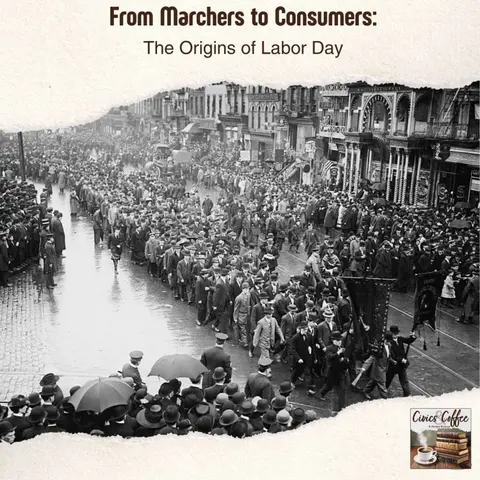
Welcome to Civics and Coffee, a history podcast. The show all about United States history, delivered to you and the time it takes to enjoy your morning cup of coffee. I'm your host, Alicia, a historian trained in United States history with a passion for telling both the known and unknown parts of America's past. So grab your coffee and get ready for some bite-sized history. Hey everyone, welcome back. Earlier this month marked Labor Day in the United States. Celebrated the first Monday in September, the holiday is intended to honor the work and achievements of the American labor movement. Yet, despite these labor activist origins, many Americans spend their day off, if they're lucky enough to have the day off, with friends or family over one last barbecue, or taking in the end of the season sales to replace their dilapidated summer gear. What once started as a quote, monster labor festival, end quote, to demonstrate the power and importance of unions during the Gilded Age has transitioned into something altogether different. And something one former Labor leader saw coming. So this week, I am diving into the origins of Labor Day. When was the first celebration? How did it start? How has it evolved? And how does Labor Day differ from May Day? Grab your cup of coffee, peeps. Let's do this. Industrialization is one of the hallmarks of the Gilded Age, and the rapid spread of factories and factory production meant more and more Americans went from working for themselves to being wage workers, earning their living by working for someone else. Rapid industrialization, however, also meant workers were increasingly facing jobs with longer hours, lower wages, and instability as the economy went through booms and busts. In economic downturns, wage workers were at the mercy of their employers. And in an era before social safety net programs, like unemployment insurance, there was little recourse for employees when they were fired to save the company's bottom line. This tension led to a series of strikes. And in the last quarter of the 19th century, the United States led the world in the number of incidents of class violence and strikes. In the aftermath of the Great Railroad Strike of 1877, American workers of all types realized the importance of organized labor and union membership began to rise. Organizations like the Knights of Labor enjoyed increased membership and new influence to negotiate better working conditions and pay raises for their members. Thus, it is with this background and context that conversations for a day celebrating the power and importance of labor was introduced. There remains some debate as to exactly who initiated the day, either Matthew Maguire of the Machinists and Blacksmiths Union, or Peter J. McGuire, who was the general secretary of the Brotherhood of Carpenters and Joiners. Either way, a number of craft unions in New York banded together to establish the Central Labor Union in 1882 to provide mutual aid and to hopefully move together on larger issues with a single voice. Comprised of roughly a dozen or so smaller unions that came from a variety of backgrounds, one of the first things on the CLU agenda was to sponsor a quote unquote monster labor festival that September. There were several goals in planning the first festival. First, the CLU wanted to unite their members. Second, they wanted to communicate the importance and power of organized labor, despite whatever internal conflicts or disagreements the various groups comprising the movement might have. The day, as historians Michael Cazan and Stephen J. Ross assert, quote, challenged the authority of capitalists and politicians over the social consequences of industrialization, end quote. There were two components to the first Labor Day celebrations in 1882, a parade of workers followed by a picnic. The parade was geared for outsiders, a pseudo-publicity campaign to demonstrate how vital workers were to the nation's economy. The picnic was meant for the workers, a chance for organizers to bring everyone together. Held in Wendell's Elm Park, the picnic proved especially appealing to wage earners since it gave them an opportunity to spend the day playing games, singing, and drinking. The event was a resounding success. Estimates put almost 10,000 marchers, who, starting on Broadway, carried tools of their trade up to 42nd Street. They carried pro-labor banners with them, including signs that read, quote, to the workers belong all wealth, and quote, labor built this republic, labor shall rule it, end quote. The parade grouped participants by trade, and approximately 250,000 New Yorkers were in attendance. To top off the day's festivities, guests enjoyed a fireworks display. The following day, the New York World reported, quote, the great labor demonstration and picnic yesterday under the auspices of the Central Labor Union, composed of the various trade and labor organizations of New York City and neighborhood, was very successful, end quote. The New York Herald focused on the palpable sense of community on display, writing, quote, fellow workers and their families sat together, joked together, and caroused together. American and English, Irish and German. They all hobnobbed and seemed on a friendly footing, as though the common cause had established a closer sense of brotherhood, end quote. Achieving such success with the parade, the CLU went forward with hosting another set of festivities the following year. And in 1884, the Federation of Organized Trades and Labor, soon to become the American Federation of Labor, put out a call for all workers to celebrate Labor Day on the first Monday in September. But why exactly the first Monday in September? What made this day so special? In a source I read that cites Maguire as the driving force behind Labor Day, it claims Maguire recommended that date because it was between July 4th and Thanksgiving, the other two legal holidays in the United States. And in suggesting a day elevating labor, Maguire pointed out the fact that while there were holidays for religious, civil, and military celebrations, there lacked a day honoring the industrial spirit. Official recognition of the holiday was slow and initially done on the local level, starting in 1885 with municipal orders. On February 21st, 1887, Oregon was the first to make it a state holiday. However, legislators failed to follow the preferred date expressed by labor leaders and designated Labor Day as the first Saturday in June, an issue they later fixed in 1893. Four other states joined Oregon in authorizing the day as a state holiday: Colorado, Massachusetts, New Jersey, and New York. Over the next several years, over 20 states would pass resolutions to mark the occasion. And in June 1894, President Grover Cleveland declared Labor Day an official holiday, likely done as a gesture of political goodwill after crushing a nationwide railroad strike. By the turn of the century, most states recognized Labor Day as an official holiday, with Wyoming bringing up the rear and neglecting to recognize the holiday until 1923. Now, like Oregon, just because a state recognized the holiday doesn't mean they followed the plan or schedule prescribed by the labor movement. California, for example, initially tried to put Labor Day in October, so it did not interfere with admission day, which fell on September 9th. But California workers refused to acknowledge that date and continued to recognize the first Monday in September as the true Labor Day. And despite the holiday's intention to honor and celebrate the power of organized labor and unions, many early Labor Day celebrations were not paid. While legislators were happy to pass an ordinance recognizing Labor Day, they were hard-pressed to ensure the workers received a paid day off as a reward for their hard work. As historians Michael Cazan and Stephen J. Ross explain, quote, few businessmen voluntarily gave their employees a day off, and government officials were reluctant to enforce a measure whose political utility had essentially ended with its passage, end quote. Thus, anyone who wished to participate in Labor Day marches or picnics were forced to engage in a one-day strike, which meant losing out on a day's pay and risk losing their job. The celebrations of Labor Day also quickly evolved. What started as a massive parade to demonstrate the power of organized labor eventually turned into more muted, generic displays. By the mid-1880s, the American Federation of Labor had taken over organizing Labor Day events, but after the bombing at Haymarket Square in Chicago in 1886, the AFL grew more conservative and cautious in its outward display of militancy. The organization and other labor leaders wanted to tone down the rhetoric and lean into more patriotic displays in their labor parades and thus actively shut down any references to international symbols. This only served to anger their own constituents, many of whom were newly arrived immigrants, who wanted to push to make Labor Day an international holiday in recognition of the working class. Some of those who were particularly upset and angered about the shift by the AFL decided to host their own separate celebrations and threw their support behind another developing holiday, May Day. Ironically enough, May Day was inspired by the American labor fight over the eight-hour workday. During the International Socialist Congress meeting in Paris in 1889, participants called for demonstrations on May 1, 1890, to align with the announced nationwide strikes planned by the AFL to push for the shorter workday. For a brief period, both May Day and Labor Day celebrations were in a bit of competition with each other in the United States. There was even a push from the Socialist Labor Party to have May Day as the International Labor Day. Although both days celebrated workers, May Day was viewed as attracting a much more militant anarchist element, something that, at least in the 1890s, immigrant communities in New York and Chicago embraced. But again, in the aftermath of Haymarket Square, labor leaders seeking broader support of their movement and looking to maintain political influence were very mindful to avoid any affiliation with anything outside of the mainstream. Now, this didn't stop their constituents from participating, of course. May Day celebrations tended to be in areas of the country where there was a high concentration of newly arrived immigrants who were supportive of pushing for an international day, supporting united class struggle. But Labor Day, of course, was the holiday that won out in the United States, much to the chagrin of the political left, who were highly critical of the day. As historian Donna Haverty-Stack tells us, critics were frustrated about a quote, legal national holiday that accepted the existing capitalist system, end quote. The AFL, who had worked so diligently to paint an image favorable of the American worker in building a holiday in honor of organized labor, quickly lost control of the messaging and the holiday. As economic conditions improved and workers enjoyed higher wages and access to white-collar jobs, they became less interested in spending their extra day off marching in a parade behind their union banner, carrying tools of their trade, instead preferring to spend that extra day taking their family to the beach, going to the movies, or heading off to the horse races. AFL President Samuel Gompers grew concerned about the growing apathy about Labor Day, warning members that without a consistent national demonstration of worker strength through the annual parade, the holiday risked losing, quote, its distinctive character and become a mere holiday for general, meaningless purposes and for the exploitation of private profit, end quote. Samuel Gompers' warning, while perhaps a bit hyperbolic, wasn't entirely off base. Throughout the 20th century and the aftermath of the post-war economic boom, Labor Day evolved into a holiday focused more on consumerism than about celebrating the labor movement. The parades that marked the holiday's origins quietly gave way to end-of-season sales and three-day weekends to the coast, or one final camping trip before the children started school. Unions have used the holiday as an opportunity to remind folks about the importance of organized labor, marching in 1959 to protest President Eisenhower's handling of the economy, and again in 1982 to protest President Reagan's domestic policy agenda. But for many, Labor Day is just another day off. This may have something to do with the fact that organized labor isn't what it used to be. An analysis done by the Brookings Institute found that union participation in the United States has fallen dramatically in the last 40 years, from almost 18% in 1985 to just 10% in 2025. Demands for stronger contracts and higher wages have consistently been criticized, and as historians Michael Cazan and Stephen J. Ross highlight, quote, labor's dilemma of the 1880s still plagues it more than a century later. No matter how accommodating unions have tried to be, the mass media and most politicians and businessmen have never fully accepted them as part of the American consensus. Born out of a growing labor movement in response to rapid industrialization and worker exploitation, the first Labor Day celebrations were notable for building a working class alliance that crossed language, religious, and ethnic boundaries. They promoted the power of organized labor and championed the work of everyday laborers. Yet even a day that was intended to acknowledge the contributions of the American worker did not come with true recognition of and respect for their labor, and unions were forced to fight for paid time off to enjoy their day. Today, of course, many Americans are unaware of the historic origins of Labor Day or the critical impact of organized labor. Perhaps it's time for another parade. As Samuel Gompers once said, Labor Day is not a time for mere merrymaking and personal enjoyment, but a time for pledging anew our faith to our cause and to each other. Thanks, peeps. I'll see you next time. Thanks for sitting down with me as I explore this chapter of American history. If you liked what you heard, be sure to subscribe and share with your friends. I look forward to our next cup of coffee together.
