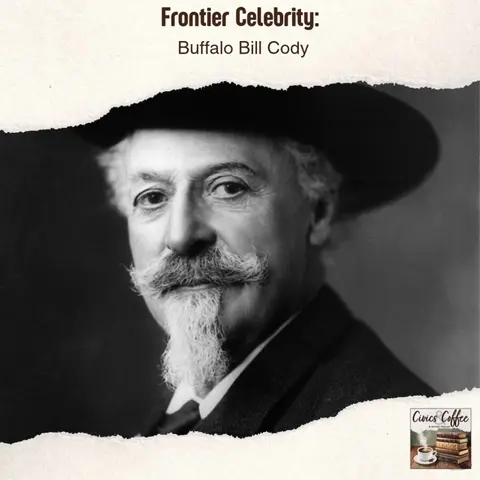
Frontier Celebrity: Buffalo Bill Cody

 RSS Feed

 Castbox

 Podchaser

 Deezer

 Apple Podcasts

 Spotify

 Amazon Music

 Overcast

 Castro

 iHeartRadio

 PocketCasts

 YouTube
Buffalo Bill Cody was one of the most famous Americans during his life time. Born of humble beginnings, Cody reinvented himself into the penultimate icon of the American West. Tune in this week to learn about the rise and fall of William 'Buffalo Bill' Cody and how this complex figure turned himself into a cultural icon that inspired hundreds of dime novels and dozens of media portrayals.
Thought This Was Interesting? Just Wait Until You Try…
Lawless Legends: Wyatt Earp, Doc Holliday & the Shootout at the OK Corral
The American Westerner: Wild Bill Hickok
Larger than Life: The Mystery of Billy the Kid
Want Me To Cover a Topic?
Want More Civics & Coffee?
Sign Up for the Substack
Join the Patreon Coffee Club
Make Sure We Are Connected:
Love Civics & Coffee?
Episode Image Courtesy of Wikimedia Commons.
Welcome to Civics and Coffee, a history podcast. The show all about United States history, delivered to you and the time it takes to enjoy your morning cup of coffee. I'm your host, Alicia, a historian trained in United States history with a passion for telling both the known and unknown parts of America's past. So grab your coffee and get ready for some bite-sized history. Hey everyone, welcome back. Appearing in an article for the Washington Post in 1906, stage performer William Buffalo Bill Cody praised then President Theodore Roosevelt for his apparent appreciation of and commitment to the West. Quote, until the coming of Roosevelt, we never had a president who understood and appreciated the actual conditions of the Great West, end quote. It may seem strange that a news organization sought and published the opinion of an entertainer, but celebrity commentary on current events in politics is not a 21st century invention. Bill Cody was considered one of the most famous individuals in America at the turn of the 20th century. Like so many who made the Western Frontier their home, Cody lived a dozen lives. And thanks to dime novels and a questionable autobiography, he would be made into a larger than life figure. Forced to grow up at the young age of 11 after the death of his father, Cody would go on to work a series of jobs before transforming himself into the ultimate icon of the American West, the character known as Buffalo Bill. But how did it all begin? This week I am diving into the life of William Buffalo Bill Cody. Who was he? How did his stage show get started? And how did he impact our vision of the American West? Grab your cup of coffee, Peeps. Let's do this. The man who would become known for stage shows that romanticized the West was born on February 26, 1846, in LeClare, Iowa, to parents Isaac and Mary Ann Laycock. Father Isaac was originally from Canada, settling in Ohio when he was just 17, and meeting Mary in 1840 as a widower. William was the third of what would become seven children, coming after older brother Sam, who was born in 1841, and Julia, born in 1843. The children came in rapid succession, and by 1853, the Cody's included a series of little sisters, with Martha, Julia, Eliza, Alice, Laura, Ella, also known as Helen, and Mary Hannah, who they called May. Isaac's primary work was that of a large farm manager, and he moved the family to Kansas in 1854 before Congress opened the territory up for settlement. If you remember your U.S. history, then you might recall that this was the site of incredible tension and violence between two opposing views regarding the nation's original sin, slavery. Isaac Cody was a free soiler and wanted the practice outlawed in Kansas, putting him at odds with his pro-slavery neighbors. This tension escalated into violence in 1854 when Isaac was stabbed by a man named Charles Dunn. The wound was severe, hitting Isaac's lung, but did not kill him. It did, however, weaken him, and Isaac suffered a series of setbacks before finally passing away in the spring of 1857. Losing the patriarch of the family was a devastating financial blow, and without any means of additional support and no safety net to speak of, the Cody were in a financially precarious situation and needed to figure out who was available to earn money and fast. Older brother Samuel had previously passed away in 1853 after a fall from a horse, meaning that at just 11 years old, young William Cody was now the man of the house. Cody took the responsibility seriously and began searching for work while Mother Mary took on boarders to help earn extra cash. Despite whatever tension may have existed due to his family's stance on slavery, Cody was able to secure work with a neighbor as an UX team driver, hauling Hay to nearby Leavenworth to sell. He next found work as a messenger boy for the firm Russell Majors, which later became Russell Majors and Waddle, where he carried messages via horseback three miles from the town of Leavenworth to Fort Leavenworth. This experience, while trying and sad, was not all that unique for Frontier families, especially ones who lost their male breadwinners. As historian Lois Warren illustrates, quote, most farm women worked out of their own homes in the 1850s. Their children were often found in the rural workplace. From nine or ten, or sometimes younger, children hired out to other settlers to bring in the harvest, drive horses, or herd cattle or sheep in exchange for cash or services. End quote. In his autobiography, Cody would later claim to have dabbled in a series of other careers, including gold prospecting, fur trapping, and being part of the Pony Express. That latter claim appears to be one of fiction and not borne out by the historical record, but was more of a mechanism used at the time to project an image of a character Cody had been hard at work developing. In 1863, Cody's mother passed away, leaving Cody and his siblings alone in the world. The following year, in 1864, Cody signed up for the 7th Kansas Volunteer Cavalry as a private, where he served for 18 months in the Civil War. According again to his autobiography, Cody spent this time as a scout and spy. Claims that some historians caution should be treated with a healthy dose of skepticism. Based on official records of Cody's time with his unit, the young soldier was actually assigned to hospital duty and delivering messages. This, combined with the fact that the spying claims put forth in his autobiography were similar to ones about Wild Bill Hickok that were circulating around the same time, make his claims highly questionable. Post-Civil War, Cody married Louisa Federici in St. Louis in 1866. Their union would prove to be a rocky yet durable one, lasting more than 50 years and producing four children. The new Mrs. Cody was the daughter of a wealthy merchant and came into the marriage expecting a certain lifestyle, which brought tension into their relationship. As the couple settled in Kansas, Cody tried his hand at more traditional occupations, such as transforming his mother's old home into an inn called the Golden Rule House, which ultimately failed due to financial mismanagement, something that would plague Cody throughout his various business ventures. Cody worked a series of odd jobs to help pay the bills, including signing up at the military, where he started as a hunter in 1868, before transitioning to a guide and then a scout, where he earned about $75 per month. Scouting turned out to be a lucrative, consistent source of income for Cody, which he maintained until 1872, and consisted of Cody helping troops through various localities and carrying messages between the myriad forts and outposts that dotted the frontier. Cody's work with the military meant that he was present during the various clashes with the Plains tribes, and he took part in several fights, eventually receiving a Medal of Honor from the U.S. government for his service as a civilian scout. Amid his scouting work, Cody also took on work for the Kansas Pacific Railroad, work that likely earned him his nickname of Buffalo Bill. One of Cody's self-proclaimed achievements was the slaughter of over 4,000 buffalo, which he did to feed the men who were working in service of the rail. He also apparently took on side work helping wealthy clients enjoy a cheap thrill with hunting and killing the animal, and the world would later learn of his moniker in 1869 when EZC Judson, writing under the pen name Ned Buntline, decided to write about Cody in Buffalo Bill, King of the Bordermen, which appeared in New York Weekly and inspired the dime novels that would flood the market in future years. Buntline is also the man to thank for getting Cody onto that first stage. In 1872, Buntline invited Cody to Chicago to appear in a play, a little western drama, where Cody was to portray a highly dramatized version of himself. The show, titled Scouts of the Prairie, was reworked to accommodate Cody's lack of acting experience, but critics were not that impressed. Despite the critical reception, audiences seemed to love Cody's natural storytelling abilities, and the show was a success. This seemed to trigger an idea in Cody's mind, and a year later, he parted ways with Buntline to form his own touring company. Cody brought in other authentic Western Frontiersmen like Wild Bill Hickhawk and Texas Jack, and over the next decade, Cody toured the country, mixing up cast members, only breaking during the summer months so that he could head back to serve as scout or as a hunting guide. As the theatrical group toured throughout the country, Cody incorporated dramatized experiences from his life into the show, such as his active revenge for the death of General Custer during the famous Last Stand in 1876. Cody, whose relationship with Custer was not as deep as he made it appear, killed Cheyenne Warrior Yellow Hare on July 17, 1876 at Warbonnet Creek, taking the self-proclaimed first scalp in revenge for Custer's death. Word of this spread and brought Cody immediate attention, as the scalping happened just a few weeks after Custer's death at Little Bighorn. Cody saw a golden opportunity in the notoriety and parlayed it into a new play that would include a reenactment of the fight between he and Yellow Hare. The show called The Red Right Hand, or Buffalo Bill's first scalp for Custer, was kind of a mess of a show. Adding to the ick was the fact that Cody displayed artifacts from that day, such as the headdress worn by Yellow Hare, to promote the show. Cody stopped performing the show in 1877, perhaps as a direct result of the onslaught of negative attention it received. In 1879, Cody published his autobiography, The Life of Honorable William F. Cody, which is a bit of a misnomer, as the book is filled with as much myth as it is fact. The book was likely intended to further promote this persona of Buffalo Bill than it was to recount the mundane details of the early life of William Cody. And thus, while there is some truth peppered throughout the text, readers should exercise a bit of caution as they read Cody's take on his life. The Cody family relocated to North Platte, Nebraska in 1882, where Cody organized a 4th of July celebration that was the next iteration of his stage show. Described as a precursor of sorts to today's rodeo, the Old Glory Blowout, as it was known, included demonstrations of horsemanship and other aspects of cowboy culture. The following year, Cody partnered with Nate Salisbury to form Buffalo Bill's Wild West, a show that would run in some form for the next 33 years and solidify Cody's place in the American memory as the icon of the West. Cody and Salisbury set out to create a truly one-of-a-kind experience, and the Wild West show seemed to deliver. Parts of the show included demonstrations of markmanship, bucking horses, and races. It helped make stars out of people like Annie Oakley and Johnny Baker, and included several indigenous individuals, including Sitting Bull, who spent four months in the summer of 1885 as a member of the troupe. The show became so successful that Cody was able to take the Wild West overseas to Europe in 1887, where he performed in London, where over two million people paid to see the Western Sensation. Cody's celebrity status only continued to rise, and the show would travel throughout Europe, including in 1890, where the Wild West performed in Belgium, Germany, Scotland, and France, among other European countries. While Cody made a substantial sum from the Wild West show, he was a speculative investor, and his investments usually wound up going bust. The cost of putting on the show, which required three train cars to move the cast, props, animals, and equipment, was quite expensive to put on. Poor investments and the lack of cash reserves meant that Cody was never in a position to fund the operation on his own, all but requiring partnerships. But partnerships are where things can get messy. One such partner, James A. Bailey, died in 1902 and left the show in a financially weak position and put Cody in the spot of having to borrow money. This eventually led to the show's bankruptcy in 1913 and forced Cody into working for what amounted to a circus act, detracting from his legacy as a performer. Adding to the fall from Grace, in 1904, Cody sued his wife Louisa for divorce over claims that she tried to poison him. As a result, his unscrupulous actions throughout their marriage came to light, including his extramarital affairs and his tendency to drink heavily. This information becoming public, with Cody being one of the most well-known Americans at the time, did little to help repair his reputation, though he maintained his ability to perform and was still featured in dime novels. His divorce request was later dismissed by a judge, and the couple remained friendly until his death. Regardless of whatever trouble he may have had with investments or brief blips of public relations snaos he weathered, Cody still has a town named in his honor in Wyoming, founded and established by the performer in 1896. And he is credited with inaugurating the playing of the Star Spangled Banner before public events, before the song became the national anthem in 1931. William Buffalo Bill Cody passed away on January 10th, 1917, in Denver, Colorado, at the age of 71 at his sister's home. He is buried on Lookout Mountain next to his wife Louisa, who joined him in 1921. William Cody was a complex individual who represented a series of contradictions. As historian Lewis Warren tells us, quote, in a time when America represented the future of the modern world in its exploding cities and its industrial power, Buffalo Bill brought together the wild, primitive past of the American frontier and the astonishing promise of a technological future, end quote. In his 71 years, Cody enjoyed the greatest heights and plummeted to the lowest depths, creating and personifying the myth of the American West and the process. Forever the showman, Cody's legacy lives on, in the physical town bearing his name, and in our perpetual fascination with the frontier and the West. Thanks, peeps. I'll see you next time. Thanks for sitting down with me as I explore this chapter of American history. If you liked what you heard, be sure to subscribe and share with your friends. I look forward to our next cup of coffee together.
