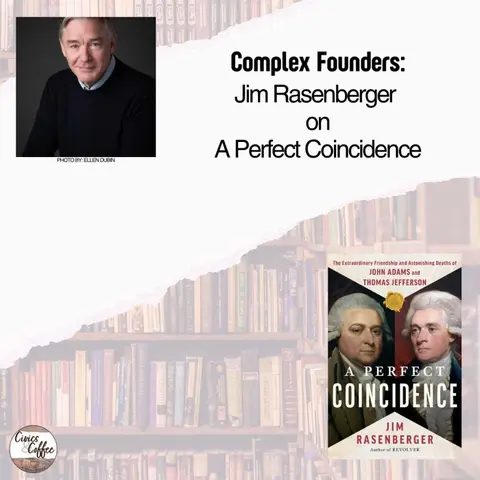
Complex Founders: Jim Rasenberger on A Perfect Coincidence

 RSS Feed
 Deezer
 Apple Podcasts
 Spotify
 Amazon Music
 Overcast
 Castro
 iHeartRadio
 PocketCasts
 Castbox
 Podchaser
 YouTube
 John Adams and Thomas Jefferson are two of the most notable men of the founding era - as is their complicated and occasionally fraught relationship. Join me as I sit down with Jim Rasenberger to discuss his latest book A Perfect Coincidence which explores their friendship, political differences, and what lessons we can learn from their reconciliation.
To learn more about Jim, check out his website: jimrasenberger.com
To grab your copy of A Perfect Coincidence, consider shopping at my affiliate link on Bookshop.org here.
Welcome to Civics and Coffee, a history podcast. The show all about United States history, delivered to you and the time it takes to enjoy your morning cup of coffee. I'm your host, Alicia, a historian trained in United States history with a passion for telling both the known and unknown parts of America's past. So grab your coffee and get ready for some bite-sized history. Welcome back, everyone. As we continue to reflect on the country's 250th anniversary, there are new opportunities to discuss the founders and evaluate their relationships, both what they meant to the country and to each other. My guest today did just that. I hope you all enjoy the conversation. Hello everyone. Joining me today is Jim Rassenberger. He is an author whose work has been featured in the New York Times, Vanity Fair, and The Smithsonian. He has also written several books, including A Perfect Coincidence: The Extraordinary Friendship and Astonishing Deaths of John Adams and Thomas Jefferson, which will be the focus of our conversation today. Welcome, Jim.
SPEAKER_00Great to be here. Thanks for having me.
SPEAKER_01Thank you so much. I want to dive on in and ask what prompted you to write about the famed relationship between John Adams and Thomas Jefferson at this moment.
SPEAKER_00Well, first of all, I I've always, really always wanted to write about them. I mean, I j I joke in the book that this book was 50 years in the making because I really first became aware of both of them and of the relationship when I was 13 years old. And it was the Bicentennial. This was 50 years ago. And I read the first serious biographies I ever read. One was of Adams and one was of Jefferson. And I was fascinated by both men and fascinated by their friendship. So they've always been on my radar. I wrote, as you mentioned, a number of other books in the meantime. I didn't start this book because of the 250th, believe it or not. I wasn't thinking, oh, I'm going to peg this to the 250th. I just thought I got to write about these guys. And then it occurred to me, duh, there's this big anniversary coming up. You know what really does fascinate me about them, and why I think now is an interesting moment is yes, it's the relationship. I think it's one of the great American early stories out of early American history, this 50-year friendship that became an enemieship at times, and then a friendship again. But also the men of their death. They both died on the same day, and this day was July 4th, 1826, which was the 50th anniversary, the 50th birthday of the Declaration, the Jubilee that Americans were celebrating at the time. At the time, it was seen as a miraculous event that this happened, that the two men most responsible for the Declaration, Adams as the chief advocate for independence, Jefferson, of course, as the author of the Declaration, died on the same day, and that this day was the 50th birthday of the Declaration, blew people's minds. And I think it had a pretty profound effect on American history afterwards. This you know, there always had been this idea in the United States that we were kind of a blessed nation, a chosen people, goes all the way back before we were the United States to the Mayflower. The idea that we were a chosen people. And this sort of confirmed that when that this miraculous seeming event occurred when these two men died, the perfect coincidence, which is the title of my book.
SPEAKER_01Yeah. Well, and you know, as you mentioned, these are two towering figures of the early American story. And so you have uh a major task ahead of you in in kind of building this narrative. So how did you balance writing about two major figures of the founding era while also trying to pay special attention to the connection that they shared throughout their lives?
SPEAKER_00Yeah, I mean, I can't pretend that I'm writing a full biography of each man. Each has had multi-volume biographies written about them and many biographies, many wonderful biographies. I'm really focusing on their relationship. Uh because I it's this 50-year relationship they had. And I think it's a great way to see either of them because they they kind of evolved in response to each other. I mean, they, you know, Jefferson's ideas were were in many ways a response to Adam's ideas and vice versa. They had very different, as they discovered, very different ideas about how government should be formed. Adams thought government should be very strongly structured, that the federal government should be relatively strong. He was a great believer in checks and balances. Jefferson really was concerned about the idea of a strong federal government. He thought government should be very diffuse, it should be local, the less government, the better. They didn't really discover this until well into the relationship, but they they sort of positioned themselves in response to each other. So I think you learn a lot about each man in the relationship. But I really am to answer your question, I'm really focused on the relationship in this book, not on their entire lives. Yeah.
SPEAKER_01Yeah. Well, and you know, you mentioned they are different men, right? So can you talk a little bit about the evolution of their early partnership and those initial first impressions?
SPEAKER_00Yeah. So they they met in Philadelphia during the Second Continental Congress. They first met a year before the Declaration in the in the spring of uh 1775. This is when Jefferson arrived in Philadelphia. Adams had already been there for quite a while. They both knew of each other. Uh, everybody knew of John Adams and his his cousin Samuel Adams. They were kind of the chief instigators of the rebellion. That's how they were seen anyway. And Jefferson had a reputation already because he'd written a pamphlet while in Virginia that many of the delegates to Congress had read. So they knew of each other. I don't think they initially saw each other as friends, more as allies. They both knew that they won, that they thought independence was a good thing. We have to recall at this time many delegates in Congress were adamantly opposed to breaking from Britain. They thought it was a very risky thing to do. Adams and Jefferson quickly realized that they, you know, that they were allies in this. Now, what's funny about them is you cannot imagine an odder couple in American history than Adams and Jefferson, where Adams is uh, first of all, their friend Benjamin Rush called them the North and South Poles of the American Revolution. So Adams is from the North, he's from Massachusetts, Jefferson's from the South, he's from Virginia. Uh physically, they're very different. Adams is 5'7, he's portly, he called himself short, thick, fat. Those are his own words, where Jefferson's uh six foot two, tall, slender, handsome, and then their temperaments are completely different. Uh Adams is pugnacious, he's quarrelsome, he's very good at making enemies. Jefferson's a very charming guy, gets along with people very well. So these are very different men, but you can see that they work together well, and they realize this. They're two, their abilities and their talents come together uh quite nicely uh in gaining independence in 1776.
SPEAKER_01Yeah. And then they're reunited in on diplomatic missions overseas in Europe. So how does that kind of expand the relationship between these two men?
SPEAKER_00Aaron Powell Yeah. So after 1776, they go their separate ways. Uh Jefferson goes back to Virginia. Adams is sent by Congress to France to join Benjamin Franklin in a diplomatic mission to France. For eight years, they they really are apart from each other. And then Jefferson is sent by Congress to join the same diplomatic mission. So you've got Jefferson, Adams, and Franklin in Paris together. And this is when Adams and Jefferson really start to become very good friends. Not just Jefferson and Adams, but also their families. Abigail Adams, the wife of John Adams, becomes very close to Jefferson during this time. Adams' children are there, including John Quincy Adams, the future president of the United States, who's 17 years old at the time and adores Jefferson. So they they spend a lot of time together doing things as families. Later, Jefferson stays in Paris. Adams is sent to London to become the first ambassador to the Court of St. James from the United States. But even then, they're very close, very in close touch, and Jefferson goes and visits Adams in England. They go on this wonderful road trip together, this uh into the English Midlands on this garden tour. They are good friends by the end of this. Um, and it's only when they come back to America that they really understand that they have very different ideas about government.
SPEAKER_01And so while your book does focus on Jefferson and Adams and their relationship, you do also explore another key figure of the founding era, which is Alexander Hamilton. So can you share a bit about Hamilton and how his relationship with Jefferson and Adams kind of stood in stark contrast with the one that he enjoyed with Washington?
SPEAKER_00Yes. I just mentioned that when Adams and Jefferson came back to the United States, they discovered they had very different views of government. But one thing they always agreed on is that they hated Alexander Hamilton. Hamilton was I mean, first of all, he just acted like he owned the government. I mean, he was an extremely assertive guy, absolutely brilliant, and he was in Washington's favor in a way that nobody else was. And for Jefferson, Hamilton represented everything that he feared in national government. He saw Hamilton as trying to uh almost have a monarchy in the United States. Hamilton had a program, it certainly wasn't for a monarchy, but it was a very strong national program. He wanted the national government to assume the debt of the states. He wanted a national bank. He wanted a national industrialization program. He wanted these things that for Jefferson seemed almost authoritarian. Adams was more in agreement with Hamilton about a number of things, but he still didn't like the idea of a national bank. And he really did not like the idea of Alexander Hamilton, nor, for that matter, did Abigail Adams, who just saw him as being having the devil in his eyes. So it's it's interesting how they both very quickly identified Hamilton as somebody they did not like. And Hamilton later became Adams, even though they were ostensibly in the same political party, the Federalists, Hamilton was one of Adams' great enemies later on.
SPEAKER_01Well, and so the Adams and Jefferson had this strong relationship. You you kind of intimated, right, it does turn into frenemies uh uh later in life. And so how did the Rights of Man controversy kind of crack the foundations of the camaraderie Adams and Jefferson?
SPEAKER_00Aaron Ross Powell, yes. So by this point, uh The Rights of Man by Thomas Paine comes out in the spring of 1791. It's a year after Jefferson has returned from Paris to become Secretary of State. Adams is vice president under President Washington. And by this point, they they realize that they have different views of government. Adams then writes a series of essays that are published in newspapers, in which he lays out his views of government. And what he's trying to say is that there are going to be in any society the haves and the have nots, the powerful and the not powerful, the aristocracy and the common people. That these are inevitable things in any society. Now, the way Jefferson and others like Jefferson, who share his point of view, read Adams' essays is that he's recommending aristocracy. Adams wasn't really. Payne publishes this book, this pamphlet first in England, and then copies come over to the United States. Jefferson ends up with one of these copies and he reads it, and then he is asked by a printer in Philadelphia to give him the copy because this printer wants to make American copies of the Rights of Man as a printer in Philadelphia. So Jefferson forwards this copy of The Rights of Man to the printer in Philadelphia, and he does it with a note attached. Now, whether he meant this note to be published is unclear. He claimed he did not ever mean this note to see the light of day. It was just a personal note to the publisher. And he was saying, thank you so much for doing this. It's a good response to some heresies, that's the word he used, that have appeared recently, political heresies. Well, everybody knew that he was referring to John Adams and the things John Adams had been writing. And it was the first real divide you see publicly in the government of George Washington, where you have these one group of people on the one side, represented by Adams in this case, and also and then this other group represented by Jefferson. And Adams always felt that Jefferson kind of um threw him under the bus here, that he he very unfairly um described his views. And to the day Adams died, he felt like Jefferson had had hurt him in the way that he presented his views. Adams gets a lot of the blame himself for writing unclearly, for kind of uh one one historian, Joseph Ellis, said that Adams tied the can, the tin can marked monarchy to his own tail. And that's true in a way. Adams invited this almost, uh, but it upset Adams greatly. And it and it started to define the political divide in the United States going forward from the spring of 1791.
SPEAKER_01Well, and just several years later, 1796, John Adams is elected to the presidency, Thomas Jefferson is vice president. So that ultimately proved to be kind of a bridge too far for these two men. So can you talk a little bit about why they just couldn't seem to reconcile their differing views given their shared history?
SPEAKER_00Yeah, and they, you know, there there seemed almost to be a moment when they could. Uh shortly after Adams was elected to be the second president, and Jefferson, as you said, became his vice president by getting the second most votes. That's how it was done then. So even if they were in different political parties, it simply was the man who got the second most votes became vice president. There was some talk that maybe they could mend their differences and uh and almost have almost kind of a shared presidency going that would take them back to the days of the Declaration. Abigail Adams was somebody who thought that they might uh do this. The problem was that by this point, it wasn't just the two of them. They each had sort of factions they represented. And just like today, you have people on the far ends of these factions who don't want there to be any reconciliation. It's not in their interest. Um, for example, Jefferson wrote this very nice letter to Adams after Adams became clear Adams was going to be president, in which he said, I'm I hope to get along with you. We're gonna work together well, all these very nice things. But he first sent it to James Madison and said, What do you think of this letter? If you agree I should give this to Mr. Adams, please do so. If you think it's a mistake, bury it. Madison decides not to give it to Adams. And the reason he does that is he doesn't, he says, Well, you know, we may have big differences later. Let's not start off on the wrong foot. If by the wrong foot, he meant let's not be too cozy with each other here. So for a few days, that you know, at the beginning of Adams' presidency, they do get along, they meet, they it seems like they can they can agree on a lot of things, but rather quickly uh the divide comes back in and they become even worse enemies. I mean, if we think we have it bad now, it was much worse than the sort of the backstabbing and the political infighting. Jefferson hires a journalist named James Callender to write scathing critiques of Adams. Adams signs the Alien and Sedition Acts. The Sedition Act put a number of Republicans, that's Jefferson's party, into jail and very well could have put Jefferson himself into prison if Adams had ever known what Jefferson was up to behind his back. So it gets it gets really brutal between these guys during Adams' presidency.
SPEAKER_01Well, and kind of the antithesis to Madison is a gentleman by the name of Benjamin Rush. And so several years later, Benjamin Rush comes in and tries to mend the fences, so to speak. So can you can you talk about Benjamin Rush and kind of how he factors into the men's eventual reconciliation?
SPEAKER_00Yeah, Benjamin Rush, I think, deserves more credit than he gets in American history. I mean, he he's the guy I mentioned earlier who described them as the North and South Poles of the American Revolution. He was a signer of the Declaration. Well, he so I, you know, I I we ended, I ended the last question by saying, you know, they they become these great bitter enemies. Well, then Jefferson defeats Adams to become the third president and kind of humiliates Adams. Adams goes back to his home in Quincy, Massachusetts, sort of licking his wounds, writing these letters about how Jefferson is going to destroy the country. And for a decade, they really have nothing to do with each other, Adams and Jefferson. But one day, uh in 1809, Benjamin Rush has a dream. And he writes to Adams about his dream. And he describes it that in this dream, he sees Adams and Jefferson reconciling and having a long correspondence, and then, as he puts it, sinking into the grave at the same time, rather incredibly. Adams writes back and goes, Yeah, dream odd, pal. This is never going to happen. And but Jeff, but Rush goes back and forth between Adams and Jefferson, trying to encourage them to get back in touch with each other for their sake, but also for the sake of the country. He says this would be a good thing for America to see the two of you who have been good friends and then so opposed to each other reconcile. Finally, Adams on New Year's Day, 1812, picks up his pen and writes a letter to Jefferson. It's a sort of awkward letter, but it's friendly. Jefferson writes back. And there begins this extraordinary correspondence, goes on another 180 letters, one of the great American correspondences in history. And they become closer and closer through the course of this. They never meet again in person, but they, through these very intimate letters, they talk about everything. They talk about religion, politics. They talk about government, of course. They talk about their personal lives, their grandchildren, the various griefs that they've suffered. And uh by the by the end of it, they are very close. They have a real love for each other. So it's it's this beautiful story, I think, of reconciliation.
SPEAKER_01Yeah. Well, and I know, you know, you you mentioned at the top that uh you didn't set off to write this kind of with the idea of the 250th in mind, but you know, we are here. We're in the 250th anniversary uh of the of the Declaration of Independence. So how does the relationship between Adams and Jefferson maybe reflect a little bit differently as the nation is in the midst of its 250th?
SPEAKER_00Well, I think given given where we are now in American history, which is we have so much conflict. I mean, but there's always been conflict. I think one thing you learn in the just story of Jefferson and Adams is this isn't new. There has been a lot of political conflict, and we have gotten through it. And that's you know, that's one thing. And then There's also the fact that they reconcile that there are ways through this. Uh Adams has this great line that he said to Benjamin Rush's, we shall blunder through. I mean, that was his view of how, you know, it's not going to be pretty, but we can make it. We can endure things as Americans, even what seem to be irresolvable conflicts. I think in the 250th, it's worth looking more closely at John Adams. I mean, Jefferson sort of won the battle in history. He really got more credit. He's the one with the monument on the mall in Washington, not John Adams. Adams, though, I think if we if we look at what John Adams was recommending, he was saying, listen, you've got to be careful, Americans, that you have a government that is very carefully structured to withstand tyranny. And what that means is you need a balance of powers between the legislative branch, the judicial branch, and the executive branch. And if you let one get more power than the others and they don't keep each other in check, you're in danger of tyranny. And I think that that checks and balances are something we should always keep in mind because I think, you know, anybody can look now and maybe whatever political view they have, things have gotten a bit out of balance. So I see John Adams as having a lot to tell us about where we are now, in some ways, more than Jefferson has to tell us. Jefferson played a very important role in our pursuit of liberty as Americans, our aspiration for certain things. But Adams is there to tell us, listen, you've got to go back and fix your house, you know, and and make sure you have a government that is well structured and that can withstand tyranny. Because we you can see things getting sort of out of whack in different directions right now in a way that they haven't for a while.
SPEAKER_01And what do you hope readers take away from the book?
SPEAKER_00I hope readers take away the caution that Adams has for us, but also the hope that Jefferson has. Adams was a continual pessimist and was always warning us to mend our house. And Jefferson was this perpetual optimist who who had great hopes for us. And we as Americans inherit both of those traditions. The pragmatic tradition of Adams and the aspirational tradition of Jefferson. And I think we want to hold on to both of those. And I hope that as we do that, we also see the reconciliation as a model for what maybe we can achieve despite our profound differences. And I also, you know, have to put in a word for Benjamin Rush. I think that Rush, you know, we it's the people who are the loudest who often get the most attention. But it's the Benjamin Rushes, the reconcilers, should get more attention. We need them in our country. We need people who are going to try to mend fences and not just shout from either end of the political spectrum. So I, you know, there are a number of messages that I hope we can take away, but certainly one of them is to try to find ways to mend fences and not just shout at each other.
SPEAKER_01Well, and where should people go when they've finished reading your book and they want to learn more about you and the work that you do?
SPEAKER_00Well, I would invite people certainly to go to my website, jimrasenware.com. It's got links to all of my books, descriptions of all of my books. I've written five books of American history, and it has some other things on it too. Um so that would that would certainly be an easy one-stop shopping kind of place to go just to find out more about what I've written.
SPEAKER_01Lovely. And before I let you go, is there anything that we haven't discussed that you want future readers to know?
SPEAKER_00Uh no, I think we've we've really sort of hit it. And I I, you know, I want readers to uh have a, I suppose, a if they read the book, to take away what I take away from it, which is a sense of of hope um for America's future, because of course we made it to 250. I don't think Adams and Jefferson would have taken that for granted. They thought we were going to have a lot of problems, and indeed we have over the last 250 years. But I hope they take a message of hope for how we can build on what we've done so far and go into the future together as a as one people.
SPEAKER_01Well, on that sentiment, to the listeners out there, a perfect coincidence is available now and is a book primed for the country's 250th anniversary. Thank you again, Jim.
SPEAKER_00Thank you so much for having me. That was fun.
SPEAKER_01My thanks again to Jim for spending his time with me. To learn more about Jim and his work, be sure to check out the show notes for the episode. Thanks, peeps. I'll see you next time. Thanks for sitting down with me as I explore this chapter of American history. If you liked what you heard, be sure to subscribe and share with your friends. I look forward to our next cup of coffee together.
