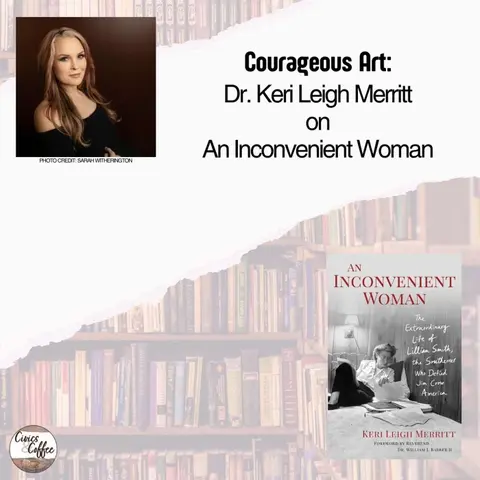
Courageous Art: Dr. Keri Leigh Merritt on An Inconvenient Woman

 RSS Feed
 Castbox
 Podchaser
 Deezer
 Apple Podcasts
 Spotify
 Amazon Music
 Overcast
 Castro
 iHeartRadio
 PocketCasts
 YouTube
 Lillian Smith was a best-selling author whose courageous decision to stand for civil rights in the Jim Crow south led to her erasure from discussions about influential leaders of the movement. Join me as I sit down with historian Keri Leigh Merritt whose insightful biography seeks to pull Smith from the shadows and highlight the ways Smith challenged societal norms and contributed to the early fights against racism.
To learn more about Dr. Merritt, visit her website: https://kerileighmerritt.com/
To learn more about the Poor People's Campaign, click here.
To buy a copy of An Inconvenient Woman, consider shopping at my affiliate storefront through bookshop.org here.
Welcome to Civics and Coffee, a history podcast. The show all about United States history, delivered to you and the time it takes to enjoy your morning cup of coffee. I'm your host, Alicia, a historian trained in United States history with a passion for telling both the known and unknown parts of America's past. So grab your coffee and get ready for some bite-sized history. Welcome back, everyone. In 1960, former First Lady Eleanor Roosevelt wrote in her book You Learn by Living that we do not have to become heroes overnight. Just a step at a time, meeting each thing that comes up, seeing it is not as dreadful as it appeared, discovering we have the strength to stare it down. In writing her biography of Lillian Smith, Dr. Carrie Lee Merritt demonstrates the fortitude it took to be courageous in an era not yet ready for racial justice and what it cost. I hope you all enjoy the conversation. Hello, everyone. Joining me today is Dr. Carrie Lee Merritt. She is a historian and writer whose work has appeared in outlets including CNN, Smithsonian, and The Hill. Her most recent book, An Inconvenient Woman, The Extraordinary Life of Lillian Smith, the Southerner Who Defied Jim Crow America, is a powerful and insightful look into the prolific author and will be the focus of our conversation today. Welcome, Dr. Merritt. Thank you so much for having me. Thank you so much for coming on. So let's jump right in. How did you come to researching the life of Lillian Smith?
SPEAKER_00So I am a Southerner, you know, born and raised, lived my whole life here, Mississippi, Georgia. I was always a big reader growing up, and I thought I had read every Southern writer, you know, around, especially the women writers. And once I got to graduate school, and I I'm a historian, so you know, I'm in the history program, but I came across Lilane Smith's name in one of the books I was reading and realized I had never really even heard of her, and that she was a best-selling author who had sold over three million copies of Strange Fruit Alone. And I started reading her novels at first and then her nonfiction and realized exactly why I had never heard of her, right? Because the things she was saying were so applicable to today and so necessary, I think, in a way that we really haven't dealt with the psychological aspects of our history of white supremacy and racism in this country. And I think that is really the main reason that she has largely been erased from history, although as we will get into it more and more, her sexuality certainly played a role as well.
SPEAKER_01Well, and her life is so multifaceted and so rich. So can you share a little bit about her youth and how influential her upbringing was in establishing what became some pretty progressive views?
SPEAKER_00Sure. Yeah. So Lillian was born on December 12th in 1897. So really, you know, we're we're talking about a while ago. And if you think about her parents were actually both born during the Civil War, during the middle and the last years of the Civil War. So that's only how far removed she was. Literally, her mother was raised and reared by an enslaved woman. And so she comes from wealth, obviously, to be well educated at that time. She would have come from wealth. Her father uh actually was middle class, but by marrying her mother, who came from a very well-established, uh wealthy, you know, her her grandfather on her mother's side owned a big plantation. I don't, I could not find exactly how many enslaved people they owned, but it was quite a few, um, making them some of the richest people in the region. And so once Calvin Smith married Anne, you know, his his kind of destiny was was cemented in wealth, and he opened lumber mills down in northern Florida, in Jasper, Florida, and raised a big family. They had 10 children, nine of them living. Lillian was the seventh, and they were a very strict Methodist family. She was raised very religiously in a kind of culture that a lot of evangelical Southerners understand, where there was kind of no dancing, no uh drinking, you know, everything was a sin. Uh, but the flip side of that was that her father really practiced a kind of Methodism that was almost akin to what Martin Luther King Jr. uh you know termed Christian socialism, which was kind of practicing the golden rule to everyone that he met. And this was seen a great representation of this, of her father's kind of egalitarianism, not only in regards to anybody uh regardless of race, class, gender, but Lillian's book, and this is her sixth out of seventh book, Memory of a Large Christmas, describes a Christmas in her late teens when her father literally invited the local chain gang to Christmas dinner and had the entire Smith family prepare and work on dinner for you know days on end to feed these prisoners. And literally, you know, there were rapists, murderers, and he gave them a very powerful lesson in that you don't judge other people, right? You you everybody makes mistakes, everybody that's human to make mistakes and that you treat people the way you want to be treated. So she was she was raised in these kind of, you know, very uh what seems like uh would be like a dichotomy, but it actually melds in this really kind of wonderful way for her. Uh in being raised as a you know, wealthy white southerner in that time period, that she had the ability and even the education uh opportunities to really question white supremacy and question the racism that she saw around her. And her parents didn't practice that kind of you know really vicious, violent racism.
SPEAKER_01And you you mentioned in uh your previous answer about Lillian's sexuality, and I, you know, I think that comes through very, very clearly in your book as perhaps another reason why Lillian was perhaps able to kind of see through some of the issues in the South. And so can you talk a little bit about Lillian's relationship with her partner Paula and and how it challenges maybe common wisdom about the LGBTQ experience in the early 20th century, especially in the American South?
SPEAKER_00Sure. Yeah, that uh this is uh one of the most compelling parts of Lillian's life, I think. And to give a little bit of context, so you know, her father was running these lumber businesses in Jasper, Florida. And then what happened was with World War I and the shipping blockades, it basically put him out of business and they had to sell all their assets in Florida. And he had had a summer investment up in basically the northeast corner of Georgia, the far northeast corner of Georgia, which is actually technically in Appalachia, the Blue Ridge Mountains, beautiful, beautiful area. And so a lot of people down, you know, in the really hotter regions of Georgia and Florida would go up to summer in the mountains there, in the Appalachian Mountains, to just kind of cool off and not be around the mosquitoes. And so he had property up there. And when everything went bust in Florida, they kind of moved back up there. Uh, that's where Lillian went to school, to college at Piedmont University up in North Georgia. And they made Rabin County in the little town of Clayton their home. And Calvin started really the first camp for girls, the summer camp for girls in Rabin County. It was called Laurel Falls. And Lillian, after college, actually went to teach at a girls' school in China for three years and taught there until 1925. And in 1925, Calvin's health was failing. He needed somebody to take over this camp. And so Lillian decided she'd come over and take it over and eventually buy it from him. And she ran the camp from 1925 until 1945. And Paula Snelling, who had actually a very similar background to Lillian, she came from South Georgia to she was born into a very wealthy family. Her grandparents owned enslaved people. She was, because she came from this kind of wealth, she was afforded a great education, college education. Paula actually went to Columbia and got a master's in Columbia University in New York in teaching and writing. And she was just an amazing mind and writer herself, an incredible literary critic who could have written many, many books on her own, but she kind of ends up devoting her life to Lillian. But anyway, so Paula was actually already employed at Laurel Falls under Calvin Smith, and she taught horseback riding and some of the sports and also English literature. And so she worked for him during the summers and then would go back to near Macon, Georgia, her family home, and work as a teacher during the year. And so Paula and Lillian had met early in the 1920s when Lillian would be visiting home, but they never really talked. And so when Lillian finally moved back from China and was riding literally the train to go to go to Clayton, she saw Paula and they struck up a conversation. And literally from that day, the two fell madly in love and basically were together the rest of their lives until Lillian died in 1966 from breast cancer. And Lillian's work, I argue in this book, would not have been possible without Paula. Paula was not only her editor and her secretary, but you know, she she really talked through all of her ideas with Paula, all of her intellectual frameworks, all of her philosophy, uh psychological Freudian questions. She talked over with Paula. Paula was amused, Paula kept her organized, Paula was her nurse when she was suffering from cancer for 13 years. So all of Lillian's success really would not have been possible without Paula. And Lillian actually dedicates Strange Fruit to Paula. And you know, I argue in this book that far from being closeted lesbians, they actually lived. They weren't going around shouting from the rooftops that they were in a relationship, but but their family and friends certainly knew that they were in some kind of relationship. They treated Paula like they would a spouse whenever they would write to Lillian, they would ask about her, inquire about her. People came and stayed with them for long periods of time and they hosted them together, you know, as mutual hostesses. And so I argue that this is a very different portrayal of what LGBTQ life was like in the South, you know, in the mid-20th century. And really, if you look at the little mountain that they lived on, it's called Old Screamer Mountain in Clayton, right outside of Clayton, there was actually several, several uh gay and lesbian couples that lived on that mountain, and they really had their own little community, which is a whole story in itself, and and more work needs to be done on this kind of openness that you know, in these rural areas, there's actually a lot of autonomy. People just kind of leave you alone and and accept your quirks and let you kind of live your life.
SPEAKER_01Yeah, no, that was uh an amazing part of the story and something that I was uh pleasantly surprised to read about. So I I thought you crafted it quite beautifully. And so you talk about the camp. Lillian ends up taking over the summer camp for her father for several years and and runs it and and kind of makes it her own. So how did this camp kind of break from the norm and shape the local community?
SPEAKER_00This camp is really Lillian's primary foray into not only becoming a writer, but also really learning how to communicate with people and teach people about racism and white supremacy and how to combat it. And you really see the genesis of everything she becomes as a writer in this camp, I argue. So the camp is called, like I said, Laurel Falls, and it is just this beautiful, it's it it's the land is still there. You can go see it if you go to Clayton. It's this bucolic landscape. It's a series of like kind of little stone cottage buildings. There used to be a great big gym. Uh, where the gym was is a is a beautiful rock chimney that she's actually, Lillian is actually buried right beside. But her house is still standing, uh, the little house she lived in at the end of her life. And it used to be a haven for artists, unfortunately, not anymore. So this camp was revolutionary once Lillian actually took it over because basically for two months every summer, girls ages seven to seventeen came not only from around the South, but from around the entire United States. And these were girls, of course, from pretty wealthy families to be able to attend. But uh Lillian made it into a very, very progressive place where they talked openly about political issues and white supremacy, and you know, even once it got into the years of Nazism, things like that. I mean, just we they would talk about sex and sexuality and bodies and all of these topics that were completely taboo, not only in the South, but in, you know, kind of uh post-Victorian America. And Lillian always said that these girls who came from some of the most powerful families in the South, especially, you know, ones that are entrenched in white supremacy and racism, she said that the parents knew exactly what she was teaching at this camp, but still chose to send their daughters there every year. And that it kind of showed the their own psychological hangups and how they knew that they were psychologically kind of ruined by white supremacy and they needed someone else to teach their children how not to be, you know, hard and racist. And and so it was just a absolute, like I said, revolutionary kind of place to learn. And really, uh, there have been projects that follow these campers throughout their lives and what they they ended up doing in society and how they changed society for the better in so many ways is pretty amazing. She came in and she got rid of like all the acts of patriotism. She got rid of like American flags and saying the pledge in the morning, and took out all of the competitive activities and you know, in time in terms of like sports and things like that, and and instead replaced it with this deeply creative curriculum where the girls could do any kind of arts and crafts, you know, literature, writing. They all had to put on plays every year. And so it became just this very generative, artistic place that nurtured, you know, anything that they wanted to talk about. And so every Sunday morning, instead of having like a church session or something, Lillian and the campers and the girls would sit around and talk openly about all of these topics that they really couldn't talk about at home or at school. And they were able to discuss literally everything with her and learn openly and honestly. And it's interesting to think she she nurtured this camp throughout the Great Depression when everything was closing, never had problems filling up the camp. And even when Strange Fruit came out, we'll talk about this in a minute, I know, but Strange Fruit was so incredibly incendiary and you know, just like people couldn't believe the things that she was talking about in this book. And yet these parents still chose to send their daughters to this camp even after Strange Fruit came out.
SPEAKER_01Well, and and you talk about how the camp was kind of uh a muse of sorts for for Lillian as well. And so how did Lillian and Paula, they launched this magazine, South Today? So how did it evolve from its its origins and challenge some Southern stereotypes?
SPEAKER_00So Paula was uh the assistant director under Lillian, and in 1935, I believe, she had a horrible horseback riding accident where she was thrown from the horse and apparently, you know, just maybe like a an inch from where she broke, I guess, her clavicle and all sorts of bones. She could have broken her neck and died very easily. But she had months and months long recovery. And at the same time, Lillian's Lillian's father had now passed, but her mother was still alive and in some kind of, it sounds like some kind of dementia, delirium, you know, almost like very combative type dementia. And Lillian was the primary caretaker for her. And so this was just like a very depressing time for both the women and you know, Lillian's working as a caretaker for Paula and for her mother. And to kind of get them out of this the doldrums, Paula said, Let's start a magazine. And Lillian just didn't even think about it, said, Yes, let's do it. And the two women started working immediately on this idea. And so by 1936, they had the beginnings of a literary magazine. And at the beginning, they were reviewing literature and talking to authors and writers. But the surprising part about it was that as white women, they were publishing black authors, and they were really the only whites to be doing that in the South at the time, as early as 1936. They were the people they they published a young Polly Murray for the first time. But they had everybody from W.B. Du Bois to you know Margaret Mitchell to all these amazing WJ Cash, all these amazing literary people in the magazine. Now, what happens is through the progression of the magazine, and it it goes through a couple of name changes from uh Pseudopodia to North Georgia Review, but mainly it's called South Today. So, South Today, by the time it kind of transitions into that in the 1940s, and it lasts until 1945, it is a really, again, a revolutionary kind of magazine where Lillian is writing all of these nonfiction pieces, telling people how to act, you know, telling white people in the South what to do to not only fight against white supremacy, but even she's advocating for complete integration as early as the mid-1930s. And she she claims she's the first white southerner to call for integration. And as far as I can tell from a historical perspective, you know, publicly, I think that's right. And so this is a this magazine is really, really, you know, it's kind of a ticking time bomb in terms of getting these women in trouble. And and they do have trouble with distribution, and there's all sorts of, you know, the GBI is watching them, the Klan is watching them. And I argue in the book that really the only thing that's keeping these women safe while they're publishing the magazine is is the fact that Lillian's brother, Frank Adams Smith, is the county ordinary in Raven County. And that is basically like the county CEO. And he has a lot of power in the county, and you know, the police are at his behest, the law enforcement's at his behest, and so he's the one that really is able to keep them safe. And and unfortunately, once he is out of office in the 50s, you see that that is exactly what has kept them safe because that's when all the arsons start happening, is once he's gone. But so they're able to publish this and basically get out of, you know, get out of trouble even when there are problems with mailing it, and because of Lillian's connections. And it's it's crazy. There's this one story where the GBI has stopped them from sending it through the mails, and the the postmistress of of Raven County has stopped them. And the governor at the time is Ellis Arnor. Arnold and Lillian had been the camp counselor. She had run the camp while Ellis Arnold's wife, Mildred Arnold, was a counselor. And so she literally has to bring up the fact that she was the headmistress of his wife, and is is he really scared of what this little hundred-pound camp counselor could do in North Georgia? And so she's got all these personal relationships with all these powerful families because of that camp, too. And she she does not hesitate to pull those strings when she needs to. So we've we've mentioned it a couple of times, Strange Fruit.
SPEAKER_01So how did it alter her life?
SPEAKER_00Strange Fruit was published in 1944, actually on Leap Day of 1944. And the publishers knew that this was going to be just an absolute they they anticipated being a complete bestseller, which it was, but they also knew that it was going to make a splash in terms of just being considered radical and incendiary and you know, kind of a really like an explosion about any kind of racial issues, not only in the South, but in America. And so they knew that there would probably be bans coming, if not silent bands like what she faced in the South, actual bands, and that's exactly what happened. Strange Fruit, for people that don't know, is a fictional book, but it was about an interracial relationship between a white man and a black woman. And it ends up in a lynching. And this book, once it comes out, makes an absolute star out of Lily. And she becomes instantly famous or infamous throughout America. She starts spending lots of time in New York. She's introduced to the kind of intelligentsia elite of New York, starts hanging out in like Dorothy Norman's salons and really having this amazing intellectual life there. Paula comes up from time to time. But because of the book's success and honestly the bans that it faces in Boston and Detroit, which brings it a lot more PR impress. And so she she's making money, she's doing well. Basically, they want her to turn it into a Broadway play. And she works with Jose Ferrer, who had just come off of Othello with her friend Paul Robison, and works to turn Strange Fruit into a play, a Broadway play. And it it opens and it runs for a little less than a year, about 10 months. It did horribly. She actually lost a lot of creative control over the play, even though she was up in New York working on it for close to a year. She lost a lot of creative control at the end and it ended up kind of being a disaster. And she she credits really that that play with ruining the kind of message she was trying to send out with the book version of Strange Fruit. But anyway, that that didn't alter the fact that she, you know, became this best-selling novelist, sold three million copies throughout the world, translated into dozens of different languages, and it really opened up the literary world for her to publish six more books after that.
SPEAKER_01Well, and can you talk about the her next book project, which was, I believe, Killers of a Dream and how that really upended the discussions about race.
SPEAKER_00Sure. So Killers of the Dream is probably the book that she's most known for. And honestly, you know, she writes two fiction books. The rest of her books are nonfiction. I think she's a better nonfiction writer, honestly. Um because even when she's writing fiction, she's trying to explain all of these kind of nonfiction ideas and constructs. She's just so cerebral. Killers of the Dream was published in April 1949, and it really focused on all the evils and abuses that she had been writing about since the 1930s. So it was ideas that she had written about in the in the magazine, from poverty and ignorance to like the political bargains that are struck, not only between the North and the South, but also between rich and poor whites. And she also calls out the timidity of white liberals and kind of, you know, especially white Southerners. And these are men like William Faulkner, men like Ralph McGill, who are always considered to be these kind of racially egalitarian heroes of the South, but she says they're not doing anything, right? They're not actually making changes. Uh, Ralph McGill doesn't actually call for integration until after integration has already happened. And uh, she makes these big kind of psychological claims. I will say that during her time as as the director of Laurel Falls Camp, she really basically does what's akin to a PhD in psychology and and philosophy as well, but psychology, and she gets so into Freudian psychology and it really influences uh everything that she writes after that. And she she melds this kind of Freudian psychology with uh white supremacy and looks at it in a way that most people still don't look at it. And I think is it's a actually a very interesting and necessary way to process the psychological aspects of white supremacy. And she says, you know, Southerners and and white Americans are basically haunted by their own past, by the actions of their forefathers and even themselves as white supremacists. And she her two main claims in this book are that all violence and anger is rooted in fear. And, you know, that's a I think that's pretty accepted at this point. But second, that the violence and anger actually hurt the perpetrator almost as much as the victims. So she says that all of this white supremacy is not only hurting the black people that that they're that white supremacists are are taking it out on, but it also really damages them. And not only from uh psychologically, but you know, as we see with class issues in in other ways as well. And so she really focuses on economic class and material deprivations and also on sexuality. And she, again, she I think because she's a woman, she can write about sexuality in a way that a lot of men don't ever try to write about it in in terms of white men's sexualization of black women and how it plays out and the violence against both black women and black men, and even white women to some extent. And I think one of the most interesting things, though, that she talks about to me personally in this book is the kind of trauma that that this white supremacist model has wrought for so many upper class and even middle class white Americans who were not raised by their mothers. And this is just kind of devastating when you think about it, and in the ways that the the attachment issues that it causes, uh what we know as attachment issues today is exactly what she's talking about. She doesn't have the language to speak of it in this way, but she says all of these, you know, upper class and middle class, upper middle class white southerners were raised by black nurses and black maids. And and so they never really knew their mothers from the time they were born. You know, even wet nurses were black. And so they don't make this this attachment with their mothers, and they're kind of always psychologically searching and wondering why they were rejected by their mothers. And they find love with with these black nurses that raise them. And so, and then they're they're taught that they're the love for the person who served as their mother, the person that they really did love as a child is wrong and disgusting and can't happen. And and so it's it's really this kind of psychological trap that white people have put themselves in. And and I think that is probably one of her strongest contributions to understanding uh the what she calls the haunted childhoods of of white supremacists and white southerners, white white Americans.
SPEAKER_01Yeah. Well, and so much of her analysis was, I think, so far ahead of its time. And and what did it mean for somebody like her to be so involved in this early push for civil rights, especially considering the era?
SPEAKER_00So she was super, super involved. I I think she probably did the most out of anybody in that early civil rights movement out of white Southerners, really. When you look at her record of not just writing about it and giving opportunities to black writers and making friendships with black writers and black activists, but what she did to even put her and and Paula's lives on the line many times, she was holding, she wasn't just speaking against segregation, she was walking the walk too. She was holding integrated events on Old Screamer Mountain as early as the 1930s, mid-1930s. She wanted to actually have black campers at Laurel Falls, but that was kind of the point at which these, you know, the campers' families, the white campers' families drew the line. But so what she did to get around that was she would just have local black children come and spend the day or come and have lunch or have ice cream socials or whatever at her house or at at Laurel Falls while camp was in session, so that they at least had these little white girls had some actual experience talking to and getting to know black people, you know, in a way that was not just their servants, but in a way that was human and on some kind of equal ground, you know, some kind of equal footing. And that was revolutionary. She had started having, and 1943 was the year that she had her big, uh famous integrated weekend of black and white women, where she had all of these like luminary, well-known writers and activists from all over the South and even up through DC, uh, Mary McLeod Bethune was going to come. She was, she was unfortunately hospitalized at the time, couldn't make it. But all of these really uh famous women, uh, as Londa Good Robeson, Paul Robeson's wife, who's you know an activist in her own right, uh, was there. And so they they came together to kind of have meals together, to swim, to to have these conversations. And she said it was really, really hard at first. It was really difficult. And there were times that things were really tense, but that by the end of the weekend, everyone was friends, like they had worked through a lot of, you know, kind of racial, psychological baggage that they needed to deal with. And it was just a transformative weekend for all those involved. And so she was holding these kinds of events. Really, what happened when she started having arsons at her house, especially the last one where they had to have, luckily, uh where Clayton is, it was the head of the forestry services in that part of Appalachia. And so, like, literally the last arson at her house in 1958, they had to have the forestry services come put it out. It was that big. But she traced it to the fact that she had literally just had all of the children from the community, both black and white, at her house for a back-to-school like ice cream, hot dog cookout. And so locals were upset about that. So she she, you know, not just walk the walk in terms of civil rights movement, but from the 1930s was actually putting in the work. She made friends with everyone. I start the book out with the fact that she was in Martin Luther King's car when he's pulled over and arrested in Decatur, Georgia here, and that that ends up becoming the the impetus for him being jailed and writing the letter from letter from Birmingham jail, essentially. But she she nurtures by the time the late 60s, you know, the mid-60s, she's fighting cancer so much and and in and out of the hospital all the time, you know, on so many drugs, she's kind of out of her head, but she's still serving as kind of a motherly figure. She and Paula host all of the activists, especially the white activists who kind of maybe don't feel like they have a lot of role models. They definitely take under their wing and host at Old Screamer Mountain for long weekends and take care of them and feed them well and you know, kind of pamper them. And so she shows up in kind of all of these different ways throughout the movement.
SPEAKER_01Well, and what lessons can we draw from Lillian's life and activism in our present moment?
SPEAKER_00Well, when I first started researching this book, you know, years and years ago, at that time there were so many books coming out about what should white people not do, right? What should we not do? How to you know not be racist, all that kind of stuff. And that was important, I think, for that time. But I think now we've kind of moved past that to a model where we need, we need some representation, we need some ideas about what to do, we need inspiration, and and everyone needs heroes. I mean, let's be let's be real. Everybody needs heroes. And at some point, we need to bring these kind of white civil rights activists and freedom fighters, like bring some light to them and have people look to them as heroes and heroines because nobody's perfect. Like nobody's gonna be a perfect role model. But this some of the things that she did were really amazing. And I think that she can be inspirational to people on such a local level. And I think we're also at a time where people are not looking to government to find all of their, you know, it's not just go vote, go vote, go vote. You can't keep saying that and there's no change. So people are wondering, how do I take things into my own hands? And she was a perfect example of what do you do on a local level? What can you literally do from your own home? What can you do while you're dying of cancer and basically can't do anything else? You can always start local. You can always start with one small thing that you're doing for somebody, even if it's nurturing someone else, even if it's, you know, showing love to someone that needs to feel loved that day. And I think the other important thing that she's she reminds us that it's not all political, that like like movements thrive, movements form with art and how important art and creativity are. And they they inspire social movements. They're they're absolutely essential. And honestly, I think personally, I think that's some of what we're missing out on today is that you know, this this art, this creativity, it served not only as spiritual and psychological nourishment for activists, but it it really is essential informing and guiding the movements themselves and getting even movement information out to other people. And then, you know, finally, I think that you know, much like Dr. Martin Luther King Jr., Lillian Smith considered that love, love was a generative, generative force and it was essential to overcoming hatred. She was a pretty strict adherent of nonviolence and and really believed that love could could work to change the world. And so if we could all work on cultivating relationships based on loving kindness, you know, it makes it just that much harder for hate to prevail in this society.
SPEAKER_01And and this is, you know, a little bit of drawing on that, on that, on my previous question, but uh focusing specifically on your book and because you you cover so much, and and this is such a nuanced and complex portrayal uh of uh quite an amazing human being. But what do you want people to take away from?
SPEAKER_00Wow. So um, yeah, outside of learning about Lillian and Paula, and really Paula should have a book in her own right. She's such an amazing person, and all the other incredible activists and writers and other people mentioned in this book, or even outside of the early civil rights movement, I think that an inconvenient woman is especially important right now, given everything that's happening politically and even economically. You know, we're at a point in time where I think a lot of people are giving up hope, or they're maybe tuning out and disassociating from the realities around them. And some people just probably feel simply too powerless to do much, right, to to create change in in society right now. And so, you know, for years we've had books and even best-selling books, like I said, telling telling us what not to do, what not how not to act. But, you know, we need to now think about what to do to create change, what to do to to be generative, to be creative, to, you know, make happiness and and even the little aspects of our life and in other people's lives. Because, you know, that's again, you look you look back to any kind of oppressed people in the world and their histories and and that kind of moments of joy, moments of happiness, moments of caring for people in your communities. You know, that's that's what you have to start basing things on when government's failing you. And where should people go when they've read your book and they want to know more about you and the work that you do? So I am on social media some. I used to be huge on Twitter, of course. That's kind of gone now, but you can find me anywhere from LinkedIn to Instagram. Uh, you can go to my website at carrieleemerit.com, carrieleemerit.com. So that's links to my books as well as like about to just probably next week, it's already up there, so you can go check it out. But new merchandise, all related to Lillian Smith and Southern women writers are up there, some t-shirts, cups, really cool stuff. And I'll also have some good op-eds coming out, certainly related to Lillian, related to Lillian's work and how, you know, the kind of stuff we're going through right now today with everything politically. But I wanted to also take a minute to shout out Dr. Reverend William Barber from the Poor People's Campaign. And he is truly one of the busiest men in America because he took the time out of his schedule to write a really poignant forward for this book. And I have the deepest, deepest respect for him and the Poor People's Campaign. And um I will definitely be sending a portion of the profits from this book to that organization. And I I urge anyone who wants to see real change at a grassroots level, real change in people's lives to support organizations like the Poor People's Campaign. And of course, that was originally started by Martin Luther King as well.
SPEAKER_01And is there anything that we haven't covered yet that you want future readers to know?
SPEAKER_00So I I think I would love for listeners to know, as I I think probably they do listening to book podcasts, that's it's just an incredibly difficult time to be in publishing and nonfiction for a lot of different reasons. You know, people aren't reading the genre just as much as they used to be. And a lot of things, it's all like romance and and I apparently fantasy, which is great, but you know, we need to know our history, we need to know where we came from and and in order to be able to fight what we're dealing with today. And so, but I also think it's unincumbent upon writers to take, you know, to to update their writing practices. And so I really tried to do that here. I tried to work to make sure that the writing was accessible, clear, concise, and that I I kept it under 100,000 words so that it wouldn't be this long, exhausting read. You can you can even take it to the pool for a weekend and hopefully get through it. And we're also, along with that, we're facing deep institutional problems, you know, with with book bands, with censorship of material. And my plea to your listeners today is that, you know, even if you don't want to purchase a certain book for yourself, ask your local library to buy it, ask your university library to buy it, because it helps authors and writers, but it also helps other readers get that content. And I think that especially with with AI today, we're not really fully grasping how important literacy really is, like really being able to sit down and read a book from cover to cover. And unless we want to really end up in this kind of post-literate society, we've got to actually take action quickly. And all of that kind of leads me to say how important your own work is here and how podcasts like yours are really helping us fight the good fight right now that, you know, getting knowledge and information and inspiration out to people is is such a good and important thing. And I I really thank you for all your work. Oh, thank you. Thank you.
SPEAKER_01And to the listeners out there, grab yourself a copy of An Inconvenient Woman to enjoy a complex, nuanced analysis of a very important figure in the early fight for civil rights. You will not be disappointed. Thank you again, Dr. Merritt. Thank you so much. My thanks again to Dr. Merritt for spending her time with me. Be sure to order a copy of An Inconvenient Woman, which is out today to learn more about Lillian Smith and her work to combat racial injustice during the Jim Crow era. Thanks, peeps. I'll see you next time. Thanks for sitting down with me as I explore through this chapter of American history. If you liked what you heard, be sure to subscribe and share with your friends. I look forward to our next cup of coffee together.
