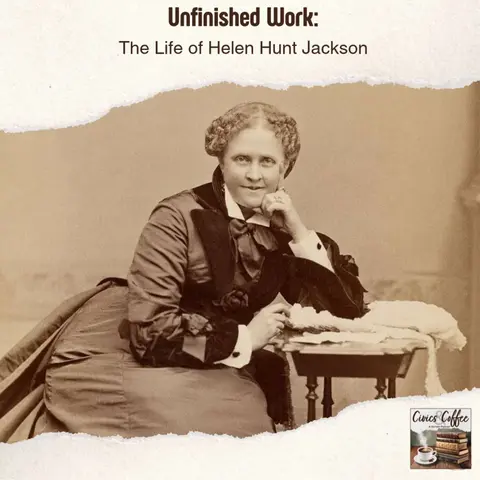
Unfinished Work: The Life of Helen Hunt Jackson

 RSS Feed

 Castbox

 Podchaser

 Deezer

 Apple Podcasts

 Spotify

 Amazon Music

 Overcast

 Castro

 iHeartRadio

 PocketCasts

 YouTube
Helen Hunt Jackson was an author, poet, and activist who sought to use her literary talents to advocate on behalf of indigenous communities living in the West. After attending a lecture in Boston in 1879, Jackson dedicated the remainder of her life to publicizing the plight of remaining tribal nations and pushed for the federal government to honor their agreements. Her 1884 novel Ramona sought to stir up the same emotions created by Harriet Beecher Stowe's Uncle Tom's Cabin - but was she successful? Tune in this week to find out.
Thought This Was Interesting? Just Wait Until You Try…
Louisa May Alcott's Little Women
Harriet Beecher Stowe's Uncle Tom's Cabin
Want Me To Cover a Topic?
Want More Civics & Coffee?
Sign Up for the Substack
Join the Patreon Coffee Club
Make Sure We Are Connected:
Love Civics & Coffee?
Welcome to Civics and Coffee, a history podcast. The show all about United States history, delivered to you and the time it takes to enjoy your morning cup of coffee. I'm your host, Alicia, a historian trained in United States history with a passion for telling both the known and unknown parts of America's past. So grab your coffee and get ready for some bite-sized history. Hey everyone, welcome back. In the fall of 1879, writer Helen Hunt Jackson was visiting Boston when she decided to attend a lecture. Little did she know when she sat among the crowd of curious patrons that the topic of discussion would set her on a path that would permanently alter the trajectory of her career, and leave scholars debating the impact and legacy of her work long after her death in 1885. Jackson's 1884 novel Ramona is one of the most famous novels of the era, and is the work best associated with the author. A piece she hoped would do for the Native Americans, what Harriet Beecher Stowe's Uncle Tom's Cabin did for enslaved black Americans, Ramona has a complicated legacy, no doubt exacerbated by Jackson's death just a year after its publication. But who exactly was the author behind the pages of the much debated novel? A woman who navigated her fair share of tragedy, Helen Hunt Jackson was a complex figure who used writing to ease her pain and later to help ease the suffering and mistreatment of the indigenous communities of the West. So this week I'm diving into the life and legacy of Helen Hunt Jackson. Who was she? What prompted her to write Ramona? And why did it fail to achieve the results she hoped for? Grab your cup of coffee, peeps. Let's do this. The author known today as Helen Hunt Jackson was born Helen Maria Fisk on October 14th, 1830, in Amherst, Massachusetts. She was the oldest of three children and was big sister to Anne, who went by Annie, and a little brother, Humphrey, who died when Helen was just three. The Fisk household was committed to the Calvinist faith, and Father Nathan Welby Fisk was a Calvinist minister before becoming a professor of Latin and Greek at Amherst College in 1824. It could be said that Jackson had the writer's gift embedded into her DNA as both her father and mother were writers who authored and edited several books. Mother Deborah Vinyl Fisk wrote a series of children's stories, and the patriarch of the family spent almost a decade putting together the Manual of Classical Literature. The parents instilled in their daughters a strong sense of self and a belief that they could achieve anything, no doubt building a strong foundation of self-confidence that would prove pivotal for Jackson in her later writing career. And while the parents seemed devoted to their daughters, Mother Deborah suffered from a prolonged battle with consumption, what they called tuberculosis, and would frequently separate from her children, either through sending the children away to boarding school or to live with members of the family. This forced separation took a toll on the young girl, who was constantly on edge about being away from her mother. Young Helen usually tried to put on a brave face, but each goodbye was fraught with questions of whether it was going to be permanent. As Jackson biographer Kate Phillips observes, quote, consumption and anxiety about consumption dominated Helen's childhood. Her mother's pain was ever present, as was the possibility of separation from her, temporary or final, end quote. Deborah Fisk did eventually succumb to the disease, passing away on February 19th, 1844, when Helen was just 13 years old. Away at boarding school, Helen was robbed of the opportunity to say a proper goodbye, something that undoubtedly bothered the young girl. Compounding the issue was the fact that her father, with whom she enjoyed a very close relationship, and who biographer Kate Phillips described as her intellectual companion, had also shown signs of illness, chronic bronchitis. His condition had deteriorated to the point where he began showing symptoms of quote unquote incipient consumption in the late 1830s, which took such a toll that Fisk had to start taking breaks away from work. After the death of his wife, Nathaniel Fisk's intermittent consumption intensified, and he was ordered by doctors to move to a different climate to get some relief. Always wanting to visit Palestine, Fisk took off for the nation in 1846, dying just a year later from dysentery. Again, Helen was unable to say her goodbyes, and it is unclear if she was even able to attend a service as her father was buried on Mount Zion. At just 16 years old, Helen was now an orphan. Luckily, her grandfather stepped in to arrange for relatives to act as guardians, and in 1851, Helen went to Albany, New York, where she planned to live for a year. It was while visiting Albany that Helen met her first husband, Edward Hunt. A civil engineer by training, the attraction was immediate, and the couple enjoyed a brief engagement, just six months, before they exchanged vows on October 28, 1852. After losing so much in her life, Helen probably hoped that her dark days were behind her. But in 1853, she gave birth to a son, Murray, who died before his first birthday from a brain tumor. In December 1855, she gave birth again to another little boy named Warren Horsford, who she called Reddy. Helen enjoyed a period of prolonged happiness before losing her husband just before their 11th wedding anniversary in a freak accident involving a weapon he designed. This was followed by the loss of her son Rennie just 18 months later when he died of diphtheria on April 13, 1865, at the age of nine. Losing her husband and son threw Helen into a deep sadness, and she would suffer from intermittent bouts of depression throughout her life. And she found that traveling and her commitment to her faith were the only things that gave her true comfort. It was in the midst of her loss that Helen also found her author's voice. Her first piece was published just a few months after Rennie's death on June 7, 1865, in the New York Evening Post. A poem titled The Key of the Casket was in honor of her son, and its publication gave Helen the motivation to make writing her full-time occupation. And while Jackson would struggle with mental health issues throughout her life, she would also wrestle with physical ailments too, prompting her to live a bit of a nomadic lifestyle in an effort to stay ahead of her illness. From childhood, Jackson suffered from terrible sore throats and may have also caught consumption, creating respiratory ailments. Throughout much of her life, the best experts in the country still believed that many illnesses were the result of bad air, and so Jackson took to moving with the seasons in an effort to avoid both the harsh winter cold and the repressive summer heat. While some have speculated just how sick Jackson really was, she appeared to have at least suffered from frequent headaches and would eventually come to need dentures. And whether perceived or real, Jackson had internalized concerns about her health, saying once, quote, I feel about my body as I do about a person who has repeatedly deceived me. I have no faith in anything short of a long probation. Helen's life as a tumbleweed did not slow until she met her second husband, William Jackson, when she settled in the Colorado Territory. Even then, however, Jackson made trips from Colorado back east and eventually to California. For Jackson, traveling buoyed her spirits. Whenever she felt down or forlorn, she would gather her bags and take to the open road. And let me just say, same girl, same. Jackson enjoyed writing but hated the idea of publicity or allowing people to have access to her inner thoughts and ideas. As a result, Jackson did not maintain a diary, nor did she invite journalists or biographers into her inner circle for interviews. She frequently instructed the recipient of her letters to burn their copies to prevent any prying eyes from drawing the wrong conclusions. For Jackson, it was of supreme importance that anyone writing about her be focused on her work. The growing trend of mining the personal lives of artists or other notable figures in the latter part of the 19th century irritated Jackson so much that she even wrote a few essays criticizing the quote, silly and vulgar passion of people for knowing all about their neighbors' affairs, end quote. This could also explain why Jackson wrote under several pseudonyms, including Murrah, Saxe Home, and H.H. Living in the Colorado Territory seemed the start of a shift that would become more pronounced after Jackson's visit to Boston. Prior to her shift into fiction, Jackson was what some would call a regionalist writer, someone who brought forth the local color, culture, dialect, and history in their writing. Jackson could see in real time the destruction to local environments and the impact it was having on the area's original inhabitants. Again, from biographer Kate Phillips, quote, from the time of her move, her writings begin to reflect an increased empathy for America's embattled ethnic minorities. Nonetheless, her main loyalties in her Colorado essays remain with those American settlers responsible for colonizing and developing the West, end quote. While Jackson understood on some level that what was happening to the surrounding indigenous communities was not right, she was not yet in a place where she felt strong enough in her convictions to act on behalf of the various tribal nations. Instead, Jackson shifted toward writing fiction, with a short story in 1871 under the pen name Sax Home, which she published in Scribner's Monthly Magazine. Her first novel, Mercy Phil Brick's Choice, would be published just five years later in 1876. Described by one scholar as a quote, female artist's coming-of-age drama, the novel was a semi-autobiographical tale about a woman and her invalid mother as they adjust to life in a New England town that may or may not be a stand-in for Amherst. Jackson followed this up just a year later with Hedy's Strange History and again in 1878 with Nellie's Silver Mine, which was a children's story. Jackson was said to be working on yet another book project when a trip to Boston completely shifted her perspective and activated her reformer energies. It was the fall of 1879 when she decided to attend a lecture by Ponka Chief Standing Bear. In his talk, the chief gave a stirring remembrance of his experience being forcibly removed from his homeland, all done at the hands of the federal government. The story resonated so much with Jackson that upon the conclusion of his talk, she threw her energy into helping them and other nations in securing the long-promised, yet all too often broken commitments of the United States government. She became what she called an advocate of the Indians' rights and did that using the best tool at her disposal, her writing. As her biographer Kate Phillips described, quote, while earlier in her career she had written both out of love for art and for money, now she wrote with a distinct social purpose, discovering in this purpose new fonts of inspiration, end quote. Jackson's efforts to help indigenous communities would manifest in two ways. The first would be in her effort to capture the truly horrific and unstatesmanlike conduct of the United States in their dealings with various indigenous nations in her 1881 publication, A Century of Dishonor. Measuring some 600 pages, the text was one of the first comprehensive historical studies of U.S. federal policy with Native Americans to date and outlined just how catastrophic the broken treaties and illegal land grabs had been to the original inhabitants. The second way Jackson's activism showed up was as a special agent for the federal government, where she eventually generated a report to the Commissioner of Indian Affairs about their livelihood. The study, titled Condition and Needs of the Missions of California, focused primarily on the welfare of those living in the Southern California Mission System and Reservations, and started out as part of an article assignment she negotiated with Century Illustrated Magazine, who wanted Jackson to write a travel series. Jackson took the opportunity to travel throughout California and a quick popover into Oregon, where she not only wrote the articles for Sentry, but also wrote a piece for Atlantic Monthly as well. As a special agent for the federal government, Jackson sought to capture as much detailed information about the lived experience of quote-unquote mission Indians as possible. According to her co-agent, Jackson had a real gift for getting folks to open up about their experience. Abbott Kinney shared in 1883 that Jackson could, quote, go up to utter strangers, people of the most diverse kind, diverse in nature, social position, work, education, ideals, and in a few minutes, he shared they quote, seemed to pour out their inmost ideas to her, end quote. Historian Martin Paget asserts that Jackson's travels through the villages and reservations took their toll on her, and that seeing their devastation firsthand had a profound impact. Quote, Jackson witnessed at first hand the grim reality of Indian social and geographical marginalization, and in the process put herself in a position of ethical responsibility to provide for their welfare, end quote. Not counted amongst scholars as a form of activism in the traditional sense, at least not in the stuff I was able to peruse through in gathering the material for this episode, I think there is an argument that a third iteration of Jackson's activism can be seen in her publication of her novel, Ramona. Having failed to appropriately grab the American public's attention with her Century of Dishonor a few years earlier, Jackson hoped she would have better luck if she hid some of the uglier bits in a work of fiction. In fact, Jackson told a friend, quote, in my century of dishonor, I tried to attack people's consciences directly, and they would not listen. Now I have sugared my pill, and it remains to be seen if it will go down, end quote. Published in 1884, Ramona became a commercial success, but it failed to communicate the message Jackson hoped for. Instead of laying plain the plight of the Indian and motivating the American public to come to their defense, the novel became a romanticized view of the California past. Jackson died before she could help change the trajectory her novel was heading, passing away from stomach cancer in 1885 at just 54 years old. Ramona has only continued in its popularity since the author's death. It is one of the few books of the era that has never gone out of print, and since 1923, hundreds of actors have taken to an outdoor stage in the San Jacinto Hills to put on a theatrical production of the novel, something that the novelist would likely have been opposed to. Helen Hunt Jackson lived through a series of heartbreaks and tribulations, using the tools of her trade to belatedly fight for the rights of a group she saw as on the precipice. While Jackson may have been fueled at least in part by a savior complex, and while her methods were far from perfect, she fought for a group of marginalized individuals at a time when the prevailing sentiment was the only good Indian was a dead Indian. And for that alone, she deserves credit for her bravery and her resolve to stand up for what she believed was right. As her friend Sarah Woolsey described her, Hunt quote, loved when she did love with her whole heart, but she hated as thoroughly as she loved, and what she hated or doubted she resisted. Her will was like an iron rod. You could influence, but never bend her. Thanks, peeps. I'll see you next time. Thanks for sitting down with me as I explored this chapter of American history. If you liked what you heard, be sure to subscribe and share with your friends. I look forward to our next cup of coffee together.
