Ma, Ma, Where's My Pa? The Rise of Grover Cleveland

 RSS Feed

 Castbox

 Podchaser

 Deezer

 Apple Podcasts

 Spotify

 Amazon Music

 Overcast

 Castro

 iHeartRadio

 PocketCasts

 YouTube
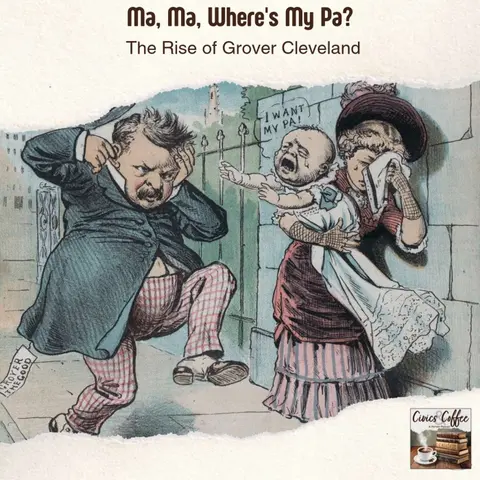
Grover Cleveland emerged as a pivotal political figure during the Gilded Age when he became the first Democrat since James Buchanan to win the White House. Running in a tight race again Republican challenger James G. Blaine, Cleveland's reputation as the man with integrity was put to the test when a late-breaking scandal involving Maria Halpin threatened to undercut his candidacy. Join me in this episode as I explore Cleveland's early life and rapid political rise to the White House - and how the Halpin scandal almost cost him the election.
Want Me To Cover a Topic?
Want More Civics & Coffee?
Sign Up for the Substack
Join the Patreon Coffee Club
Make Sure We Are Connected:
Love Civics & Coffee?
Welcome to Civics and Coffee, a history podcast. The show all about United States history, delivered to you and the time it takes to enjoy your morning cup of coffee. I'm your host, Alicia, a historian trained in United States history with a passion for telling both the known and unknown parts of America's past. So grab your coffee and get ready for some bite-sized history. Every citizen owes to the country a vigilant watch and close scrutiny of its public servants, and a fair and reasonable estimate of their fidelity and usefulness. Thus is the people's will impressed upon the whole framework of our civil polity, both municipal, state, and federal.
SPEAKER_00And this is the price of our liberty and the inspiration of our faith in the Republic. Grover Cleveland, March fourth, eighteen eighty five. Hey everyone, welcome back.
SPEAKER_01In the presidential contest of eighteen eighty-four, Stephen Grover Cleveland became the first Democratic candidate since James Buchanan to win election to the White House. Eking out a victory by the slimmest of margins, Grover Cleveland would become one of only two men in U.S. history to be elected to non-consecutive presidential terms. One of the many otherwise forgettable Gilded Age presidents, Cleveland's first term came at a time of intense party polarization and partisanship, which may have contributed to his loss just four years later. So this week, I'm diving into the life and first presidential term of Stephen Grover Cleveland. How did he get his political start? What was his first term in office like? And how did he survive the scandal with Maria Halpin?
SPEAKER_00Grab your cup of coffee, Peeps. Let's do this. Stephen Grover Cleveland was born on march eighteenth, eighteen thirty seven, in Caldwell, New Jersey.
SPEAKER_01The fifth of nine children, Cleveland would grow up especially close with his sister Mary, whom he referred to as Molly. When the young boy was four, the Cleveland family moved to Fayetteville, New York. His father Richard, a graduate of Yale University, was a Presbyterian minister and took his family with him when he took over as pastor. The Clevelands were devout, and it was said that everyone in the family was expected to attend their father's two hour service every Sunday, with only the babies getting a pass. The Clevelands moved once more, this time to Clinton, New York, where the senior Cleveland took on a position with the American Home Missionary Society. Unfortunately, the frequent travel required of the post was rough on his health, and Richard Cleveland died in October of eighteen fifty three at just forty nine years old. As was common for the time period, the death of the patriarch put a significant strain on the family, and young Grover assumed financial responsibility for his siblings and mother. Thus, despite a desire to attend college, Cleveland sought employment, moving to New York City, where he worked for the New York Institute of the Blind. It was not his calling, however, and Cleveland tired of the work after just a year. He hoped, instead, to go west. Initially attracted to the city bearing his name in the state of Ohio, the young man made it as far as Buffalo, where he moved in with his uncle Lewis Allen, his wife Margaret, and their two children. In exchange for room and board and a stipend, Grover agreed to tend to his uncle's cattle and keep the books, and introduce him to one of the lawyers in town to help his nephew achieve his goal of eventually becoming an attorney. In an age before law schools were the standard practice, any young man looking to practice the law usually clerked or apprenticed with an active attorney before applying to the bar. At the end of the season, Alan made good on his promise, and after a false start with one law firm, Cleveland began an apprenticeship with the firm Rogers, Bowen and Rogers, where he would have to prove himself by working without a salary for two months before he would be considered for a fuller position. Cleveland did eventually earn his keep and was issued a salary of $6 per week. After studying for three and a half years, Cleveland went before the New York State Supreme Court to be admitted to the bar in May of 1859. He was 22 years old. As the Civil War arrived, Cleveland, who identified as a Democrat, fell into the camp that believed that the abolitionists were troublemakers, but that the Union needed to be preserved. Yet he did not feel so strongly about the Union's preservation to take up arms, or to fill the duty when called. Instead, Cleveland paid a Polish immigrant to take his place, a significant departure from others of his generation, who saw service in the military as a duty and a key component to future career advancement. As for how much Cleveland paid, I've seen varying amounts, everything from $150 to $500. But whatever the payment, his decision to defer his service and send someone in his place would become a criticism later in his political career. When pushed about the decision, Cleveland would claim that he was financially responsible for his mother and his sisters during the war and that they were his priority. Thus, while other men fought on the field of battle, Grover Cleveland worked as the assistant district attorney of Erie County, where he earned a reputation for his work ethic and his ability to recite case notes from memory. In 1870, Cleveland became the sheriff where he served for three years and earned a reputation as a civil servant with integrity. During the era of Tammany Hall, this was no small feat. Despite his sterling reputation while in public office, Cleveland returned to private practice before getting elected mayor in 1881. He barely had time to settle in before he was elected governor in 1882, which put him in a prime position for the Democratic nomination for president in the 1884 contest. While the Democrats had come within striking distance, they had been locked out of the White House for nearly three decades, as the last Democrat to win was back in 1856 with James Buchanan. But Cleveland had a few things on his side running up to the 1884 election. He had taken a stand against Tammany Hall, which made him appealing to middle class voters from both political parties who believed he would fight against moneyed interests and corruption. He was going up against a problematic candidate in Republican James G. Blaine, who was considered to be in with the big bankers on Wall Street, and as the governor of New York, Cleveland was believed to be a shoe-in for carrying a critical state. To top it off, he had a sterling reputation for being a hardworking, honest public servant. Cleveland even made honesty part of his platform, promising to bring it along with efficiency back into government. There were just two small problems, and their names were Maria Halpin and Oscar Folsom Cleveland. Ten years before Cleveland decided to run for president of the United States, he became involved with a woman named Maria Halpin, who gave birth on September 14, 1874, to a little boy named Oscar Folsom Cleveland. Shortly after giving birth, Halpin was admitted under what one article described as murky circumstances to an asylum for the insane. Yet after examining Halpin, the doctors released her, finding that she was perfectly coherent and not meeting the clinical definition of someone requiring treatment, which, given the era, says a lot about the perception of Halpin's state of mind. When the story of the quote unquote illicit affair came to light during the campaign, Cleveland told supporters to quote unquote tell the truth. But it's unclear whether anyone actually knew what that was. The resulting response was dismissive. While Cleveland admitted to the possibility of paternity and the rendezvous, it was done while also insinuating that Halpin had several lovers, and that Cleveland only stepped up to protect others who may have had a run-in with Halpin since he was a bachelor and others were not. The innuendo got to such a fever pitch that Halpin decided she could no longer keep quiet. In an interview with the Chicago Daily Tribune in October 1884, Maria Halpin denied Cleveland's version of events. Further, she submitted an affidavit that contained its own stunning set of accusations. Protecting her honor, Halpin attested in the affidavit that the presidential hopeful had sexually assaulted her, stating, quote, he accomplished my ruin by the use of force and violence and without my consent. After he had accomplished his purpose, he told me that he was determined to secure my ruin if it cost him $10,000 or if he was hanged by the neck for it, end quote. Further, Halpin claimed she told Cleveland she wanted no further contact with him, but had to change plans when she discovered she was pregnant. It was shortly after she gave birth that her son, Oscar Folsom Cleveland, was taken from Halpin, and she was admitted to the asylum. After securing her release and locating her son, arrangements were made to put the young boy up for adoption. In exchange, Halpin was paid $500. When asked why Halpin decided to finally speak up, she indicated that her family pleaded with her to clear her name after the volume of mud Cleveland and his associates had thrown against her. Scholars have thus far been hesitant to put much weight behind the allegations against Cleveland, citing Halpin's struggle with alcohol addiction and her institutionalization as reasons to doubt her accusations. Some also find the timing suspicious, especially when taking Cleveland's battle with Tammany Hall into account. Why, some wonder, if Cleveland represented a threat to the influence and power Tammany enjoyed, wouldn't they have used the information to strike at Cleveland earlier in his career? The fact that Cleveland's association with Halpin was not a secret, combined with the fact that Tammany and other Cleveland critics sat on the information until the presidential election have led scholars to discount the veracity of Halpin's claims and chalk it up mostly as a he said, she said affair. Historians are notoriously gun shy about making proclamations without evidence, and in an era before DNA evidence, there is, as of this recording, no definitive proof that I'm aware of that verifies whether Cleveland was in fact the father of Halpin's child. However, historians are also supposed to evaluate the context when the evidence is lacking or in conflict and make their best assessment based on the information available. And I might be in the minority here, but in my review of the facts, it seems plausible that Halpin was telling the truth. First, Cleveland previously used money at least once before to make an obligation go away when he paid for a replacement during the Civil War. Second, while Halpin was committed to an asylum, this wasn't all that difficult to do to women during the Gilded Age, and, as I mentioned, the doctor who examined her released her, finding no reason to halt her. In an era where quote unquote hysteria covered a whole host of sins, Halpin's early release is significant. Third, women are not prone to make up accusations of assault. The best data available suggests that false reports account for no more than 10% of accusations, and this figure represents contemporary reports. If Halpin wanted to protect her honor, which was something that was very important to women during this period, she could have made a statement claiming Cleveland had promised marriage and later backed out. Taking the step to accuse a very powerful man who was seeking the highest position of authority in the country was quite the risk, if not true. Halpin had a lot to lose and very little to gain by doing so. Ultimately, we might never know what transpired between Cleveland and Halpin, but I think we should give Halpin's accusations a little more weight than what I have seen they've received thus far. Regardless of the accusations, however, Cleveland's supporters were successful in their messaging campaign that while their candidate may have had a slip of judgment in his private life, Blaine had a long, documented history of behaving unethically in public life. Their argument essentially was who would you rather pick? A man who faithfully served in public office without issue, but made a questionable call privately, or a man who was a well-known abuser of the public trust, who may or may not have also had a scandalous private life. When the votes were tallied, Cleveland came out the victor, just barely winning the popular vote. New York proved critical to victory, where Blaine lost to Cleveland by just over a thousand votes out of the over one million cast. Once in office, Cleveland reasserted executive authority and forced Congress to repeal the Tenure of Office Act, a law that plagued his predecessors, including Andrew Johnson, who faced impeachment over it. The battle began in July of 1885, just a few months after Cleveland was sworn in, when the new executive chose to suspend the U.S. attorney for the Southern District of Alabama, Republican George M. Dushkin, and replace him with Democrat John D. Burnett. The removal and replacement were done during a congressional break, making the selection a recess appointment. And when Congress reconvened, the Judiciary Committee requested information and materials about both the nomination of Burnett and the cause of firing Dushkin from the White House. The Attorney General responded that while he was happy to provide the requested material related to the nomination, he had been instructed by the president to withhold any information relating to the suspension and removal of Dushkin. The Senate censured the Attorney General and the President for noncompliance, but it backfired. Cleveland still refused to provide the requested information, and eventually Congress backed down and submitted a bill to repeal the Tenure of Office Act in July of 1886. The president signed the bill in March of 1887. Cleveland was a big fan of the veto, using it a total of 170 times during his first term, a number he would surpass during his second scint in office. And as historian Donald Greer Stevenson tells us about Cleveland's overall use of the veto, quote, Cleveland's large tally of vetoes surpasses those of all his presidential predecessors combined, and those of each of his successors save Franklin Roosevelt, end quote. When Vice President Thomas Hendricks died in November of 1885, President Cleveland responded by signing the Presidential Succession Act in January of 1886. The law was an update from the bill passed in 1792, which specified that if the president and vice president were unable to serve, the President Pro Tempore of the Senate, followed by the Speaker of the House, would take charge. The law in 1886 changed the succession to stipulate that the leadership of the country would fall to the heads of the executive departments in the order in which they were established and remained on the books until 1947. Cleveland was also in office to accept the Statue of Liberty and was part of the dedication ceremonies in October of 1886. While Cleveland entered the White House a bachelor and initially continued to enjoy the company of his male colleagues, he did eventually get married at the age of 49 to a woman that was more than half his age and the daughter of one of his associates, 21-year-old Frances Folsom. The couple exchanged vows in the White House on June 2nd, 1886, and had one child together, a daughter named Ruth. In 1887, Cleveland hesitantly signed legislation establishing the Interstate Commerce Commission. The bill, the Interstate Commerce Act, sought to regulate industry and it became the first federal independent regulatory commission. The president followed that up with the Dawes Act, which divided tribal lands into individual allotments and further pressured Indigenous Americans to assimilate into American society. Under the parameter of the bills, each family unit would be given 160 acres of land, with single individuals eligible for 80 acres and orphan children eligible for 40 acres. Past episode topic, Helen Hunt Jackson's publication, A Century of Dishonor, may not have moved the general public in a way that she wanted, but it is cited as one of the motivators for a general reform of how the government approached its treatment of the indigenous community. Cleveland was said to be a major supporter of the bill and helped push it through Congress, believing this was the best chance for the Indigenous community to thrive. In the final year of his first term, Cleveland signed the Scott Act of 1888, yet another Chinese Exclusion Act. The bill was intended to expand upon the law signed in 1882 and prevented re-entry into the United States after visiting China, and was signed without agreement from the Chinese government, putting relations with the country in a precarious place. That did not seem to be enough to keep Cleveland in office, however, and although he won the popular vote, he was defeated on November 6th, losing to Benjamin Harrison. But this represents only the midway point of our story for Cleveland, who will make a comeback in four years to become the 24th president of the United States. We'll cover the second administration in a future episode. A man who represented the first Democrat to return to the White House in decades, Grover Cleveland did not leave much of a mark. Described as both courageous and unimaginative, Grover Cleveland is most remembered for his work in strengthening the executive power. In an era known for its forgettable presence, Cleveland remains notable only for his lack of college education and the distinction he used to hold as being the only president elected to two non-consecutive terms. Thanks, peeps. I'll see you next time. Thanks for sitting down with me as I explore this chapter of American history. If you liked what you heard, be sure to subscribe and share with your friends. I look forward to our next cup of coffee together.
