The Fifth Annual Friendsgiving Spectacular

 RSS Feed

 Castbox

 Podchaser

 Deezer

 Apple Podcasts

 Spotify

 Amazon Music

 Overcast

 Castro

 iHeartRadio

 PocketCasts

 YouTube
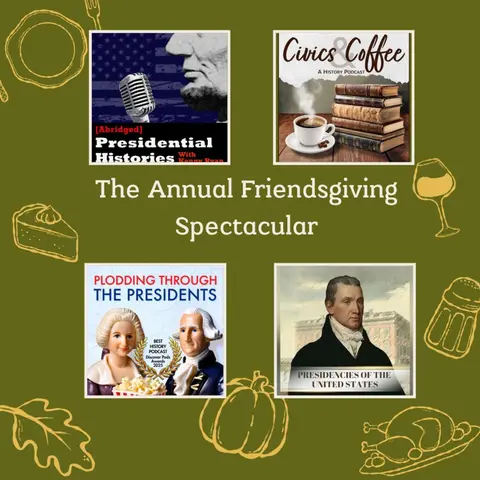
It is the week of Thanksgiving which means it is time for your favorite history podcasters to get together and ask each other questions about our research, podcasting, and of course history! The annual tradition continues with Howard from Plodding Through the Presidents, Jerry with Presidencies of the United States, and Kenny with Abridged Presidential Histories.
This year we asked what we would change about how history is written, which prior presidential administrations we might want to join, and why William Henry Harrison deserves a Presidential Library. Plus, listen as I try hard not to pick a fight with Ken Burns and prepare for Howard's campaign to make Aaron Burr president.
Welcome to Civics and Coffee, a history podcast. The show all about United States history, delivered to you in the time it takes to enjoy your morning cup of coffee. I'm your host, Alicia, a historian trained in United States history with a passion for telling both the known and unknown parts of America's past. So grab your coffee and get ready for some bite-sized history.
SPEAKER_04Welcome to the 478th Friendsgiving Spectacular. I am not sure of the actual count, so I rounded up. This is an annual tradition where four podcast history friends and nerds get together to be thankful for our friendship and enjoy a roundtable discussion of US and presidential history. Each of us will ask one question of each of the rest of us, and it'll be a good time. But first, who are we? Let's go around the table. First up, I want to introduce Jerry Landry. Jerry is the host of Presidencies of the United States Podcast, a the deep dive of all deep dive podcasts that will give you every detail you could possibly want to know about Jeech administration over multiple episodes. He is a fantastic. If you really want the full story, he will give you the full story. Jerry, anything you want to add?
SPEAKER_01So thank you for that introduction. And yes, I do the deep dive. I finally got to the Monroe Presidency this year. It was an exciting time. And I'm about to hit my 10-year anniversary of presidencies. And if that gives you any indication, after 300 episodes in nearly 10 years, that I'm just getting to Monroe, there you go.
SPEAKER_04Well, I think when you get to Monroe, you're almost to the end. I'm pretty sure. I forget the exact order of them, but I think you're almost.
SPEAKER_01I mean, I'm just gonna speed through like the rest of them. It'll be fine.
SPEAKER_04Try it. Like, like uh, you know, you're wrapping up the rest of those seasons really quick. I think you got it.
SPEAKER_01I mean you got it. I can probably knock out Lincoln in like three episodes, right?
SPEAKER_04Probably. Yeah. He's pretty not much happens there.
SPEAKER_01It was it was pretty dull time, yeah.
SPEAKER_04Dull times, dull times. So that's Jerry, the deepest of deep dives. And we have Alicia of Civics and Coffee, which gives you your history lessons and the time it takes to drink a cup of coffee. And Alicia always brings such diverse topics, such interesting takes on things. I hear, Alicia, you also hit the speaking circuit this year, and we're getting out of the house, away from the mic. Tell me about what you've been up to.
SPEAKER_03Yes. So uh, whereas Jerry does the deep deep dives, I try to just pepper people and get people uh interested and force them to do their own deep dives. So uh, yes. I was in Boston earlier this year where I was able to do a talk about the Triangle Shirtwaist uh factory fire, which is my what I would call my gateway drug into history. Uh it's my favorite event from U.S. history, and it was a really great time. I was extremely nervous, even though I've done you know online talks, I was able to, you know, be in the safety of my home. So uh if nobody could throw tomatoes at me, it was it was perfectly safe. Uh so uh it was a little nervous going into Boston, but they were quite lovely. It was so fun. And uh I'm looking forward to doing a couple of more events in person next year. I'm going on the conference circuit. So look for me in a city near you.
SPEAKER_04Please let me know if you make it up to Seattle. I will definitely be in the audience for that. That would be awesome. Thank you. Thank you for the updates, Alicia. And then uh we got Howard Dory with us of plotting through the president's, a sometimes very serious and sometimes very irreverent co-hosted podcast with his wife that goes through history. Howard, what have you been up to? Tell me more about your podcast. Yeah, yeah.
SPEAKER_00So I'm I uh we do deep and and shallow and deep dives into shallow topics, I think. Um we like to look at the lesser-known stories behind American history, behind the presidents and their families and the people uh who they intersected with. And yeah, it's been it's been a fun year. I'm working on my master's degree, so I've been focused heavily on that and not producing as much content as I would like, but hoping to change that soon. And yeah, uh been I've had the pleasure of presenting at a couple of conferences on different things that I'm working on and uh teaching some folks to the O'Share Lifelong Learning Institute about some of the topics that I love about presidential history.
SPEAKER_04That is awesome. All right, another person who will have to come speak in Seattle and let me know when they're in town. This is great. Good luck on the rest of your degree, Howard. Um and then my myself, I am Kenny Austin. I am the host of Abridgres Presidential Histories, which gives you the successes, setbacks, and scandals of each president in order in an hour or less. That has actually covered all the presidencies up through uh Trump won. Gonna let a little more time pass before I get to Biden. I also host a new podcast called Democracide, which I co-host with my sister. And the genesis of this is John Adams once said, There's never yet been a democracy that didn't die by suicide. To which I asked, or was it murder? I tell the tale, Heather tries to figure out who committed the crime. So those are the podcasts that we hope. And are y'all ready to dive into some questions? Yeah. Absolutely. Yeah, let's do it. Let's do it. Let's do it. All right. I got the first question for Howard to get us rolling. Howard, imagine you have a what-if machine. And imagine that if you push the green button on that what-if machine, it lets you go back in time and change the outcome of any one election from the country's first 200 years. What election result would you change? Why? What do you think the immediate impact of that change would be? And how would today's world be different as a result of that change?
SPEAKER_00Wow. Um, well, first of all, I think it's very irresponsible to speculate about such things. Um it's also one of my favorite things to do, so you're in luck. Um, I would go with a big election, okay, the election of 1800. You've got John Adams, incumbent, running against Thomas Jefferson, um and and Aaron Burr's in there. And John Adams actually got the majority of votes to stop being president. So he wasn't even a contender anymore. Uh and Burr and Jefferson, as many people know, tied. Jefferson, you know, pulled ahead. I would say, what if Burr won? What if he won that election? Um I think he would have risen to the occasion. I think there were times that he proved himself as a uh non-partisan statesman. Uh part of that might be because he could go wherever the wind blowed, but I also think that he really believed in the principles of the Constitution. And I think he was the greatest threat to the nation when he was trying to get power. So I say give it to him. Let him be president, let him do what he can. I think um immediately you've got a pretty cool acting first lady and his daughter, Theodosia Burr. I think she was like 17 at the time. Um I think she would have been great. I think she would have been a great role model because he, Burr, highly believed in um educating uh women, and she was a great example of that. Um I also think that some people think that uh Burr had so many enemies that he wouldn't have been able to get anything done. And maybe part of that's true, but they point to John Quincy Adams as an example. Like he was not a popular president, more people wanted Jackson, so Adams' presidency uh was kind of a nothing burger in terms of big ideas that he could actually get done. Burr, though, Burr was the opposite of John Quincy Adams. He was incredibly charismatic. In person, he could like hypnotize you to the point where you would see his way and think that he was the best person you'd ever met. And he did this to people like John Quincy Adams and his wife Louisa. So I think that he could possibly have been a very effective president. I think he was very organized. Um, I think he might have even led Congress to shore up the Constitution with actual rules and guardrails that could keep someone like him and other presidents in check later. Um I think you'd nip the Virginia dynasty in the bud. I think Burr Burr didn't have a perfect record on slavery. He he enslaved some folks, but he was also in favor of abolition in a lot of ways. And I think he probably still would have jumped on the Louisiana Purchase. But I think maybe he would have prevented the West from being as open to slavery as it was and might have tamped down that. So I and another thing, I don't think Hamilton would die in advance. I've been thinking this whole time. At least for Burr. You know, Hamilton may very well have gotten someone else to kill him, possibly Monroe. But I think I think that Burr might have been savvy enough to offer Hamilton some advisory position, whether it's a financial advisory position, something like that. I don't think he'd take a cabinet position. But I think that he might have put Hamilton in a place where it's like, look, you can either have a seat at the table or you can, you know, start trying to pull the strings from behind the curtain like you've been doing already. Um so I think there could have been some really interesting things. As far as foreign policy, I don't know. Might have been worse. Maybe we'd have Mexico. It's hard to say. Um, but I I think that all the people who say no, Brett was terrible, uh, I think in power he might have proven himself to be otherwise.
SPEAKER_04Okay. And today's world, what would today's world be different as a result of that?
SPEAKER_00Well, I think that I think that you might see a different timeline as far as the end of slavery in the Civil War. If we didn't see the expansion of slavery into the West following the Louisiana Purchase and things like that. It's obviously it's hard to say what might have happened, but I think that things might have looked different if you didn't have Jefferson, Madison, Monroe, three um notorious enslavers in a row, 24 straight years of that. I think Burr, not to say that he necessarily would have stopped all those other presidencies or that Jefferson wanting to come along later, but you have to wonder what it might have looked like if that wasn't the norm for so long coming from the top.
SPEAKER_04That that's a I was not expecting you to go back to 1800 and flap those butterfly wings. So, Howard, that was fantastic.
SPEAKER_01And can I just say for any listeners who think that the life of a history podcaster involves sitting around and talking about history and what ifs all day long, this is actually the second time today the subject of Aaron Burr actually becoming president has come up for me today.
SPEAKER_00Oh wow. So yes, it is the game today. If I got anything wrong, Gary, I'd love to hear.
SPEAKER_01like uh w one hundred percent spot on, I agree.
SPEAKER_03I see a historical novel in your future.
SPEAKER_01There we go.
SPEAKER_04Yeah, move over, Corvedal. All right, Howard, you're next up. Ask a question. All right, let's see here.
SPEAKER_00Uh yes. My question is for Alicia.
SPEAKER_03Hit me.
SPEAKER_00Um, Alicia, let's say that you could change how history is written about, or really who history is written about. Um, like imagine you could go into a bookstore and you could pick someone who's got a bunch of books written about them, and instead replace that person with another historical figure who should be studied and taught about. Uh, what switch are you making?
SPEAKER_03Yeah, so this one was hard because part of me, right, as a historian, wants to say, uh, you know, pretty much everybody deserves to be studied. So I want to approach it from a lens of maybe turn it down. Maybe we don't need as many books about the person that I would like to replace. And that's Jefferson. I feel like we've talked about Thomas Jefferson enough. Uh, specifically, I think the the book that came out over the summer uh with the quote unquote definitive proof that he fathered children with Sally Hemings. I'm like, this is something that that uh has already been done. Annette Gordon Reed uh did this uh, I think what, 30 years ago now at this point. And yes, of course, the scientific DNA, sure is is, I guess, one more extra step, but uh uh we don't need yet another book about the guy uh personally. I I get that he's a founding father, I get that he was a major contributor to the Declaration of Independence, and I understand that he's a very complex figure, and uh that in and of itself uh makes him very fascinating for people to study. So I I I understand that. Um, I just think uh perhaps we need less of Jefferson and more of Frances Perkins, which again I think is probably not a shock to anybody who uh follows the the podcast or or knows me offline. Um so Frances Perkins, for anybody who does not know, is the first woman to serve in a presidential cabinet and is uh, in my opinion, the most uh impactful cabinet secretary in the 20th century. I think she probably is one of the most uh impactful US cabinet secretaries in US history. Um she is the uh brainchild behind Social Security. So the workmen's comp, retirement benefits that people get, uh, you know, if you're if you need to go out on long-term disability, that was all her. She was one of the ones that uh pushed for universal health coverage, something that we're still fighting about in 2026. And uh, you know, unless maybe you watched Dirty Dancing or went to uh the play Annie, you don't really know who she is. And you know, some of that is by her own design. She was somebody who wanted to operate very much in the shadows. She did not want to be in the spotlight. She operated also in a time period that was not very warm towards women taking on leadership positions, and so you know, that she's a product of her time, and that's why there's there's not that much uh, you know, about her. But I just find it disheartening that a woman that was made history in so many ways is uh to this day just she doesn't uh in my opinion, she doesn't get enough flowers. And so uh it's my mission in life to scream from the rooftops. Uh and also I think too, I'm a little bit biased because I study welfare when I'm not uh writing episodes for the podcast. And so I have a appreciation for her because without the Social Security Act of 1935, I probably, you know, wouldn't have had a career for a good part of my adult life and um wouldn't have had a thesis topic. So uh Frances Perkins would be the person that I would definitely say deserves uh much more attention. Uh she deserves a movie, she deserves a miniseries, she deserves five 50,000 books, and uh to date she has, I think, you know, less than a hundred.
SPEAKER_04So a great one.
SPEAKER_03Okay, so uh my question is for Jerry. Given your extensive knowledge of presidential administrations, so people who who know this podcast know that you have uh you've read about all of the presidents. So given your extensive knowledge of the presidential administrations, if you could join any administration in history, which would it be and why?
SPEAKER_01So this is an interesting question. And I was trying to go through my mind, trying to think through all the administrations. Uh, there are definitely some, you know, of course, would not want to be in the midst of the Civil War. You know, that's that was a rough time. Uh I think I can skip that one. Um, so like thinking of me actually being in an administration, and I don't know if it's part because I'm just living in the Monroe Times right now, but the Monroe administration was pretty calm and tranquil. You know, there was stuff going on, there were events, but in terms of the actual administration, by and large, everybody got along well, except for the um secretary of the navy position, which went through a couple of folks. It was by and large a pretty stable administration for eight years. Of course, after you know, they got closer to 1824, everybody wanted to be president and got a little tense at that point. But for the most part, it was kind of calm and tranquil. It would mean that I would have to deal with John C. Calhoun, and that would be rough. But I'd have John Quincy Adams with me, so you know, I think we could take him. But if I just really wanted an administration for the sit back with the popcorn and just watch the sparks fly, the Tyler administration all day, every day, because talk about turmoil for three years and 11 months. And oh, by the way, there's also a literal explosion and cabinet members that die with it. So, in terms of entertainment factor, as long as I don't have to deal with some of the characters, I'll be fine. But you know, just let me sit back with the popcorn and you know, just watch everything happen. Just stay below deck on any bruises in the do not go up above deck, don't go on deck.
SPEAKER_04Don't watch the canon demonstration, do not want to watch that.
SPEAKER_01But great question. I love that. Thank you, Alicia. Yes. Good choice. And so my question is for Kenny. So, in the course of research for either of your podcast, is there a historical figure or topic that you came across that you don't know much about and thought that you'd really like to do a deep dive on to learn more, but you just haven't had the opportunity yet?
SPEAKER_04So many. Moving up the list is Francis Perkins.
SPEAKER_02Apparently, I need to do more reviews.
SPEAKER_04But I mean, everybody who's listened to my podcast knows I love Winfield Scott. Oh, fussing feathers, would love to read more about him. You got Tamar Lane would be crazy to read about Thurgood Marshall, Hubert Humphrey, Catherine the Great, McNamara, the Meiji Revolution in Japan's always been interesting to me. I'd love to find like a good study of social movements that have succeeded and what makes a successful social movement succeed. Like, I'd love just a history on that. But I do know that next up, uh topic that I've always heard mentioned since a young age, but for whatever reason, none of my schools in Texas ever really went too deep on the topic is reconstruction. So I do know for a future season of Democracy, we're gonna look at who killed democracy for African American citizens in the South. And so I'm gonna dig deep into Reconstruction and what went wrong there. So I think that's my next topic that I haven't had the opportunity to go deep on yet, but I'm going to.
SPEAKER_01I can say as a listener.
SPEAKER_04You got a few books. Yes, send me your recommendations, please. All your favorite books on Reconstruction, send them my way. I am I'm growing a list and we're coming up on the holidays, so I can put them in front of people.
SPEAKER_01I can say as a listener, I'm looking forward to that series. So we're excited to be on the journey with you.
SPEAKER_04Thank you. Thank you. And I I've got a question. I'm gonna throw it to Alicia for my next question. And uh this, you know, on the eve of the recent midterm, and I should mention we are recording this on November 8th, which may be why we are less stressed out than if we had done this. But on the on the eve of the recent midterm, Ken Burns wrote an op-ed piece that called our current political moment the fourth great crisis in US history because our democratic systems are under threat. He he said the first three were the Civil War, the Great Depression, and World War II. So, multi-partter question. What do you think of his take? Like, are those the four crises? Would you would you pick different ones? What do you think of his take? Is this the fourth great crisis? And if so, how do we get out of it?
SPEAKER_01No pressure. Well, yeah, I know.
SPEAKER_03Uh so I would say that we've been in a crisis since January 6th, 2021. And so, and I think you know, the Tuesday's election helped, but I think I'm already seeing language from some of the representatives that I find troubling. And I'd like to remind folks that section three of the 14th Amendment does not require a conviction. And there is an argument to be made that the current person sitting in the White House should not be there based on January 6th, 2021. And apologies if that's political, but an insurrection is an insurrection is an insurrection. And I don't know how you qualify January 6th, 2021 as anything other than uh an attempted uprising against the United States government because uh you did not uh win an election. I think Ken Burns, I respect him tremendously as a documentarian. I think he has made some of the most beautiful films about American history ever. I think sometimes he uh tends to be a little rosy-eyed. And uh I uh struggle with some of his takes because he is a man of great privilege. He's a he's a rich, white, uh, heterosexual man. Things are gonna work out okay for him 99.9% of the time. Um and so I, you know, I I read his piece and while I can agree with him that yes, we are in a crisis, uh I I would say that you know it's it's been a long time coming. Um, I think too that some of his takeaways are perhaps a little too rosy. Um and I think that yes, uh the voting results on Tuesday were wonderful. And I'm I'm very, you know, I'm very happy to see that people were able to overcome the gerrymander. Um, it was not it, it was not beaten. I think that some of that language too is kind of concerning to me that I'm seeing that it was not beaten. Uh they just got lucky. And so I'd I'd like to see uh more diversity and the leadership in Congress. Uh, the gentleman in Mississippi who is looking like he's on track to uh win that Senate seat and become the first black senators senator from the state of Mississippi since Reconstruction made a very valid point in saying that the leadership currently in Congress, uh at least on the Democratic side, lives in the same borough, both from from the east, and that you know it it's time that it that they look more like your average Americans. And so I think we need to really think about that and and look at that and and realize that congressmen need to learn how to walk and chew gum at the same time, and we need to hold people accountable, and that that's not something that the United States has got a great history and track record on. Talking about Reconstruction. Um that means we look at impeaching officials, whether that's the Supreme Court justices, sorry, uh, whether that's uh you know, members of the cabinet who failed to follow the law, um, and doing policy and legislation. I I think the fact that there's already kind of talk about kind of being conciliatory and reaching across the aisle and bipartisanship. Let's not counter chickens before they they hatch. Um let's look at what's going on. Uh, I'm somebody who's very concerned about the language that I'm seeing, um, and and this whole like, oh, you can vote your way out of fascism. Okay. Um, not not exactly the language I would use, but that's just where I'm at. I again I appreciate Ken Burns. I think he's a great documentarian, but not I don't necessarily agree with a lot of what he said. So apologies. I feel like I brought a lot of politics into that.
SPEAKER_04But I appreciate your take, Alicia. Thanks for sharing. Yeah, it's a different perspective from Ken Burns.
SPEAKER_03I know, I just feel like uh, you know, flames, fires coming up coming my way, but um, you know, I said what I said. Okay, so my question is for Howard. Uh, you are in the midst of a master's program, so I know you are exhausted. Um, but you're also traveling the country and giving talks about various pieces of your research. So I have to know have you landed on a thesis topic yet? And if so, what is it?
SPEAKER_00Um yeah, these are great questions. And wow, that was I I'm still feeling the weight of your answer. Um sorry. No, no, no. In a good way, in a good way. Um, yeah, and but it's like, you know, there are like bombs going off behind me, and somebody's like, how's the weather there? Let's cut a habit. Um but but I feel yeah, I feel ya. Um I just I you know, I want to take the wings where we can and uh still be concerned. But yeah. Um maybe maybe later we'll talk about some some thankful things, um, but for now. Alright, yes, my my thesis, actually. Um yeah, I have actually. I'm I'm working on my thesis now. It took a long time for me to figure out what it was gonna be. At first I'm like, I have to think of something nobody's ever thought about and dig into some hidden crypt of documents no one's ever seen. And then I realized like I should lean into what I've been doing for years, which is digging into presidential myths. And I've I've picked three of them, uh, George Washington and the cherry tree, uh, John Quincy Adams' uh skinny dipping ambush interview with the female reporter Anne Royal, and William Howard Tapped in the Bathtub. And I'm doing a deep dive into what these three things, uh, these three myths have in common, which is some exciting stuff, and looking at what their origins, uh, and some things about their origins that I think people hadn't really discovered before, uh, what those say about why these particular stories appeal to us so much, uh, even though they've been debunked over and over, and what they have meant to people over the years. So I'm really leaning into that, and that's that's exciting. Um, as far as traveling the country, that's that that makes it sound a lot cooler than it is. But I did uh I had a great time in Houston. I presented there at the Houston Public Library on the founding frenemies, and that was amazing. Um, and I've uh gotten the opportunity to go to a couple of history conferences and present on papers that I've written, and that's been fantastic. So um, yeah, I love kind of sharing the research that I'm doing and looking at sharing it in bigger and better forms.
SPEAKER_03Well, I can't wait to read your thesis, so please share it when it's all nice and written, please. And if if if your school does the whole like, you know, um you're gonna defend it and it's available online, you know, drop a link to a friend because I would love to be there and share you one.
SPEAKER_00Yeah, not to my knowledge do they do that. Um, but damn it. But yeah, I know. Um and and and I'm doing an online program uh through UMass Boston and I'm in LA. So my plan is for like me to defend it uh like this in a in a you know Zoom type environment where they ask really hard questions, and then I pretend there's an internet connection problem. Um to the less hard questions.
unknownYeah.
SPEAKER_00Um, but I'll let you know.
SPEAKER_03Okay, please do.
SPEAKER_00Yeah, yeah. So my next question um is for Jerry. Um, I know we've had a lot of speculative questions, and that's crazy, and here's another. Um, let's say the next president, whoever they are, has a time machine, and they ask you to choose their secretary of state from anybody in history, not necessarily uh previous secretary of state, but it could be. Now, here's the tricky part. You have to pick two people, but you have to be strategic. Your first pick has to be someone that you throw out there because you know there's no way they're going to be approved by a modern Senate. So your second choice looks like a compromise pick and who you really want. So, yeah, that's my convoluted question. Who do you pick and why?
SPEAKER_01Hold on, I'm experiencing technical glitches.
SPEAKER_02Sorry, I don't think.
SPEAKER_00If we can get the third answer today where someone basically erases Jefferson from history, I'll be impressed, but we go.
SPEAKER_01No, I I had to think long and hard about this one because you know there are so many figures and so many fascinating figures, and that's one of the the joys of doing this podcast is being able to really learn about these folks that maybe you only see on a list or get a mention in a a book once or twice, and to find out that they are really fascinating people for better or worse. You know, they're definitely some characters. Um, Calhoun, I'm looking at you. But so the one that I don't think the Senate would approve is actually the guy that you were talking about, Aaron Burr. So let's start by putting up Aaron Burr, and they start diving into his past. And oh my gosh, there's a lot there. He is a scandalous guy, and especially, oh, you know, he actually thinks women are equal and should be educated. Oh, you know, equal rights, all that. And oh, he tried to go on the scheme to possibly take Texas or Mexico or whatever. We don't really know what was going on. You know, this this guy seems, and also he doesn't have much of a, you know, we're wanting him for secretary of state, but he doesn't have much of a foreign policy background. So I could see the Senate struggling to confirm him. Okay, well, we'll we'll put him to the side, you know. He's he's got other things he can do. He's he'll occupy himself, don't worry. Let's put up Albert Gallatin and actually get him to the Secretary of State position. So Albert Gallatin was the Secretary of the Treasury under Jefferson and Madison. He was a key figure in the politics of that time. And he was also a foreigner, and so some of the Jeffersonians didn't like that, you know, and but he was integral to uh making the Democratic-Republican administrations happen, and he was somebody who had a foreign policy experience, he was involved in the negotiations to end the war of 1812, he has experience as a diplomat in Europe, and so Albert Gallatin would be because he did want to become Secretary of State and knew that the Senate would not confirm him. But I think the comparison of Burr to Gallatin, I think the Senate would go for Gallatin as the compromise candidate. And, you know, by and large, his policies he he was kind of an aberration. He was he had some Jeffersonian tendencies, but he also had some federal federalist leanings as well. Also, some of the reasons why folks in the Democratic-Republican camp didn't like him because you know he was too much like those Adams folks, and they didn't like that. But I think we could get him through the Senate.
SPEAKER_00Now, Jerry, obviously there's no right or wrong answer, but here's why you're wrong. Um, I think I think Burr I think Burr, when you get him in front of the Senate, um and because he would need a Senate confirmation hearings, right? Is that how that works for those? I uh yeah. Um, at that point, at that point, he gives such a speech that they're crying, which literally happened during his farewell address in the Senate, um, even after he killed Hamilton. So I think that your your pick um would surprise you and would somehow win enough of them over that he would be confirmed because that is the power of Aaron Burr.
SPEAKER_04That just feels like the more likely thing to happen in U.S. history, too.
SPEAKER_01Yeah. The the person that nobody expected and they were planning. Yeah, and nothing goes according to plan. But I think that was secretly your plan anyway, I think really I actually am somebody who Burr is one of the most fascinating figures that I've studied to date. And you know, every time I have an opportunity to talk about him, I'm like, yes, please, let's learn some more. I'd love to do a deep dive into even more. So I love that question. Thank you so much, Howard. Thank you. So my next question is for Alicia.
SPEAKER_03Okay.
SPEAKER_01So, Alicia, in your your peppering of history over the years, as you described it, with Civics and Coffee, of all the historical figures and topics you've explored, which one were you most frustrated with when you went to research? When you went down that research well, you started to try and explore it, and you found there was little there, even though it seemed like there was some intriguing history there that if more sources had survived, if something would have happened in a different way, that we would have more to talk about, but it just came up dry. But it's like you're just snagging that there's something here that we just can't get to.
SPEAKER_03Yeah, this was a good question. And I'll first say that, you know, as a podcaster who primarily works with what I can access, you know, online via various article databases and digitized records and books. Um, you know, it's entirely possible that there are some materials out there available in like a university archive or, you know, a library that I just that is there that I just don't have access to. So I do want to put that disclaimer out there, not saying that it doesn't exist, but maybe just not easily accessible to me. Um, but I will say, you know, a lot of the early first ladies was frustrating. You know, Jerry, because I would email you all the time, be like, um, okay, I'm not missing it, right? There's like, there's just literally nothing available. Um, so that was kind of frustrating. And I know part of that is, you know, just tradition, right? They they usually burned a lot of their correspondence, um, and and women just disappeared after they got married, um, if they existed much at all in the historical record before marriage. So that was always a little bit frustrating. And I still find it a little bit from time to time as I'm as I'm dealing with the the first ladies. So I'm hoping as I get into the 20th century that that will be less of a problem. But uh I will say a toy, who was a a madam in in Gold Rush, San Francisco, that one I just I know that that must be such a juicy story, and I wanted so much more than what I found. And, you know, being a California native and being in the Bay Area myself, I I wanted to dive in and put my teeth into it. And, you know, unfortunately, it's a lot of like innuendo, and there's a lot of what they think they know, right? Um, and so I would have liked to have a little bit more information to to share about her. But, you know, I'm sure somebody will find something and it will be, you know, a great book. And then I'll have to do an update and do a re-release of my of my episode. Um, but yeah, it's usually women, you know, unfortunately. But Atoi, I think, as I looked through all of the the topics, she was one that stood out to me because I was so excited to to finally get to her and and talk about her, only to discover like there just wasn't enough of what I was looking for to have a a good meaty episode about her.
SPEAKER_01So absolutely, and and it's interesting, like you said, Alicia, and I know one that we talked about was Elizabeth Munro, and I was very lucky, you know, part of my secret plan for holding off on Monroe for so long was somebody finally put out a book about Eliza Munro Hay, their daughter. And that was a wealth of information because I basically had in my plans, since there's not much about Elizabeth, let's go into the daughters as well. And without that book coming out, it was like the well would have been dry. So hopefully, hopefully, there's some more scholarship to come that will help us to understand more.
SPEAKER_03Yeah. So thank you for that. That was a good question. Okay, so my question is for Kenny. So you've been at your second podcast, Democracy, now, for a little bit. So I'm curious if you found any consistencies to what prompted the downfall of democracies. And of course, where you see the United States in terms of its quote-unquote downfall that so many pundits state is coming.
SPEAKER_04This is a fun question. And I'm gonna quickly apologize. My internet keeps hiccuping, so if I seem to hiccup, I apologize for that. Um, I do notice several trends. The first trend that is really glaring is the fall of a democracy always starts with somebody, usually a man. Frankly, so far, always a man. They get the idea into their head that the rules don't apply to them, and then they discover that they are right. And that's where it starts. And so, do the rules apply to everyone equally or not? And this kind of goes to where we are now, and I'll unpack this a little more in a second. But if the answer is no, then we are in trouble because people will continue to make grabs for power if they see the rules don't really apply and there aren't really punishments if you go for it. Um, other trends I've noticed, you almost never successfully kill a democracy on the first try. Democracies are stubborn things. It takes repeated tries over multiple years to kill one. And it usually has to get to a point where the people just tune out and don't care anymore. Like they're too nihilistic. They just don't believe it matters anymore. Or they are just so desperate for like food or peace or for people to stop murdering each other that they put their trust in the authoritarian who promises them, I will make sure that there is peace, and uh, I will put food on your plate. And they're like, that's all I want at this point. So, where's the United States in this? We've survived our first recent democracy attempt. But unless there's accountability, there will be more. So, will we treat this threat seriously and hold people to account? Or are we gonna just sit here and watch another attempt, another attempt, another attempt until somebody strikes the heart of the thing? So that's what I'm taking away so far from my uh studies of democracies. Thank you, Alicia.
SPEAKER_03Yeah, no, thank you.
SPEAKER_04Uh, I've got a question for Jerry. And Jerry, I think you'll enjoy this one. Lighter topic. On the nation's 250th birthday, July 4th, 2026, the Theater Roosevelt Presidential Library opened in the Dakota Badlands. It is surrounded by outdoor activities, which is so appropriate. It has exhibits on Teddy's life and major decision moments he faced, and that even the architecture of the building is designed to blend into the landscape of the region that he loved so much. So, my question for you, Jerry, is if you could open a presidential library for that other great American president that you love so much, William Henry Harrison, where would it be located? What would the most musty exhibits be? How would the design look like and why?
SPEAKER_01So I love this question. And I'm gonna say if there are any donors out there who would like to go ahead and help us to make the Harrison Presidential Library happen. And I'm glad and willing to serve as its first executive director. Please, let's let's talk. Please reach out. Mackenzie Scott, are you listening? Let's make this happen. So, of course, thinking about Harrison, three key locations come to mind. You know, first along the James River in Virginia, it's where he was born and raised. Vincennes, Indiana, where it was the capital of the Indiana Territory. That's such a key part of his life. And North Bend, Ohio, which is close to, and it's interesting because he kept coming back to Ohio, which is part of the reason why I would say let's go with the North Bend location. I say Virginia's probably already out because after he left, he really he came back to visit, but it really wasn't that big of a role in his in his actual career. Vincennes would be a nice location, but I think that with North Bend being a suburb of Cincinnati, just thinking strategically, I think it's more likely to get more visitors there. Also, I'm a big fan of Centsi and have quite a few friends there. So I'm also biased to North Bend. So I would put it in North Bend. And I'm picturing, you know, the main exhibit of the library being going through the various phases of his life, starting with you know, the Harrison family. They have a rich history. It's his early days, his time under General Anthony Wayne, his tenure as the governor of the Indiana Territory, his time in military service during the War of 1812, his time in Congress, his diplomatic tenure in Columbia, focusing on his letter to Simon Bolivar, which if you haven't read that yet, I'm sure that everybody has, but you know, if you haven't read it yet, it is a great deep dive. There's so much there. Uh, then of course we get to the 1836 and 1840 elections, his brief time as president, and his untimely death and legacy. Now, I would want some special exhibits focusing on his complicated relationship with slavery, the awful impact of his actions on Native peoples in the old Northwest, and an exhibit on his immediate family, as there's some interesting stories about his wife and kids. So, you know, we can we can definitely make some great exhibits happen. You know, of course, if it's in Ohio, we'll have to talk about his impact on Ohio history. And I think that an activity that would be fun, you know, let's go ahead and get folks outdoors. The Harrison campaign ball. We need to have that set up so that folks can roll it along. We've got to incorporate it.
SPEAKER_04You have to have the ball. And Jerry, can I recommend one other idea? I think it should host a summer camp where you can reenact the 30 some days of his presidency yourself. That would be a great summer activity.
SPEAKER_01Absolutely. Let's let's go to the farmer's market. You know, that was one of the things that he did. Let's tell Henry Clay to stay on Capitol Hill because we don't need you over here, Clay. Mind your business. Um, we can tell the cabinet that no, we are not equals. I'm the president, and you can step off and then drink some tainted water. Just like everybody loves to do. We can talk about water filtration and its importance. But yes, I I would love to make the William Henry Harrison Presidential Library happen. So, donors, please contact me. Let's let's make this let's make a deal.
SPEAKER_04We can hear people writing checks right now.
SPEAKER_01Cha-ching. I love it. And just set myself up for, you know, I'll take the position. We'll make it happen. It'll be wonderful. So thank you so much for that question. That was that was so much fun to think about. What the Harrison Library would look like. So, my next question is for Howard, and it's a two-part question. So I'll start with part one. Of all the presidential history myths that you've debunked over the years on plotting, which one do you really wish was true and why?
SPEAKER_00All right. Um I'm gonna go with uh the Tennessee legend of the Bell Witch. Um Yeah, there's this legend in Tennessee that the this family, the Bells, in the late 1810s, early 1820s, was haunted and tortured by this poltergeist, ghost, witch creature thing. Um, and part of the lore became that Andrew Jackson brought a team of men to come check it out, and the witch attacked one of them. Uh, there's a historical marker in Adams County that even says, you know, legend has it, but it it mentions that Jackson's carriage was stopped in its tracks by the witch. So I I would use a magic button to make this one be true. Because um, first of all, how crazy would it be if, like, well, one time there was a witch, it's real. Um, but I I want to see Andrew Jackson fighting a supernatural force.
SPEAKER_02Yeah.
SPEAKER_00Because we have never had a president closer to being a supernatural monster himself. Riddled with bullet holes, looking like Dracula, just a ganglion of bones, driven by hate. Um he was unkillable. Like an assassin had two guns pointed at him, pulled the trigger point blank, um, they didn't go off, and they were later inspected and said to be just fine. Um, you couldn't kill the guy. So I think that putting him up against the Bell Witch, who reportedly had killed John Bell with some evil potion, I think they would have been a good match. And I would like to have that be a genuine piece of American history.
SPEAKER_01Yeah, and and my money is on the witch going down because I mean it's Andrew Jackson. She's not winning that one.
SPEAKER_04I would settle for the movie.
SPEAKER_00I would love to see this movie next Halloween. I agree. I I think I think it needs to be made. Um you mentioned Monroe.
SPEAKER_01So my the second part of my question. Oh, it's okay. So the second part of my question is just the personal question. Since I am so immersed in the Monroe presidency, I've noticed there's a lack of Monroe content on plotting. And is there a conspiracy there? Do you have something against Monroe? I mean, yes. For our listeners, I do have a Munro t-shirt on because you know, I'm I'm I'm with Munro right now.
SPEAKER_00Somebody has to be, right? Yes. Um, James Monroe, uh, he's just not as interesting to me, to be honest. And there are aspects of him that I'd like to dig into someday. Uh like his public beef with George Washington, I find really fascinating. Uh and I did cover the time that he nearly beat a dude with firecoms in the White House, uh, his own Secretary of the Treasury, William H. Crawford. But I just haven't been struck by him in the same way that I have other earlier presidents who have who have really big personalities. And but there are things I like about him. I like how much he really loved his wife and children. Um, but you know, John Adams loved Abigail too, and you see that in all their letters, which they wrote because they were apart, and we have them. We don't have a bunch of letters between Monroe and his wife because he took her everywhere, which is boring. And there's one, there's probably one more reason, to be honest. Um, when I started my presidential interest with reading a biography of each one, uh, the book I chose to read about James Monroe was by Harlow Giles Unger, uh, who recently passed away. Uh prolific writer, wrote a bunch of beloved biographies, but he tends to fall in love with his subjects and to make each person the one person who saved America all by themselves. Uh and what he wrote about Monroe, things like uh he wrote that Munro wrote the Munro Doctrine all by himself, and how dare you suggest that John Quincy Adams had anything to do with it, um, that rubbed me the wrong way. And uh by the way, in his biography of John Quincy Adams, he writes that John Quincy Adams wrote it all by himself. So um, but I think that that left a bad taste in my mouth for Monroe, which I admit is not uh fair to Munro and not his fault. So maybe I should give him another chance. But when there's folks like you who are doing him such justice, I mean, like, who am I to talk about him as well?
SPEAKER_01I mean he he was the president smooth. He was the president re-elected in one of the most boring elections in American history. He they basically were like, well, he's president already. I guess he can stay for sure a few more years. Yeah.
SPEAKER_00Monroe Monroe. I love how the pendulum of drama swung so hard, and the next election was like, we're gonna get crazy. You get Monroe out of the picture and things get fun again, right?
SPEAKER_01Well, I appreciate that. I will continue to work on Monroe while you continue the myth busting.
SPEAKER_00Sounds good. Maybe someday we'll meet in the middle in the Venn diagram of stuff about Monroe that's not true. Um so let's see. My my question now is for Kenny. You've dug into all the US presidents. Now you're digging into democracies and their death. Um so thinking about what you've learned from both of those things, what do you see maybe as some lesser talked-about qualities that make a leader popular with the people and good at maintaining a democracy?
SPEAKER_04I like this question. And the first thing I'll just like strike out some of the popular ones, the things that Arl talked about. Like good communicator, people always talk about that. Are they good at communicating? Um, effective at managing relationships with others, with Congress, you know, people always talk about that. Decision making, you know, ability to implement an agenda, those all get talked about. The thing that I don't really hear people talk about today, and it might change soon, because this was one of the biggest buzzwords when the United States was new, is integrity. Just the integrity of candidates. If you have a president, if you have a leader who has good integrity, then they're gonna be popular with the people because the people presumably will see that and see that, you know, this person can be trusted, is doing their best, is not corrupt. I can trust them. I might not agree with them a hundred percent of the time, but I can see that they are acting with integrity and doing the best. And it is also the most important thing to maintaining a democracy is a leader with integrity. And that is why the founding fathers wrote about it and talked about it of like this is the number one trait you need in a president is somebody with good integrity. So I think it's as simple as that one word right there is integrity. And given what's come out of the recent elections and what you know people are focusing on right now, you see so much talk about corruption right now. I do wonder if integrity will make a return. Because you know, going to what I said earlier, where are we in our own journey with a recent attempt of democracy? If we want to get out of it, we will need to focus on integrity and leaders of integrity to instill us a trust and a faith in the democratic process again and to avoid reaching a point where people just feel like, oh, it doesn't matter, I don't care. What does a democracy mean to me anyway? So thank you for that question, Howard.
SPEAKER_00Yeah, yeah. And I'm part of me feels like that integrity stuff was a personal attack against Aaron Burr. But um I do I do see what you're saying, and I agree, except for Burr. Um who I think at least cared about the appearance of integrity.
SPEAKER_04A lot of people like the appearance of integrity. Right. But we need some genuine integrity. I would honestly take the first one. You know, that would be refreshing.
SPEAKER_00But I agree, both would be amazing.
SPEAKER_04Before we wrap today, we've all now asked each other a question. Let's wrap with one question for all of us. And since you know, this is all about a Friendsgiving, Thanksgiving, spectacular, let's wrap on a wholesome note. For each of you, what is one thing you are thankful for this year? Whoever is brave enough to raise their hand and go first.
SPEAKER_00Well, I don't want to have the last words, so I'm gonna jump in. Um so uh not one thing, it's gotta be two, because one would be you know, uh just the support of my family and the folks involved in my master's program, um, their encouragement, their support, and the stuff that I'm writing and digging into has been uh really incredible. Really grateful and thankful for that. Um on a bigger uh United States level, uh I am thankful that the 250th anniversary, birthday, secescent centennial, whatever. Um I am thankful that that will now be associated with something that's not, as others have said, as much like a funeral. Um that it will be associated with the ongoing fight and the swinging pendulum of democracy uh with the midterm elections. I'm thankful that that is now a part of the historical record tied to the 250th because in July it didn't feel that way.
SPEAKER_04Well said. Jerry or Alicia, either of y'all want to go next?
SPEAKER_03I'll jump in. Um as always, I'm very thankful for my husband. He uh, you know, makes it to where I can do this podcast thing where he reminds me to do things like eat. So um, you know, and and you know, very supportive of my going to doing all these conferences and and doing the public talks and stuff. So uh, you know, the the back end part of this podcast would not be possible without him. So I'm very, very appreciative of of my of my spouse. Um I too am very, very uh thankful for uh what we saw on Tuesday last week. Um and I I am I'm hopeful, I'm very hopeful that uh this motivates people to stay engaged. That's my that's my Christmas wish, my holiday wish. I'm just gonna go ahead and move on to the next holiday since everybody else does it too. My my holiday wish is that that's motivation, but and it and it and it shows what can happen when folks come together and and are engaged in in the process. And and no, don't take your foot off the gas, folks.
SPEAKER_04You heard it from Alicia.
SPEAKER_01Well, I I'll continue the trend and I'll say to start, I'm so thankful for my husband, for our family and friends, and like Alicia was saying, it's you know, this couldn't happen without that love and support. The folks that are behind the scenes or you know, occasionally dragged in to be a co-host sometimes. But you know, it does mean so much to have that support, you know. Uh being a history podcaster, being a podcaster in general is a labor of love. And there's so much that goes into it, and so having that support and love and encouragement is so key. And likewise for the history podcast community, including, but not limited to the amazing folks on this call. So supportive, and I'm so appreciative to have all of you in my life and to our listeners and the community that has been built there. I'm so thankful for all of you. I was just talking before we got on this call with somebody who is thinking about getting into podcasting, and I was telling him how much it has transformed my life. You know, this I'm nearly 10 years into it, and I can't imagine my life without all the amazing folks that I've had the opportunity, listeners, fellow podcasters, guests that I've had the opportunity to speak with and learn from, learn with. And so I'm just my heart is full of thanks for all of you. And like Alicia said, let's keep going. We can't stop now. We part of studying history is at least for me, taking lessons and moving forward. And let's keep that going. Let's make sure that we keep we get to the next 250 years. Let's see what we can do together.
SPEAKER_04I'll uh also share my thanks for my family, my wife and my two-year-old daughter, who's friggin' adorable. And uh in a year that has had its share of dark moments, you know. We've all seen them. Uh, my family's been the bright spot consistently there for me. Uh, and I'm also just so thankful to live in a democracy, just like period, right there. How much of human history have people lived in societies where if things got bad, they tough luck. Hopefully nobody kills you. You know, that's kind of all you got to hope for. But to live in a country where we do get that chance to go and vote and have a say in who our leaders will be and express when we're unhappy with the direction we're on, I'm just so thankful for that right now. So here thank you. Thank you all for joining me. Yeah, thanks. Um, this has been another episode of the Friendsgiving Thanksgiving Spectacular. If you want to see more from myself or any of my hosts, you can find Jerry, the host of the Presidencies of the United States podcasts. You can find Alicia's podcast, Civics and Coffee. You can find Howard on Plotting Through the Presidents, and you can find me, Kenny Austin, on Abridged Presidential Histories or the Democracy Podcast. So thank you all very much. Have a happy holiday season. Be safe out there. Thanks.
SPEAKER_03Thank you.
SPEAKER_04Thank you. Thank you.
SPEAKER_03Thanks for sitting down with me as I explore this chapter of American history. If you liked what you heard, be sure to subscribe and share with your friends. I look forward to our next cup of coffee together.
