The Fever That Haunted the South: The Forgotten Epidemic of 1878
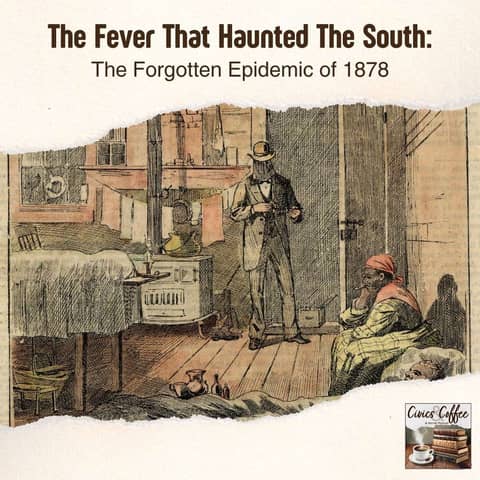
What kind of epidemic could turn a thriving American city into a ghost town almost overnight?
Join me as I explore the chilling story of the 1878 yellow fever epidemic—a public health disaster that decimated Memphis and echoed far beyond the Mississippi River Valley. While yellow fever had haunted the U.S. since the slave trade, it was the post–Civil War era—with its railroads, riverboats, and lack of national infrastructure—that turned an outbreak into a catastrophe. The fever emptied cities, bankrupted local governments, and revealed just how unprepared the nation was. But in the aftermath came something surprising: a rare moment of national unity and the first federal steps toward epidemic response. This is a haunting chapter of U.S. history, where disease reshaped the map, the economy, and the legacy of Reconstruction.


SOURCES:
“1878 Epidemic.” American Experience. PBS. (LINK)
Andrea Prinzi. “History of Yellow Fever in the U.S.” American Society for Microbiology. May 17, 2021. (LINK)
Blum, Edward J. “The Crucible of Disease: Trauma, Memory, and National Reconciliation during the Yellow Fever Epidemic of 1878.” The Journal of Southern History 69, no. 4 (2003): 791–820. https://doi.org/10.2307/30040097.
Hall, Randal L. “Southern Conservatism at Work: Women, Nurses, and the 1878 Yellow Fever Epidemic in Memphis.” Tennessee Historical Quarterly 56, no. 4 (1997): 244–61. http://www.jstor.org/stable/42627377.
History.com Editors, “First Victim of Memphis yellow fever epidemic dies.” History.com. Updated May 27, 2025. (LINK)
Russell, Mary Jane Duke. “Yellow fever in the Felicianas: the epidemic of 1878 and its effects upon the residents of these rural parishes.” Master’s Thesis. Louisiana State University. 2005. (LINK)
INTRO
Hey everyone. Welcome back.
One of the most startling images to come out of the Covid-19 pandemic in 2020 was the desolate cities throughout the world. New York, Venice, Paris, Tokyo - no matter where you looked, streets sat empty and I remember being struck by just how ghostly some of the largest cities in the world looked without the thousands of pedestrians walking its streets.
In the late nineteenth century another disease wrecked havoc on the city of Memphis, Tennessee - prompting residents to flee and creating a ghost town for those who remained. The Yellow Fever epidemic of 1878 spread rapidly throughout the southern half of the United States, leaving a string of bodies in its wake. Yet it also allowed the country - still holding onto residual anger and distrust from the Civil War - the chance to come together in unity, even if only temporarily.
So this week I am diving into the Yellow Fever epidemic of 1878. What happened? How did it spread? And how did it prompt a national response?
Grab your cup of coffee peeps. Let’s do this.
Yellow fever is an infectious disease originating from West Africa that is transmitted by local mosquitos. Scientists believe yellow fever came to the United States via water barrels on the ships involved with the slave trade with the earliest infections dating back to 1693. Thriving in warm climates where mosquitos can breed, outbreaks of yellow fever were very common during the summer months - especially in any town that experienced hot, wet summers. Early American history is littered with stories of families taking leave from their homes during the summer months to avoid contracting the disease and while outbreaks were common, they were generally contained within a town’s borders and did not pose much of a risk outside of the immediate infected area.
The technological advancements during and after the Civil War, including the expansion of railroads, meant that communities were more closely tied together. People, goods - and even disease - could travel faster and further than ever before. And while this no doubt enabled increased commerce and communication, it would also prove deadly for many living in the south during the spring and summer of 1878.
In the spring, a high number of yellow fever infections were reported throughout the Caribbean and Cuba. Thousands living in Cuba left the island at the end of the war of independence from Spain and many landed in New Orleans. In addition to these new arrivals, the U.S. was also a trading partner with Cuba and during the summer months, ships would travel back and forth on a weekly basis to deliver goods including sugar, fruit, and cigars.
Recognizing the potential dangers posed by the frequent interaction with ships and individuals from areas with high infection rates, President Rutherford B. Hayes signed the Quarantine Act on April 26th, 1878. The law put the Marine Hospital Service in charge of preventing communicable diseases from hitting the United States and gave the service the appropriate authority to take any action it deemed necessary to stop disease that might emanate via sailors arriving in local ports.
Upon hearing about the yellow fever outbreak in Cuba, several quarantine areas were established along the southern coasts where ships were expected to hold for up to 10 days. In May one sailor, traveling to New Orleans aboard the ship the Emily B. Souder was diagnosed with malaria and was removed from the ship for treatment. However, the captain of the Souder refused to comply with the established quarantine, complaining that by the time the quarantine was lifted, the fresh fruits on his ship would be rotten and unfit for sale. Thus, a compromise was made and the ship was fumigated before it was allowed to proceed to port. Unfortunately, the fumigation proved too little too late as the same night the ship docked another sailor on board became sick, eventually dying. This was followed by another sailor just four days later. Despite the deaths on board, the ship left New Orleans on May 31st, with cargo intended for Key West, Florida.
Just as one ship left, another arrived - this time the Charles B. Woods. Within six weeks of their landing and coming ashore, every single family member of the ship’s captain and engineer became sick. While they all managed to recover from their bouts of illness, a four year old little girl living in the same neighborhood died - becoming the first victim of yellow fever for New Orleans that year. Once word got out that there was a confirmed case of yellow fever, residents embarked on their ritualistic sojourn away from the city limits - with nearly 20% of residents vacating the city, leaving taverns and local businesses empty. Those who remained were no match for the raging fever and many fell prey to the disease. Doctors tried in vain to treat their patients, but lacking an accurate understanding of what the disease was and how it spread, their treatments – including bloodletting and prescribing doses of quinine - often did more harm than good. By August, the fever had metastasized to an outbreak and on the 10th, the state board of health declared a yellow fever epidemic, citing 438 reported cases and 118 deaths. Unfortunately, this was just a drop in the bucket for the total loss of life as the fever had already escaped the city of New Orleans and was well on its way to decimate another bustling city: Memphis.
On July 27th, two sailors infected with fever arrived in Vicksburg via a towboat and another member died from the fever while still on board the ship. In August, 100 cases of fever were reported in Grenada, Mississippi - about 100 miles south of Memphis. Even before the August spike, reports of the rapidly moving fever throughout Louisiana and Mississippi prompted the Mayor of Memphis to declare a citywide quarantine on July 28th. This prevented pretty much anything from entering the city limits - trains, goods, and people were all prohibited from entering Memphis. This was not welcome news for business leaders, who applied significant political pressure on the Mayor to allow an incoming train from New Orleans to stop and offload goods, threatening to sue the city if the Mayor didn’t relent. Buckling to the pressure, city leaders allowed the cargo-filled train to stop.
Although allowing the train was a risky decision, it is believed that the source of the infection actually came from a sailor who managed to avoid quarantine and later died at a Memphis area hospital. This was followed a few days later when on August 13th a local food vendor who set up shop near the docks fell ill and died. Like those living in New Orleans, once word spread that Yellow Fever had arrived in Memphis, more than 50% of city residents fled – either to other cities or nearby camps. Out of the roughly 47,000 residents at the time, anywhere between 25,000 and 27,000 left the city - leaving the once booming city of Memphis looking like a ghost town.
The Memphis residents who remained were the ones unable to afford the costs associated with leaving and were predominantly the poor and black residents of the city. Those left behind tried to chip in and care for those who got sick - including a madam who repurposed her brothel into a makeshift hospital. But the fever was too strong and spreading too fast; in his analysis of the outbreak, historian Randal Hall highlights that of the estimated 19,600 people who remained in Memphis post-outbreak, 17,600 of them got sick and over 5,000 died. At the height of the infection, people were dying at such a pace that some bodies sat unburied for days after death. With the disease spreading so rapidly, there was little infrastructure in place to properly care for the sick and Memphis was in dire need of help - and it came from an unexpected place: the North.
In his analysis of the impacts of the Yellow Fever outbreak, historian Edward Blum argues that the epidemic actually helped alleviate some of the residual animosity between the two regions after the Civil War. The outbreak prompted Northern whites to reassess their views of their Southern neighbors - from rebellious evil doers to honorable people doing their best to survive an incredibly dangerous and highly contagious disease. As Blum describes, the softening of opinions worked both ways as southern residents no longer saw their northern neighbors as quote unquote aggressive invaders, instead seeing them as quote heroic compatriots,” end quote.
Upon hearing of the outbreak, northern residents were quick to raise funds and donate goods - everything from clothing to chickens to wine - in order to alleviate the suffering of their fellow Americans to the south. Their support also included sending doctors and nurses into the infected areas to try to care for the sick and dying. These northern practitioners joined other locally established relief organizations - including the Howard Association which temporarily hired 3,000 nurses, many of them women. Despite their training, many women had to contend with a dismissive population who felt that they were, as historian Randal Hall describes quote, “violating their proper place,” end quote in society.
While Memphis struggled to care for its increasingly sick population, city residents who successfully fled Memphis actually took the fever with them, enabling the disease to spread like wildfire. Some towns took action to try to prevent the spread, setting up blockades with armed men - known as shotgun blockades - to prevent anyone coming from a city or town known to have infection from entering their borders. This blockade was not nationwide and thus fever was detected as far as Kentucky, Indiana, and Ohio. At its peak, it is estimated that roughly 200 people died per day and those who managed to survive dealt with the impacts of infection for months after. As the fever spread, national panic ensued with Americans from coast to coast worried that their city or town could be the next reported place of infection. This, Blum argues, created a sense of collective trauma which established pathways toward reconciliation and healing - if only temporarily.
The fever finally broke after the first frost of the season and city leaders officially declared the end of the epidemic on October 29th. And although the fever might have released its grasp on Americans, cities and states were just beginning to realize the devastation wrought by such a widespread epidemic. The mass exodus from Memphis not only turned the area into a proverbial ghost town, it also had tangible economic impacts, including eliminating its impressive economic gains in the years after the Civil War. Memphis lost upwards of $15 million prompting the city to declare bankruptcy and state leaders to revoke Memphis’ charter, leaving it as historian Randal Hall describes as quote “a taxing district under state control,” end quote. And this is just one city estimate - when looking at the totality of the devastation wrought by the epidemic, some contemporaries believed the losses totaled in the hundreds of millions of dollars which, as historian Edward Blum highlights was quote “a substantial blow given that the federal treasury expended less than $237 million in 1878,” end quote.
The epidemic - and its spread - also prompted residents and health professionals to demand increased sanitary controls. In the wake of the 1878 outbreak, several southern cities adopted enhanced health policies, eradicating potential breeding grounds for the mosquitos who could transmit the disease. Local governments weren’t the only ones to act. In the fever’s aftermath, the federal government convened a commission to investigate the outbreak which eventually led to the establishment of the National Board of Health in 1879. During its brief four year existence, the board assumed responsibility for preventing the arrival and spread of contagious disease in the United States, basically taking over the responsibility once held by the Marine Hospital Service. During this time, the National Board of Health faced steep criticisms from business leaders who felt that any interference with shipping - such as imposing quarantines - negatively impacted trade.
The legislation that established the National Board of Health was limited to a four-year term, meaning that if Congress wanted to extend the agency’s existence, it would have to renew the law that established its charter. Given the drop in infectious disease and the sharp criticism by leading members of the business community, Congress chose not to extend the law and responsibility for preventing infectious disease was re-routed back to the Marine Hospital Service - just in time for the arrival of bubonic plague in San Francisco in 1900. If you want to hear more about that story, I’d suggest signing up for the Patreon as it was a topic of conversation on the bonus series Civics & Cocktails.
At the close of the nineteenth century, Americans in general and southern residents specifically lived in fear as they navigated one of the worst epidemics in American history at that point. The Mississippi Valley reported 120,000 cases of fever leading to the deaths of 20,000 Americans. The massive spread of fever also led to a renewed time-limited unity amongst Americans and led to demands for more sanitary conditions. While the fever may have bankrupted a city, it nevertheless brought about more public attention and research in trying to understand contagious diseases and learning ways to prevent the spread, proving that there can be opportunity to grow in even the darkest of situations.
Well friends, this marks the final episode in my spooky series. I hope you have enjoyed the macabre tales and that you have a happy, safe, and frightful Halloween. If you want to hear about the Golden Gate’s battle against the Bubonic Plague, head on over to the website at www dot civics and coffee dot com. You can learn all about how to join the Patreon, see show notes, and learn about other ways you can support the show. Lastly, I am proud to announce that I have recently partnered with Bookshop dot org as an affiliate. If you like supporting independent bookstores and want to also support the show, please consider shopping through my store. So far I have a shop dedicated to past guests and one dedicated to Women’s history. Thanks, peeps. I will see you next week.
OUTRO


